
The proposed route of the Ben Gurion Canal runs roughly 300 kilometres from the Gulf of Aqaba to the Mediterranean, slicing through the Negev desert before emptying into the sea south of Ashkelon
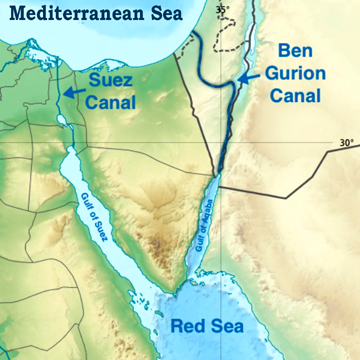
At its core, the Ben Gurion Canal is a proposal to link Israel’s Red Sea access at Eilat to the Mediterranean, creating a sovereign alternative to Egypt’s Suez Canal. It promises redundancy in a world allergic to single points of failure. It threatens entrenched monopolies without claiming to replace them. It reimagines Israel not merely as a security state but as a transit state, one whose relevance would be measured not only in missiles intercepted but in containers moved. The project’s endurance is itself instructive. Truly implausible ideas die quickly. This one lingers because it sits at the intersection of geography, trade anxiety, and power politics.
Yet the canal’s ambition also explains its paralysis. Infrastructure on this scale does not exist in isolation. It reshapes borders, reorders incentives, and forces uncomfortable conversations about territory, authority, and permanence. The more seriously one takes the canal, the more one is forced to confront questions that polite diplomacy prefers to defer.
Strategic motivation: Ending dependence without starting wars
The Suez Canal has always been more than a ditch. It is leverage incarnate. Built for empire, nationalised as a declaration of sovereignty, and periodically weaponised by history, Suez is the artery through which a significant portion of world trade still flows. When it works, it is invisible. When it fails, it freezes economies.
The EverGiven incident of 2021—when a single container ship wedged itself sideways and halted traffic—did more for alternative-route thinking than decades of white papers. It demonstrated that fragility, not hostility, is the real enemy of global trade. Modern supply chains are not designed for patience. They are calibrated for precision.
Israel’s strategic motivation for a canal is therefore less about rivalry with Egypt and more about insulation from systemic risk. A Ben Gurion Canal would not seek to “defeat” Suez. It would discipline it. Redundancy is power in a world where disruption is cheap.
From Israel’s perspective, this redundancy also has a political dimension. Dependence is vulnerability. Control over a global chokepoint transforms a small country’s diplomatic weight. It does not make conflict disappear, but it changes how others calculate pressure.
Geography as destiny: Why the route matters
Any serious discussion of the Ben Gurion Canal begins with geography, because canals are unforgiving of abstraction. The proposed route runs roughly 300 kilometres from the Gulf of Aqaba to the Mediterranean, slicing through the Negev desert before emptying into the sea south of Ashkelon.
The southern entry near Eilat places the canal directly on Red Sea shipping lanes, within proximity of Jordan and Saudi Arabia, and under Israel’s air and naval umbrella. This is not incidental. Control of the Red Sea has become a central concern as disruptions near Bab el-Mandeb and the Horn of Africa remind traders how narrow global arteries really are.
From Eilat, the canal would cut northwest through sparsely populated desert terrain. This is the longest and most expensive segment, requiring massive excavation, water management systems, artificial lakes, and environmental mitigation. Proponents argue that the Negev’s emptiness is an advantage. There are fewer people to relocate, fewer cities to disrupt, and ample space for ancillary infrastructure.
Beersheba, long treated as Israel’s periphery, would suddenly sit astride a global trade corridor. Its transformation from desert town to logistics and knowledge hub would echo what Dubai did with ports—though with less spectacle and more engineering.
The northern exit is where controversy sharpens. Ashkelon, with its deep-water access and military infrastructure, is often favoured over Ashdod. The exit must be secure, scalable, and insulated from political volatility. And this is where the canal’s logic collides with Gaza’s reality.
A canal that will change trade related behaviour
Imagining a world where the Ben Gurion Canal exists clarifies its true purpose. By the late 2030s, ships transit a blue scar across southern Israel, flanked by solar farms, LNG terminals, data centres, and exclusion zones. Satellites track traffic in real time. Insurance models adjust premiums dynamically. The canal does not replace Suez. It keeps it honest.
Trade flows respond quickly to incentives. When Suez is calm, cheaper, and efficient, it retains traffic. When it is volatile, politicised, or congested, ships divert. The existence of an alternative forces discipline without confrontation.
This is why comparisons to nuclear weapons, while provocative, are not entirely misplaced. The canal’s power lies less in monopolisation than in deterrence. It changes calculations. It reduces the ability of any one actor to extract rents from global dependency.
Who uses the canal and why markets don’t have emotions
In this imagined future, the canal’s largest users are Asian shipping companies. Chinese, Korean, Japanese, and Indian firms value predictability over politics. Public statements downplay usage to avoid diplomatic friction, but cargo data tells a quieter truth.
High-value goods benefit from shorter transit times and lower insurance premiums during periods of tension. Just-in-time supply chains crave redundancy. Energy traders, especially LNG shippers, prize flexibility. Pipelines are fixed and vulnerable; ships can reroute.
The irony is inescapable. Arab energy exports flow through Israeli infrastructure not because of reconciliation, but because markets are indifferent to symbolism. Invoices matter more than slogans.
Power shifts: Egypt loses monopoly, not relevance
The emergence of a Ben Gurion Canal would not render Suez obsolete. Egypt would remain a central transit nation, earning billions and hosting a mature, efficient waterway. But it would lose monopoly pricing power.
This shift is psychological as much as economic. When a route is irreplaceable, it dictates terms. When it has competition, it negotiates. Egypt would be forced to lower fees, improve services, and engage shipping interests more flexibly.
For Israel, the gain is structural. Control of a chokepoint elevates its strategic relevance to the United States, Europe, India, and even China. Diplomatic pressure becomes harder to apply when supply chains run through your territory.
Militarisation without apology: Securing the indispensable
A canal of this significance would be among the most heavily defended civilian infrastructures on earth. Naval patrols, missile defence, AI-based monitoring, and hardened perimeters would be standard. Any attack would be framed not as a local incident but as an assault on global trade.
This internationalisation of security concerns is not accidental. It transforms local defence into collective interest. The canal becomes a deterrence multiplier, tying Israel’s security directly to the stability of world markets.
The Argument for administrative control
It is at this point—when the canal is treated not as fantasy but as functioning infrastructure—that arguments about Sinai and Gaza surface with uncomfortable inevitability.
Canals are linear assets. They hate ambiguity. Their value is determined by their weakest point. Fragmented authority along their length is not a political inconvenience; it is a commercial liability.
From an operator’s perspective, adjacent territories matter almost as much as the canal itself. This is not ideology speaking but actuarial logic.
Sinai: Depth, buffers, and the problem of response time
The Sinai Peninsula looms large in southern canal security calculations. Its vast, lightly policed spaces have historically hosted smuggling networks and militant activity. Even with Egyptian sovereignty intact, coordination is not the same as control.
Proponents of Israeli administrative involvement in Sinai do not frame it as annexation. They speak in the language of buffers, monitoring belts, and emergency-response zones. The argument is blunt: shipping insurers care about response time, not flags.
Unified surveillance, rapid deployment without cross-border delays, standardised protocols, and control of airspace and electromagnetic spectrum are seen as essential for protecting a trillion-dollar asset. From this perspective, shared authority introduces friction where none can be afforded.
Gaza: The terminal risk no one can ignore
If Sinai is about depth, Gaza is about proximity. The Gaza Strip sits near the Mediterranean exit, adjacent to LNG terminals, container hubs, power infrastructure, and subsea data cables. In canal economics, this is not a distant conflict zone. It is a reputational risk.
As long as Gaza remains politically unstable and governed by actors hostile to canal operations, three risks dominate: operational disruptions, insurance premium spikes, and reputational damage. A canal associated with repeated conflict loses credibility quickly.
This is why proponents argue that only direct administrative control of civilian, economic, and security functions can stabilise the area sufficiently for uninterrupted operations. Outsourcing governance to volatile actors is seen as incompatible with the demands of global infrastructure.
Administrative control versus occupation: A semantic battle with real stakes
Advocates are careful with language. They avoid annexation and instead propose models drawn from historical precedents: long-term administrative mandates, internationally supervised governance executed by Israel, special canal security zones, and economic integration without political absorption.
The argument is pragmatic rather than moral. You cannot outsource the governance of land bordering a trillion-dollar chokepoint. Panama, Suez, and major ports worldwide have all operated under special regimes when global commerce demanded clarity.
Whether these distinctions would be accepted by affected populations or the international community is another matter entirely.
Insurance: The quiet driver of hard decisions
Behind every grand strategy sits a spreadsheet. Shipping insurers, lenders, and sovereign wealth funds demand clear lines of authority, single-command security responsibility, predictable dispute resolution, and zero ambiguity over who is accountable when something goes wrong.
Joint security arrangements sound attractive until stress tests expose their weaknesses. Shared authority slows response, blurs accountability, and inflates premiums. From a financial standpoint, administrative control reduces uncertainty—even if it increases political controversy.
This is not a moral argument. It is a market one.
Why multilateral guarantees often fail under pressure
Critics of international oversight point to familiar problems. UN forces lack enforcement power. Multinational mandates fracture under crisis. Consensus-driven bodies move slowly. A 72-hour canal disruption can spike energy prices, freeze supply chains, and trigger market panic.
From a hard-infrastructure perspective, this level of risk is unacceptable. Linear assets demand unified command, even if that command is politically uncomfortable.
The unspoken assumption: Infrastructure reshapes sovereignty
At the heart of the administrative-control argument lies an assumption rarely stated aloud: global infrastructure eventually reshapes local politics. Railways redraw borders. Pipelines create protectorates. Canals harden spheres of influence.
Administrative control is presented as the least explosive way to reconcile permanent infrastructure with unstable geography. Whether it would succeed or backfire remains an open question.
Why the argument is resisted and why that resistance matters
Opposition is fierce and justified. Egypt would resist any dilution of sovereignty in Sinai. Gaza’s governance is inseparable from Palestinian self-determination. Legal challenges would be immense. Resistance could intensify, turning the canal into a magnet for conflict rather than a stabiliser.
Many analysts argue that administrative control could increase risk, not reduce it, by entrenching grievances and inviting perpetual sabotage. Infrastructure does not exist in a vacuum. It sits on human terrain.
The project as it stands: Vision, not reality
As of early 2026, the Ben Gurion Canal remains conceptual. Its engineering challenges are daunting, its costs astronomical, and its political obstacles formidable. Nuclear excavation fantasies belong to history, not policy. Environmental concerns alone could stall it for decades.
Yet the idea persists because the problem it addresses has not gone away. Global trade remains vulnerable. Chokepoints remain few. Redundancy remains scarce.
Bottom line: Explaining the logic without endorsing the outcome
Arguments for Israeli administrative control of Sinai and Gaza arise not from expansionist ideology alone, but from the cold logic of infrastructure economics. Canals demand uninterrupted security. Fragmented governance raises costs. Adjacent instability threatens global trade. Linear assets crave unified command.
Understanding why these arguments emerge does not require agreeing with them. The Ben Gurion Canal may never be built. Or it may be built in a form that renders these debates moot. Or it may fail precisely because the politics prove unmanageable.
What is clear is this: the canal’s significance lies less in concrete and dredging than in what it reveals about power in an age where supply chains decide elections and wars are fought with shipping delays rather than tanks.
Suez was built for empire.
Panama was built for commerce.
The Ben Gurion Canal, if it ever exists, would be built for control in an age of uncertainty. Whether the world is willing to pay the price—politically, morally, and financially—remains the unanswered question.

