
One of the most important aspects of this political contest is that the BJP and communist parties share a structural similarity: both are cadre-based organisations. Cadre-based parties focus on ideological training, discipline, and long-term organisational penetration
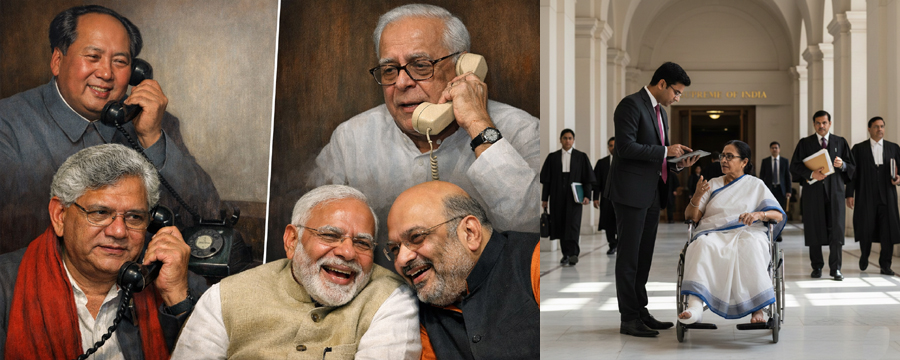
As the Bharatiya Janata Party (BJP) attempts to expand its footprint in Bengal and Kerala, two historically Left-dominated states, the contest is not merely electoral. It is civilisational, institutional, and economic. The BJP’s growing presence in Kerala and its aggressive ambitions in West Bengal signal a deeper challenge to the ideological architecture that has shaped these societies for generations. Few Indian states evoke as much ideological certainty—and as much political contradiction—as Kerala and West Bengal. For decades, both have been celebrated as intellectual, progressive, and socially advanced societies, governed largely by left-leaning political formations that claim moral superiority over the rest of India. Yet beneath this narrative lies a more complex and uncomfortable reality: persistent economic stagnation, weak industrial bases, politicised institutions, and an uneasy relationship with capitalism itself.
Union Home Minister Amit Shah’s assertion that governing 21 states is less satisfying than winning Bengal may sound provocative, but it reflects a strategic truth: Kerala and Bengal are not just states, they are symbols. Breaking into them means dismantling the last strongholds of India’s post-colonial Left consensus.
Kerala’s Political Landscape: Slow but Visible Shifts
Kerala remains one of India’s most politically aware states, with exceptionally high voter participation, intense public debate, and strong ideological loyalties. Historically, power has oscillated between the Communist Party of India (Marxist)-led Left Democratic Front (LDF) and the Congress-led United Democratic Front (UDF). For decades, the BJP existed on the margins, dismissed as culturally incompatible with Kerala’s political ethos.
That dismissal is no longer as confident as it once was.
Over the last decade, the BJP has steadily increased its vote share in Kerala, built grassroots organisations, and established a presence in local bodies. While it has yet to translate this into significant legislative power, the shift is undeniable. The party’s appeal is not rooted in religious mobilisation alone—as critics often claim—but in growing dissatisfaction with economic stagnation, youth unemployment, and the limitations of Kerala’s development model.
Kerala’s political debate is slowly moving from ideological purity toward questions of opportunity, mobility, and economic realism. This shift, however gradual, is precisely what threatens entrenched political interests.
Kerala’s Agricultural Contribution: Quiet Strength Amid Structural Limits
Ironically, Kerala’s economy contradicts its own political rhetoric. While the state is often portrayed as anti-industrial, it plays a critical role in India’s plantation economy. Kerala remains a major contributor to India’s production of coffee, tea, rubber, spices, and coconut-based products—commodities deeply embedded in global trade.
Rubber, in particular, has been a backbone of Kerala’s rural economy, supporting smallholders and cooperatives. Coffee and tea estates in Wayanad, Idukki, and parts of Malabar connect Kerala directly to international markets, exposing local farmers to global price cycles, currency fluctuations, and export logistics.
Yet the paradox remains: while Kerala participates in global capitalism through agriculture, it resists the industrial, logistical, and manufacturing ecosystems that could add value to these commodities. Processing, branding, and scale manufacturing are limited, often outsourced to other states. The result is a state that produces raw value but captures little of the surplus.
This contradiction is not accidental—it is ideological.
West Bengal: The Heavier Weight of History
If Kerala represents a soft Left—tempered by remittances, tourism, and social indicators—West Bengal represents a harder, more destructive legacy of ideological rigidity. The state’s industrial decline following decades of Left Front rule is well-documented. Once India’s industrial heartland, Bengal systematically alienated capital, demonised entrepreneurship, and politicised labour to the point of paralysis.
The Trinamool Congress (TMC), despite branding itself as anti-communist, inherited much of this institutional culture. Its politics remain deeply cadre-driven, patronage-based, and suspicious of independent economic power. Ideology may have softened rhetorically, but the underlying mechanisms of control have not.
This is the Bengal Amit Shah is targeting—not just as a political prize, but as a symbolic reversal of India’s most consequential economic failure.
“Victory in Bengal Matters More”: Reading Amit Shah Correctly
Amit Shah’s statement that victory in Bengal would bring greater satisfaction than governing 21 states was widely criticised as arrogance. In reality, it was strategic honesty.
Bengal is not electorally large enough to alter national arithmetic dramatically. But it is ideologically enormous. Winning Bengal would signal the collapse of the Left’s last credible claim to moral and intellectual dominance in Indian politics.
His prediction of over 50% vote share may be ambitious, even aspirational. But ambition is the point. The BJP’s strategy is not incremental accommodation—it is ideological replacement.
Cadre Politics: The Shared DNA of the BJP and the Left
One of the least discussed but most important aspects of this political contest is that the BJP and communist parties share a structural similarity: both are cadre-based organisations. Unlike personality-driven parties, cadre-based parties focus on ideological training, discipline, and long-term organisational penetration.
This is precisely why the BJP has been able to challenge entrenched Left ecosystems. It understands their language, their tactics, and their vulnerabilities. The difference lies not in organisational form, but in ideological content.
While communist parties historically trained cadres to control institutions, unions, and narratives, the BJP trains cadres to build parallel ecosystems—social, cultural, educational, and economic.
In states like Kerala and Bengal, this creates an unusual mirror war: two cadre systems competing for the same institutional space.
Education Under Political Capture
Perhaps the most damaging legacy in both Kerala and Bengal is the politicisation of education. Schools, colleges, and universities in both states are deeply influenced by political appointments, ideological gatekeeping, and unionised inertia.
Academic merit often takes a back seat to political loyalty. Administrative positions are frequently allocated based on affiliation rather than competence. Curriculum debates become ideological battlegrounds rather than pedagogical discussions.
This has long-term consequences. While both states boast high literacy and graduation rates, employers across India frequently note a mismatch between credentials and workplace readiness. Professional skills, adaptability, communication, and organisational competence often lag behind peers from less “intellectual” but more market-aligned states.
Education, when captured by ideology, produces confidence without competence.
The Corporate Reality Check
One of the most uncomfortable truths for both Kerala and Bengal is their relatively weak performance in corporate leadership pipelines. While individuals from these states succeed academically and intellectually, they are underrepresented in senior corporate management relative to population size.
This is not a question of intelligence, but of exposure. Decades of ideological hostility toward private enterprise have limited engagement with corporate culture, professional networking, and risk-taking. The private sector is often treated as morally suspect rather than economically necessary.
As a result, talent migrates—or stagnates.
Anti-Industry as a Political Identity
In both states, opposition to industry has often been reframed as moral virtue. Environmental concerns, labour rights, and social justice are invoked selectively to block projects, discourage investors, and preserve political control.
This is not environmentalism—it is veto politics.
Industries that threaten to create independent economic power centres are resisted, while dependency-based welfare structures are encouraged. The goal is not prosperity, but manageability.
This is precisely the political culture the BJP seeks to disrupt.
BJP’s Challenge: Not Just Winning Elections
For the BJP, Kerala and Bengal present a unique challenge. Electoral success alone is insufficient. What is required is institutional patience—long-term engagement with civil society, education, culture, and economic narratives.
The party’s slow growth in Kerala suggests it understands this. Its aggressive posture in Bengal suggests urgency. In both cases, the real battle is over legitimacy: who gets to define progress, education, and modernity.
The End of Ideological Immunity
Kerala and West Bengal have long enjoyed ideological immunity—shielded from scrutiny by reputations built decades ago. That immunity is weakening.
As India’s economic centre of gravity shifts, states that remain suspicious of capital, hostile to enterprise, and captive to political patronage will fall behind—no matter how proud their intellectual histories.
The BJP’s rise in these states does not guarantee reform. But it does guarantee confrontation. And confrontation, in systems long insulated from competition, is often the first step toward change.
Whether Kerala and Bengal adapt or resist will define not just their own futures—but the final chapter of India’s post-colonial ideological experiment.