When the economy turns sour, the party ends and the buffet tables are cleared. That is when the finance professional becomes an endangered species, wandering the corporate savannah looking for numbers to massage, spreadsheets to tweak, and,most importantly,other people’s money to play with
There are many heartbreaking sights in a downturn economy. Empty malls. Half-built flyovers. LinkedIn posts that begin with “Humbled to announce…” But none tug at the heartstrings quite like the finance professional during a slowdown.
Yes, have pity. Genuine, tear-soaked pity.
For when the economy is booming, finance professionals are gods. They stride into boardrooms with PowerPoint decks thicker than Tolstoy novels. They speak in acronyms that sound like secret CIA programs; IRR, EBITDA, ROCE, NPV, leaving ordinary mortals nodding politely while understanding absolutely nothing.
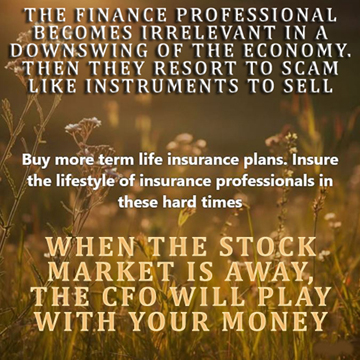
But when the economy turns sour? When the party ends and the buffet tables are cleared? That is when the finance professional becomes an endangered species, wandering the corporate savannah looking for numbers to massage, spreadsheets to tweak, and,most importantly,other people’s money to play with.
This is the tragicomic tale of what happens to CFOs, chartered accountants, venture capitalists, investment advisors, insurance agents, and assorted bean counters when there are no beans left to count.
Boom times makes finance professionals Gods; bust spells lust – for your savings
In a boom, finance professionals are treated with reverence usually reserved for astrologers and godmen. Every decision,Should we expand? Should we acquire? Should we buy a coffee machine?,requires their blessing.
In these golden years, money flows like monsoon rain. Venture capitalists throw around terms like “dry powder,” which sounds suspiciously like something you’d keep in a gun cabinet. CFOs talk about “leveraging synergies,” which usually means borrowing more money and hoping tomorrow never comes.
Chartered accountants, meanwhile, become mystical creatures. They know where the tax loopholes are buried. They know which expense can be called “business development” and which one must be reluctantly declared as “personal indulgence.”
During booms, finance professionals are relevant because there is abundance. There is something to optimize, something to arbitrage, something to repackage and sell back to you with a 2% advisory fee.
In short, they thrive when there is excess. Like pigeons in a grain market.
Bust time: When there is nothing left to optimize
Then comes the downturn.
Suddenly, revenues shrink. Costs refuse to shrink fast enough. Growth projections look like they were written by a stand-up comedian after three drinks. The fancy dashboards turn red,lots and lots of red.
And that is when the uncomfortable truth emerges: finance professionals are least useful when there is no money.
After all, what exactly are they supposed to do? Optimize what? Reallocate which surplus? Hedge which exposure? You can’t diversify a famine. You can’t arbitrage emptiness.
In a downswing economy, the engineer still builds, the doctor still heals, the farmer still grows food. But the finance professional? He adjusts fonts in Excel. She renames cost-cutting as “strategic frugality.” They hold meetings to discuss meetings.
The downturn strips finance of its mystique and reveals it for what it often is: a sophisticated way of rearranging money that already exists.
The disappearing act of the CFO
The Chief Financial Officer is a majestic creature in good times. In bad times, however, the CFO becomes strangely elusive.
During booms, the CFO is everywhere,earnings calls, strategy offsites, investor roadshows. During busts, the CFO is “working on scenarios.”
Ah yes, scenarios. Finance professionals love scenarios because scenarios do not require action. They require slides. Lots of slides. Base case. Worst case. Apocalypse case. Zombie invasion case.
Meanwhile, the business quietly bleeds.
In downturns, CFOs suddenly discover the spiritual value of “conservatism.” They speak of “preserving cash” as though cash were a rare panda that must be protected from human interference. They cancel office snacks, delay laptop upgrades, and proudly announce savings that would not cover the CEO’s car service bill.
The CFO, once a high priest of growth, now becomes the head monk of austerity,ringing bells and asking everyone else to tighten their belts.
Chartered accountants and the art of looking busy
Chartered accountants face a special kind of existential crisis in a slowdown. When profits evaporate, tax planning loses its charm. When revenues dry up, compliance becomes less glamorous.
So what does the CA do?
They audit. And then they audit the audit. They create checklists to verify that previous checklists were properly checked. They send emails asking for documents everyone knows no longer exist.
In downturns, chartered accountants master the art of looking intensely busy while contributing absolutely nothing to revenue revival. Their spreadsheets grow longer even as company fortunes shrink.
This is not entirely their fault. You cannot squeeze tax savings out of losses. You cannot creatively interpret the law when the law itself says, “You made no money.”
Still, the CA soldier carries on, valiantly reconciling accounts that refuse to reconcile with reality.
Venture capitalists: From visionaries to vultures
Few creatures change behavior faster than venture capitalists in a downturn.
In boom times, VCs speak of “vision,” “founder empathy,” and “long-term value creation.” In downturns, they speak of “unit economics” and “path to profitability,” as though these were new concepts recently discovered in a forgotten cave.
When the stock market is up, VCs encourage founders to burn cash aggressively. When the market is down, the same VCs ask, “Why did you burn so much cash?”
In slowdowns, venture capitalists stop being cheerleaders and start behaving like forensic accountants. Every expense is questioned. Every hire is suspicious. Even office plants are scrutinized for ROI.
Yet somehow, management fees continue uninterrupted. Because even when startups die, the VC lifestyle must live on.
The myth of “maximizing your wealth”
In downturns, finance professionals often reinvent themselves as wealth maximization gurus.
They tell you they can “protect” your money. They claim to “optimize” returns even in bad markets. They assure you that volatility is an opportunity,usually an opportunity for them to charge fees.
What they mean by maximizing your wealth is quite simple: maximizing their wealth using your fear.
Suddenly, every product becomes “safe.” Every instrument is “guaranteed.” Every brochure has smiling families walking on beaches they clearly cannot afford.
The downturn turns finance professionals into salespeople with spreadsheets.
Term Life Insurance: The savior of the finance industry
When stocks fall and IPOs disappear, insurance emerges as the last refuge of the finance professional.
Hence the heartfelt advice: Buy more term life insurance during downturns.
Not because you suddenly became more mortal. Not because actuarial tables changed overnight. But because insurance professionals, advisors, and agents need to pay their EMIs too.
In bad times, insurance is sold not as risk protection but as moral duty. “What will your family do without you?” they ask, conveniently ignoring what your family will do with you once they see the premium payments.
Downturn economics has a simple rule: when nothing else sells, sell fear.
When the stock market is away, the CFOs will play
There is an old saying: When the cat is away, the mice will play.
In finance, when the stock market is away, the CFOs will play,with your money, what else?
With no growth stories to tell, finance professionals turn inward. They restructure debt. They refinance loans. They reshuffle capital between subsidiaries like children swapping toys.
None of this creates value. But it creates activity. And in finance, activity is often mistaken for intelligence.
The absence of market discipline allows internal games to flourish. Budgets are reclassified. Losses are deferred. Numbers are “normalized.” Reality is postponed to the next quarter.
The cult of cost cutting
Downturns turn finance professionals into cost-cutting evangelists.
They do not cut their costs, of course. Advisory fees, retainers, and bonuses are “strategic.” Instead, they cut paper cups, travel allowances, and employee morale.
Finance professionals love cost cutting because it gives an illusion of control. Revenue depends on customers. Costs depend on memos.
So entire organizations are subjected to penny-pinching rituals that save thousands while destroying millions in productivity and goodwill.
Excel: The emotional support animal
In hard times, finance professionals cling to Excel like a life raft.
Spreadsheets multiply. Tabs increase. Cells turn increasingly complex. Somewhere deep inside the workbook lies a formula so convoluted that no one dares touch it.
Excel becomes an emotional support animal,a place where reality can be bent, smoothed, and made presentable. Numbers can be made to look less ugly simply by changing column widths.
In downturns, finance professionals don’t solve problems. They format them.
Why finance needs growth like fish need water
The uncomfortable truth is this: finance as a profession feeds on expansion.
Without growth, there is nothing to allocate, nothing to value, nothing to project. Finance professionals become priests without a religion, magicians without a trick.
They can survive for a while on fear, insurance, and advisory fees. But eventually, even that runs out.
Downturns expose the dependency of finance on the real economy,the factories, farms, services, and sweat that actually create value.
A modest proposal for hard times
So what should we do with finance professionals in a downturn?
We should not mock them too harshly. After all, they are victims of the very systems they helped design. We should offer them sympathy,and perhaps retraining.
Teach them to build something. Teach them to sell something real. Teach them that not all value comes from rearranging numbers.
Until then, buy that term life insurance if you must. Smile politely at the wealth advisor. Listen patiently to the CFO’s scenarios. And remember: in every downturn, while the economy suffers, the finance professional suffers most,because for the first time, there is nothing left to play with except your patience.