
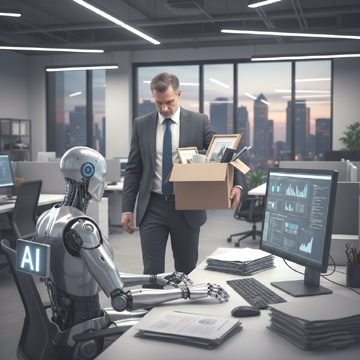
AI is quietly, efficiently dismantling the invisible scaffolding of coordination that middle management once monopolised. The managers who knew whom to call, how to escalate, how to synthesise updates, and how to manage ambiguity are discovering that machines now do this faster, cheaper, and without fatigue
For decades, management has enjoyed an almost unquestioned legitimacy in modern organisations. The assumption was simple: as companies scale, coordination becomes complex, and complexity requires layers of management. Titles multiplied, reporting lines thickened, and seniority itself became a form of capital. If you had spent enough years inside the system, you were presumed to “know how things work.” That knowledge alone was enough to justify authority, compensation, and job security.
Artificial intelligence has shattered that assumption.
Contrary to popular belief, AI is not primarily threatening coders, engineers, or creators. Those professions deal in tangible outputs. What AI is quietly, efficiently dismantling is the invisible scaffolding of coordination that middle management once monopolised. The people whose value lay in knowing whom to call, how to escalate, how to synthesise updates, and how to manage ambiguity are discovering that machines now do this faster, cheaper, and without fatigue.
This is not a distant future. It is already happening.
How seniority became a proxy for value
In the industrial and post-industrial corporate world, seniority served as a stand-in for operational knowledge. The longer you stayed, the more institutional memory you accumulated. You knew the processes, the informal power structures, the unwritten rules. You knew which email would get a response, which meeting mattered, and which could be skipped.
This knowledge premium justified managerial layers. Managers were not necessarily builders; they were translators and coordinators. They converted strategy into execution, filtered noise into signal, and aligned teams that rarely spoke the same language. In large organisations, this role was essential because information moved slowly and asymmetrically.
AI has collapsed that asymmetry.
When information is instantly accessible, synthesised, summarised, and acted upon by machines, the marginal value of “knowing the process” approaches zero. What once took years of experience can now be replicated by an AI agent trained on company data, workflows, and historical decisions.
Why AI targets managers before makers
There is a fundamental misunderstanding in popular AI discourse: that routine, technical tasks are most vulnerable. In reality, AI thrives in precisely the space middle management occupied—non-deterministic workflows involving unstructured data.
Managers excelled at reading between the lines, reconciling conflicting inputs, making sense of ambiguity, and coordinating across silos. These were not rule-based tasks; they were judgment calls. Ironically, these are the very areas where modern AI systems perform best.
Large language models can synthesise reports, prioritise tasks, generate action plans, flag risks, and align stakeholders in seconds. They do not get tired of meetings. They do not forget context. They do not hoard information. And they do not require compensation packages that reflect decades of accumulated political capital.
As a result, the traditional middle manager—particularly the “VP of Operations” who does not directly operate anything—is becoming an endangered species.
Lean companies, massive revenue, minimal headcount
Perhaps the clearest signal of this shift is emerging from new-age companies achieving astonishing revenue with astonishingly small teams. Firms generating hundreds or even thousands of crores in annual recurring revenue with fewer than fifty employees are no longer outliers. They are early indicators of a new organisational logic.
These companies are not under-staffed; they are over-automated in the best sense of the word. AI agents handle scheduling, customer support, analytics, internal reporting, sales outreach, and even parts of decision-making. Human employees focus on high-leverage tasks—product vision, architecture, creative strategy, relationship building, and final judgment.
What disappears in this model is not work, but layers. The layers whose sole function was coordination, approval, and supervision without measurable output.
The illusion of activity versus the reality of output
One of the most uncomfortable implications of AI-driven work is that it exposes how much of corporate life was performative. Status meetings, alignment calls, decks created for other decks, and updates summarising other updates were treated as productivity. In truth, they were rituals that maintained hierarchy.
AI has no patience for rituals.
If a role produces no direct, measurable output—code written, revenue generated, customers retained, designs created, insights delivered—it is quickly revealed as overhead. And overhead is the first casualty in any environment where capital is expensive.
In a high-interest-rate world, companies can no longer afford organisational obesity. Investors demand efficiency, not elegance. Every salary must justify itself in outcomes, not optics.
Why high interest rates accelerate the cull
Cheap money masked inefficiency. For more than a decade, capital was abundant and forgiving. Growth mattered more than profitability. Companies could afford layers of management because the cost of carrying them was negligible. That era is over.
As interest rates rise, cash becomes precious. Every additional headcount is scrutinised. Roles that once survived because they reduced friction are now questioned for adding it. AI, with its ability to reduce coordination costs to near zero, makes the comparison brutal and unavoidable.
A manager who coordinates ten people is competing with an AI system that coordinates a hundred—instantly, continuously, and without ego.
The rise of the “Individual Contributor”
Out of this disruption emerges a new archetype: the Individual Contributor. This is not a return to lone-wolf work, nor a rejection of leadership. It is a redefinition of leverage.
The Individual Contributor can build, code, design, write, sell, or strategise—but crucially, they can do so amplified by AI. They are not replaced by machines; they are multiplied by them. Where a traditional team needed twenty people, one highly skilled individual with the right AI stack can now deliver comparable results.
This person does not manage in the traditional sense. They align systems, set direction, and exercise judgment. Their authority comes from competence, not title. Their value is visible, measurable, and undeniable.
Management is not dead, but It must become real
It would be a mistake to declare management obsolete. What is obsolete is management without substance. The future does not belong to people who manage work; it belongs to people who understand the work deeply enough to improve it.
True leadership now requires operational fluency. A leader must be able to step into the workflow, interrogate outputs, challenge assumptions, and use AI tools themselves. Delegation without understanding is no longer viable.
The new manager is closer to a principal engineer or lead creator than to a coordinator. They do not ask for updates; they read dashboards generated in real time. They do not rely on intermediaries; they engage directly with systems and outcomes.
Skill of coordination as a commodity
Perhaps the most profound shift is the commoditisation of coordination itself. Calendars, task prioritisation, cross-functional communication, documentation, and reporting—once the bread and butter of management—are now automated.
When coordination becomes cheap and ubiquitous, it stops being a differentiator. What matters instead is judgment: deciding what to build, what to ignore, what to accelerate, and what to kill.
Judgment cannot be outsourced entirely. But it must be informed, fast, and grounded in reality. Those who cannot separate signal from noise will drown in AI-generated information. Those who can will wield unprecedented power.
Learning to build in a world that no longer cares about titles
The advice is blunt but necessary: learn to build, not just manage. This does not mean everyone must become a programmer, but everyone must become operationally literate. You must be able to create something tangible—be it a product, a model, a narrative, or a deal—using AI as a force multiplier.
Default thinking is fatal in this environment. Processes that existed because “that’s how we’ve always done it” will not survive contact with machines that ask, implicitly, “Why?”
Speed of synthesis becomes more valuable than depth of memorisation. The ability to move from raw information to actionable judgment is the new career moat.
Anxiety, resistance, and the human response
Unsurprisingly, this transition is generating anxiety. Middle management represents a vast segment of the global workforce. Many built careers optimised for a world that no longer exists. Resistance is inevitable, and denial is common.
Some will attempt to regulate AI, restrict its use, or frame it as dangerous. Others will retreat into jargon-heavy roles that appear complex but produce little. These strategies may delay the reckoning, but they will not prevent it.
The market is unforgiving. Value eventually asserts itself.
A reckoning disguised as progress
AI is not just a technological shift; it is a moral one. It forces organisations to confront uncomfortable questions about who actually creates value and who merely manages its appearance. It strips away the insulation that hierarchy once provided and replaces it with radical transparency.
For individuals, this moment is both threatening and liberating. Those willing to relearn, reskill, and reorient around output will find themselves more powerful than ever. Those who cling to titles and coordination without contribution will discover that seniority is no longer a shield.
The future does not belong to managers or coders as categories. It belongs to builders with judgment—people who can think clearly, act decisively, and use machines not as crutches, but as amplifiers. The question is no longer whether AI will change work. It already has. The only question that remains is who is willing to change with it.