
At independence, Bihar, Jharkhand and Uttardesh may have inherited weak industrial bases, exploitative agrarian structures, and fragile institutions. In contrast, western India benefited from early private capital, ports, and mercantile traditions, while southern India invested heavily in education and public administration. Bengal received every crumb from the British Empire but still turned paralytic
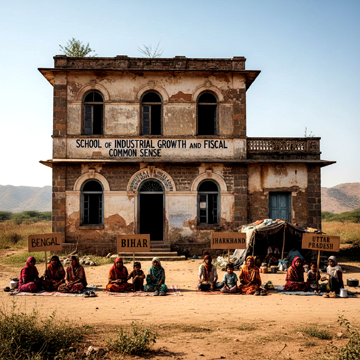
The assertion that Uttar Pradesh, Bihar, Jharkhand, and West Bengal together constitute a “dark hole of India,” draining fiscal and industrial growth through laziness, illiteracy, and communism, is deliberately provocative. It reflects a sentiment increasingly voiced in policy circles, business forums, and urban drawing rooms—particularly in India’s western and southern states, which often perceive themselves as subsidising the rest of the country. However, while such a claim captures real frustrations, it oversimplifies a far more complex historical, political, and economic reality. These four states are not merely laggards by choice or ideology; they are products of structural distortions, policy misadventures, colonial legacies, demographic pressures, and governance failures that have compounded over decades.
To understand whether these regions truly act as a “sinkhole” for India’s growth—or whether they represent unrealised potential shackled by history—we must move beyond rhetoric and examine the roots of their underdevelopment.
The weight of history: Colonial extraction and early neglect
One cannot discuss eastern and north-central India without acknowledging the colonial past. Bihar, Jharkhand, eastern Uttar Pradesh, and Bengal were central to British extraction. Bengal financed much of the British Empire in India through land revenue, while Jharkhand’s mineral wealth—coal, iron ore, mica—was systematically extracted without local industrialisation. The infamous Permanent Settlement of Bengal destroyed incentives for agricultural productivity and created a rent-seeking landlord class that survived well into independent India.
At independence, these regions inherited weak industrial bases, exploitative agrarian structures, and fragile institutions. In contrast, western India benefited from early private capital, ports, and mercantile traditions, while southern India invested heavily in education and public administration. The developmental divergence was thus embedded early, long before contemporary political ideologies took root.
Demography as destiny: Population pressure and its consequences
Uttar Pradesh and Bihar alone account for more than 25 percent of India’s population. This demographic reality profoundly shapes development outcomes. Even modest economic growth, when spread across such vast populations, appears anaemic in per capita terms. Infrastructure, healthcare, education, and employment generation struggle to keep pace with sheer numbers.
High fertility rates—particularly in eastern UP and Bihar—are often attributed to illiteracy or cultural inertia, but they are equally a function of poverty, poor female education, and inadequate healthcare access. Demographic momentum ensures that even well-designed policies take decades to reflect measurable outcomes. Branding these states as “lazy” ignores the reality that millions migrate annually from these regions to build India’s cities, staff its factories, and power its service economy.
Education deficits: Cause, consequence, or convenient scapegoat?
Illiteracy is frequently cited as both cause and proof of stagnation. There is no denying that learning outcomes in government schools across Bihar, UP, Jharkhand, and parts of Bengal remain deeply concerning. Teacher absenteeism, politicised appointments, and weak accountability have hollowed out public education systems.
Yet, illiteracy here is not ideological—it is institutional. Where states like Tamil Nadu and Kerala built education as a political priority, these regions allowed schooling to become a casualty of patronage politics. Importantly, wherever credible educational opportunities emerge—be it coaching hubs in Patna, private schools in UP towns, or missionary institutions in Jharkhand—demand is overwhelming. This suggests aspiration is not absent; systems are.
The role of politics: Populism over productivity
Governance failures lie at the heart of the problem. For decades, politics in these states revolved around identity, symbolism, and redistribution rather than wealth creation. In Uttar Pradesh and Bihar, caste-based mobilisation substituted for administrative reform. In Bengal, ideological rigidity under decades of Left rule discouraged private investment and hollowed out industrial confidence. Jharkhand oscillated between unstable governments, preventing long-term planning.
Populist policies—loan waivers, free electricity promises, bloated public payrolls—crowded out capital expenditure. While welfare is essential in poor states, the absence of a parallel growth strategy created fiscal dependency on the Centre. This dependency, in turn, fuels resentment among net-contributing states, reinforcing the “dark hole” narrative.
Communism and capital flight: The Bengal case study
West Bengal presents a unique case where ideology demonstrably shaped economic outcomes. Once India’s industrial heartland, the state lost its edge through militant trade unionism, anti-industry rhetoric, and policy hostility to private capital during its long communist rule. The exodus of industries from Kolkata to Mumbai, Ahmedabad, and later Bengaluru is well documented.
Even after the Left’s decline, investor confidence has been slow to return. Industrial memory, once broken, is hard to rebuild. Bengal’s experience illustrates how ideology, when rigidly applied, can lock a region into long-term stagnation—long after the ideology itself has lost popular support.
Jharkhand: Resource-rich, institution-poor
Jharkhand exposes another paradox: immense mineral wealth coexisting with extreme poverty. The problem here is neither communism nor laziness, but chronic institutional weakness. Illegal mining, rent extraction, displacement without rehabilitation, and the absence of local value addition have turned natural wealth into a curse.
The state has failed to translate resources into human capital, infrastructure, or industrial clusters. Royalties flow outward; social costs remain local. This is not underdevelopment by ideology but by governance vacuum.
Fiscal transfers and the myth of permanent dependence
Critics argue that these states perpetually drain central resources without reform. It is true that they are net recipients under India’s fiscal federalism. However, this is by constitutional design. Richer states today were beneficiaries yesterday. Maharashtra and Gujarat themselves relied heavily on central investment in their formative decades.
The real concern is not redistribution, but stagnation—whether recipient states use transfers to build capacity or merely fund consumption. Here, outcomes have been mixed, but recent improvements in infrastructure, electrification, and sanitation suggest change is possible when governance aligns with execution.
Labour migration: The silent subsidy
Ironically, these so-called “dark hole” states subsidise India’s growth through labour migration. Construction workers, factory hands, sanitation staff, and gig economy workers from UP, Bihar, Jharkhand, and Bengal underpin urban prosperity elsewhere. Their low wages keep inflation in check and margins high for Indian industry.
This labour dividend rarely enters fiscal calculations. If migration flows reversed, India’s growth story would falter rapidly. The problem, therefore, is not a lack of productivity, but the absence of local opportunities to absorb it.
Signs of transition: Change beneath the surface
Recent years have seen cautious optimism. Expressways in UP, manufacturing corridors, digitised welfare delivery, improvements in law and order, and competitive politics are altering perceptions. Bihar’s focus on roads and electrification, Jharkhand’s attempts at mining reform, and Bengal’s renewed infrastructure push suggest that stagnation is not destiny.
The pace remains uneven, but dismissing these states as irredeemable ignores the scale of transformation already underway—and the political costs of failure that leaders now increasingly face.
From rhetoric to responsibility
Labeling Uttar Pradesh, Bihar, Jharkhand, and West Bengal as a “dark hole” may offer rhetorical satisfaction, but it obscures more than it reveals. These states are not drains by nature; they are regions where history, demography, and governance intersected disastrously for decades. Their failures are India’s failures, and their revival is essential to India’s future.
India cannot become a $10 trillion economy while half its population remains trapped in low productivity. The choice is not between writing these regions off or endlessly subsidising them. The real challenge is enforcing accountability, rewarding reform, and integrating these states into India’s industrial and educational transformation. The question, ultimately, is not whether these regions hold India back—but whether India is prepared to do the hard, unglamorous work of pulling them forward.