
The clash Between Trump, Walz, federal agents, and a state at a breaking point. Besides the Federal stand off, we need a police investigation and the murderer on the electric chair on camera
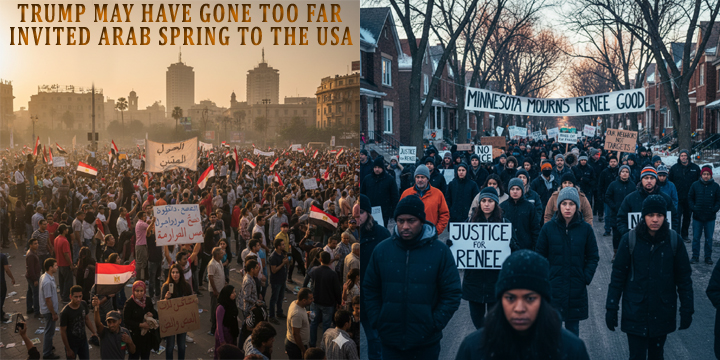
In early 2026, Minnesota—a state long known for its progressive politics, vibrant communities, and Midwestern restraint—became the unexpected epicenter of one of the most intense American political conflicts in decades. What began as a concentrated federal immigration enforcement campaign spiraled into a clash involving deadly force, mass protests, federal subpoenas for state leaders, and open accusations of constitutional overreach.
Some commentators have even asked whether Minnesota is entering a moment reminiscent of the Arab Spring—a popular uprising shaking political hierarchies far beyond its borders. But before such comparisons can be justified or dismissed, it is crucial to walk through the unfolding events, the competing narratives, and the social forces turning Minnesota into a flashpoint of national contention.
Operation metro surge: The trigger
In December 2025, the Department of Homeland Security (DHS) launched what it called Operation Metro Surge—an aggressive immigration enforcement initiative centering on the Twin Cities metropolitan area of Minneapolis and St. Paul. Citing the need to crack down on fraud and criminal activity, DHS deployed thousands of agents from Immigration and Customs Enforcement (ICE), Customs and Border Protection (CBP), and other federal units to conduct raids, detentions, and arrests across Minnesota.
Federal authorities described the operation as the largest immigration enforcement action in the state’s history, with thousands of arrests reported in the weeks that followed. Supporters within the administration argued that the surge was lawful, necessary, and targeted at individuals “not legally present” and involved in serious offenses.
For many Minnesotans, however—particularly immigrant communities, civil liberties advocates, and progressive political leaders—the sheer scale and aggressive tactics of the operation were deeply alarming.
Killing of Renee Good: Federal stupidity, national outrage
The flashpoint that transformed local tension into national controversy was the January 7, 2026, killing of Renee Nicole Good, a 37-year-old American citizen and mother of three. Good was shot and killed by an ICE agent in Minneapolis during the enforcement operation. Witness accounts, video footage, and subsequent reporting fueled public outrage, as many observers contested the federal account of events.
Federal officials portrayed Good as a threat who used her vehicle to endanger officers. Local leaders, eyewitnesses, and protesters rejected this narrative, saying that the shooting was unjustified and emblematic of an escalating and unchecked use of force.
The tragedy was quickly seized upon by state and local politicians as evidence that the federal surge posed a danger to ordinary residents and civil liberties—energies that had been building underneath the surface over months of sustained enforcement activity.
From law enforcement action to political conflict
What might have remained a contentious state-federal dispute escalated dramatically when the U.S. Department of Justice (DOJ) opened a criminal investigation targeting Minnesota’s governor, Minneapolis’ mayor, and other Democratic leaders. The investigation focuses on allegations that these state and city officials may have obstructed federal immigration enforcement efforts and conspired to impede agents during Operation Metro Surge.
Grand jury subpoenas now require Minnesota Governor Tim Walz, Attorney General Keith Ellison, Minneapolis Mayor Jacob Frey, Saint Paul Mayor Kaohly Her, and other local prosecutors to produce records and communications related to their public opposition and actions tied to federal operations.
The subpoenas, and the broader investigation, have ignited charges from Minnesota Democrats that the DOJ is engaging in politically motivated retaliation—weaponising federal law enforcement against elected officials for their criticism of national policy.
Clashes over narrative and responsibility
A central feature of this conflict is not only what happened, but who gets to define it.
President Donald Trump and senior allies have characterised federal immigration enforcement as lawful and necessary—emphasizing public safety and the administration’s mandate to uphold border and interior immigration laws. When addressing the shooting of Renee Good, Trump defended ICE agents and described such incidents as unfortunate but inevitable in the course of duties.
Trump’s rhetoric veered into warnings of invoking extraordinary powers like the Insurrection Act if state leaders did not curb unrest, further heightening national attention.
On the opposite side, Governor Walz and city leaders have accused the federal government of overreach, disrespect for local autonomy, and failing to hold federal agents accountable for the use of force. Walz has been explicit: Minnesota does not need further federal intervention, but a fair investigation and restoration of trust and public safety.
Legal battles and judicial checks
The conflict has not remained purely rhetorical. A series of lawsuits and legal rulings now complicate the enforcement landscape:
- Local authorities challenged DHS and ICE actions in federal court, leading to judicial restrictions on how federal agents can interact with peaceful protesters. A federal judge ruled that agents cannot arrest or use certain crowd-control tactics against peacefully demonstrating individuals—a decision the administration appealed.
- Minnesota’s attorney general and city officials filed lawsuits seeking to halt or limit ICE deployment, framing the enforcement surge as unconstitutional and discriminatory.
- The DOJ, in turn, is deploying additional federal prosecutors to Minnesota to assist with the immigration enforcement work amid shortages and resignations that followed the controversy.
These legal maneuvers underscore a broader constitutional tug-of-war over federal authority versus state and local sovereignty.
Mass mobilisation: Economic boycotts and protests
Unlike many previous localized disputes, this conflict has spilled into the broader civic sphere. Community groups, labour unions, faith organisations, and civil rights advocates in Minnesota announced an economic blackout day to protest the federal surge—calling on residents to refrain from working, shopping, or attending school to demonstrate opposition to the aggressive enforcement presence and to demand accountability for Good’s death.
Protestors argue that the surge has disrupted everyday life, instilled fear among immigrant families and citizens alike, and damaged the social fabric of Minnesota communities. They are pushing back not only against federal enforcement tactics, but against what they see as a political weaponisation of law enforcement.
Does this resemble an “Arab Spring”?
The idea that Minnesota could become a domestic version of the Arab Spring—a cascade of popular uprisings challenging entrenched power—is a bold comparison. The original Arab Spring was defined by spontaneous, bottom-up movements demanding deep systemic change across nations with autocratic governance structures. In contrast, the unrest in Minnesota is currently rooted in a specific policy conflict over immigration enforcement, constitutional authority, and police powers.
Yet the metaphor highlights two important dynamics:
- The Potential for Rapid Escalation: What began as targeted enforcement has ballooned into widespread protest, legal action, and a broad moral contestation about the role of federal power versus community rights.
- Polarised Narratives: Competing stories about reality—whether federal agents are saviours of law and order or instruments of oppression—are shaping public response in sharply divergent ways.
However, important distinctions remain. Minnesota still operates under the rule of law, with multiple independent institutions checking power. There is not a unified or cohesive revolutionary movement seeking regime change; rather, the players are tactical political actors using legal, electoral, and civil society channels to advance their positions.
The risk of polarisation and nationalisation
Still, Minnesota’s situation is serving as a national lightning rod. Politicians in other states, civil rights organisations, and national media have weighed in. Conservatives highlight federal authority and border enforcement; progressives focus on civil liberties and state rights. The conflict is sharpening the ideological divide over immigration, federalism, and law enforcement in ways that resonate far beyond Minnesota’s borders.
Already, legislators in other states are introducing measures to limit cooperation with federal immigration agents, citing the events in Minnesota as both cautionary case and rallying cry.
Human stories behind the headlines
At the heart of these political and legal battles are human tragedies and community fears. Renee Good’s death brought a mother’s life into national discourse—forcing many to confront the real human consequences of enforcement policies. Families of those detained, immigrant communities already wary of law enforcement, and everyday citizens caught in the media storm are all stakeholders in the unfolding situation.
Their voices, and the emotional energy they carry, add depth and urgency to what might otherwise be abstract policy debates.
What next?
The conflict in Minnesota is far from resolved. In the coming months and years, several possible trajectories could unfold:
- Escalation: Further confrontations, including mass protests, legal showdowns, or additional federal action against state and local leaders.
- Legal Resolution: Courts might clarify limits on federal enforcement authority and define new parameters for cooperation between federal and state entities.
- Political Fallout: Minnesota could become a symbolic battleground in broader national elections and political realignment.
- Policy Change: The controversy might prompt congressional action on immigration enforcement reform or federal-state relations.
No matter the outcome, the situation in Minnesota is a vivid demonstration of how deeply contentious issues like immigration, federal power, and civil liberties can reshape political landscapes when local experiences intersect with national priorities.
Beyond rhetoric to reality
Minnesota today is not Syria, Egypt, or Tunisia, and this conflict is not a revolution in the classical sense. But the metaphorical question—whether Minnesota could become an “Arab Spring” within the United States—captures the intensity, urgency, and political volatility of the moment. This is a state in constitutional confrontation, a community in emotional turmoil, and a governance system under strain.
Whether it becomes a sustained catalyst for national change remains to be seen. What is clear is that Minnesota’s clash between state power and federal authority, sparked by immigration enforcement and marked by tragedy and protest, has become one of the most consequential domestic political crises of the early 21st century.
The nation is watching. And what happens next may define American politics for years to come.