
Nirula’s enjoyed that infinitesimal craving that every brand craves for but in 2026 the customer is still willing but the shareholder is weak. The spirit is willing but the flesh is weak
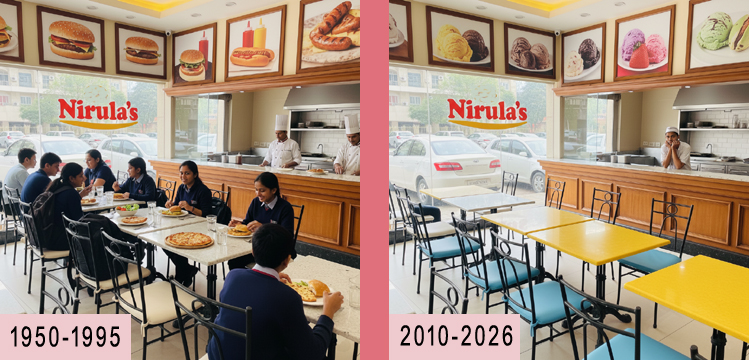
Nirula’s occupies a singular place in the modern urban memory of North India, a brand that once defined eating out for generations who grew up between the 1960s and the 1990s. Long before the acronyms HORECA entered management vocabulary, long before mall food courts homogenised taste and experience, Nirula’s was already a complete hospitality ecosystem. It was a restaurant, a café, a patisserie, an ice cream parlour, and for many families, a weekly ritual. In 2026, the brand still enjoys astonishing recall. The name still lights up something warm in the mind. Yet the offerings are feeble, delivery is virtually absent, and the gap between memory and reality is painful. Nirula’s today is a textbook case of a brand where the customer is willing but the shareholder is weak, where the spirit is willing but the flesh is weak.
The story of Nirula’s begins in post-Partition Delhi, a city absorbing refugees, ambition, and hunger in equal measure. The Nirula family, originally from Peshawar, arrived in Delhi with little capital but deep experience in food and hospitality. In 1934, before Independence, they had already established a small restaurant near Connaught Place, but it was after the 1950s that Nirula’s began to assume its iconic form. Delhi was expanding, middle-class incomes were rising slowly, and eating out was still an occasional indulgence rather than a lifestyle habit. Into this landscape stepped Nirula’s with a proposition that was radical for its time: consistent quality, predictable taste, visible hygiene, and a menu that made Western food approachable for Indian palates.
By the 1960s and 1970s, Nirula’s had become a destination. Connaught Place was its beating heart, but outlets spread across Delhi and later into other North Indian cities. For schoolchildren, college students, office-goers, and families alike, Nirula’s was neutral ground. It was not intimidating like five-star hotels, nor chaotic like roadside eateries. It offered burgers before burgers were a category, pizzas before pizza chains arrived, hot dogs, grilled sandwiches, pastries, sundaes, and what would become legendary ice creams. Its menus were laminated, its counters gleamed, and its staff wore clean uniforms at a time when most Indian eateries did not even acknowledge the concept of visible cleanliness.
The Nirula family itself remained closely involved in operations for decades. This was not a faceless corporation but a family-run enterprise where ownership and stewardship overlapped. One encountered members of the family not in boardrooms but on shop floors, supervising kitchens, tasting sauces, speaking to managers. That proximity mattered. It created a culture where standards were enforced not by manuals alone but by personal pride.
I encountered this family dimension firsthand during my years in South Delhi. In the late 1980s and early 1990s, I lived in Shanti Niketan, a quiet, leafy enclave close to Anand Niketan. It was there that I came to know Deepak Nirula, who lived nearby. Our meetings were informal, neighbourly, and unpretentious, reflecting the ethos of the family itself. Conversations drifted easily from food to business to Delhi’s changing social fabric. There was no corporate swagger, only a quiet confidence rooted in decades of having fed a city. What struck me then, and strikes me even more in hindsight, was how deeply personal the brand still was to the family. Nirula’s was not an asset on a balance sheet; it was an extension of identity.
That identity was built on food of remarkable consistency and quality. Ingredients mattered. Ice cream was made with real milk and cream when vegetable fat substitutes were the norm elsewhere. Burgers used fresh buns, patties that tasted of meat rather than filler, and sauces that were made in-house. Pizzas, long before the arrival of Domino’s or Pizza Hut, had soft bases, generous cheese, and toppings that felt indulgent rather than parsimonious. The hot chocolate fudge sundae, the pineapple ice cream, the club sandwich, and the chicken sizzlers became benchmarks against which later entrants were measured. For a generation, Nirula’s defined what “continental food” meant in an Indian context.
Equally important was cleanliness. It is difficult today to convey just how exceptional Nirula’s standards were in the 1960s and 1970s. Kitchens were visible. Floors were scrubbed. Cutlery shone. Toilets, a neglected afterthought in most Indian establishments, were maintained to a level that made families comfortable bringing children. In an era when food safety regulations were minimal and enforcement negligible, Nirula’s practised hygiene as a matter of internal discipline rather than external compulsion. This built trust, and trust built habit.
By the 1980s, Nirula’s was not merely successful; it was dominant. It had first-mover advantage, brand loyalty across age groups, and a deep understanding of local tastes. Yet this dominance also bred a certain complacency. The brand had grown organically, slowly, without facing a global competitor of comparable scale. That changed dramatically in the mid-1990s when McDonald’s entered the Indian market.
McDonald’s was not just another restaurant chain; it was an entirely different operating model. It brought with it industrial-scale processes, obsessive standardisation, deep-pocketed marketing, and global supply chain efficiencies. For the first time, Nirula’s faced a competitor that could match and exceed it on consistency, speed, and pricing, while also projecting a modern, aspirational image to a newly liberalised India. The battle was not merely for customers but for capital, systems, and vision.
Confronted with this new reality, the Nirula family made a decision that would alter the brand’s trajectory irreversibly: they sold out. The buyers were private equity and investment interests who saw value in the brand equity but lacked emotional attachment to its legacy. Over time, ownership changed hands more than once, each transaction extracting value rather than reinvesting it. The logic shifted from stewardship to short-term returns.
What followed was a slow erosion rather than a sudden collapse. Menus were rationalised, but not always intelligently. Ingredients were cost-cut without compensating innovation. Expansion plans were announced and abandoned. Delivery, which became central to food service economics in the 2010s and 2020s, remained underdeveloped. While newer brands built app-based ecosystems and cloud kitchens, Nirula’s seemed stuck between nostalgia and inertia.
The tragedy is not that Nirula’s declined—decline is common in business—but that it declined despite having so much going for it. The brand still evokes trust. Older customers still want to return. Younger customers, curious about heritage brands, are willing to try. But willingness alone is not enough. Without investment in systems, menu innovation, and distribution, nostalgia becomes a fragile crutch.
In 2026, Nirula’s exists in a strange limbo. It is remembered more vividly than it is experienced. Its name still carries weight, but its physical presence is diminished. Delivery is almost nonexistent in a market where convenience defines choice. The outlets that remain struggle to match the standards that once defined them. This is where the metaphor becomes painfully apt: the spirit is willing, but the flesh is weak. The customer’s spirit, fuelled by memory and goodwill, is eager. The brand’s spirit, shaped by history, still flickers. But the flesh—the capital, the operational muscle, the shareholder commitment—is inadequate.
Nirula’s story is therefore not merely about one brand but about a broader Indian dilemma. It is about what happens when family stewardship gives way to financial engineering, when legacy brands are treated as assets to be sweated rather than institutions to be renewed. It is also a reminder that food, unlike many other consumer categories, is deeply emotional. People forgive occasional mistakes, but they do not forgive abandonment.
To walk past a Nirula’s today is to feel a quiet sadness mixed with affection. One remembers birthdays celebrated, exams survived, friendships cemented over sundaes, first tastes of a world beyond home kitchens. Those memories cannot be monetised indefinitely without fresh substance behind them. If Nirula’s is to matter again, it will require not just capital but conviction—a return to the values that once made it extraordinary.
Until then, Nirula’s remains a powerful lesson in Indian brand history: how early excellence can build infinite goodwill, how competition can expose structural weaknesses, and how selling out without a long-term vision can hollow out even the most beloved of names. The craving is still there. The question is whether anyone with the means and the will is prepared to feed it.