
Family budgets across United States are experiencing the pinch of rising prices of essential items for the household. Things imported from China, India, Latin America, South East nations are being taxed at the US border under Trump’s new economics
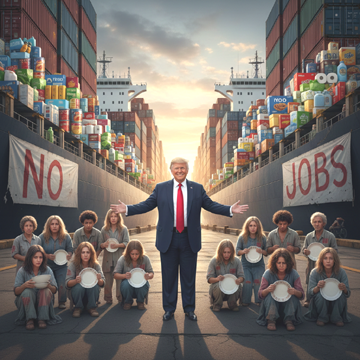
America has begun to grate again – it’s once powerful teeth. Across the United States today, millions of families face a harsh economic reality: wages are stagnant, the cost of essentials is rising, and opportunities for stable work are scarce. For many households, basic needs like food, clothing, and transportation are no longer secure, and social indicators reflect this strain — from widening food insecurity to increased financial stress, and, in some communities, to an uptick in crime and instability.
At the center of much public debate is U.S. trade and economic policy, including the widespread use of tariffs on imported goods, which some argue has exacerbated these pressures on everyday Americans. According to multiple economic studies, tariffs function effectively as a tax on consumers and businesses, pushing up the prices of essentials and eroding real household income — particularly for the middle and lower income brackets.
How tariffs are hitting American households
Tariffs are designed to protect domestic industries by raising the cost of imported goods. However, in practice, when import costs rise, those costs are generally passed directly to consumers — especially for everyday imports like clothing, electronics, and basic household goods.
A 2025 analysis by the Yale Budget Lab (summarized in multiple economic summaries) estimated that tariff increases could cost the average U.S. household roughly $2,400 per year — a significant burden for families already operating on tight budgets. Other studies show that costs for clothing, shoes, and food items have seen double-digit percentage price increases, and these effects are regressive, hitting lower- and middle-income families disproportionately.
Even staples that many Americans take for granted — from pasta imported from Italy to Christmas trees made in China — have seen notable price rises due to tariffs or tariff uncertainty, prompting stock-up behavior or reduced consumption. While some tariff rollbacks have been proposed, economists caution that consumer price relief from tariffs takes months to materialize and does not erase earlier inflationary effects.
And these cost pressures are not theoretical: U.S. consumer prices experienced one of the largest annual increases in 2025, partly driven by tariff-related inflation, according to economists.
Poverty, food insecurity, and economic stress
Rising living costs — without commensurate wage growth — have pushed many families into deeper economic insecurity. Data from the U.S. Department of Agriculture (USDA) show an increase in food insecurity across the country: Entire households, and particularly families with children, are struggling to keep enough food on the table.
Food insecurity is more than a statistic; it reflects real families skipping meals, struggling to afford basic groceries, and relying heavily on food assistance programs. In 2023, nearly 1% of U.S. households with children — more than 350,000 families — reported that children had skipped meals or gone without eating for a day because of a lack of funds for food.
Beyond hunger, poverty impacts quality of life more broadly: Under-resourced families are far more likely to live in substandard housing, rely on unsafe neighborhoods, and have limited access to health care — conditions that all contribute to social stress and community instability.
The link between economic hardship and crime
It is a well-established finding in social science that economic stress — especially persistent poverty, unemployment, and food insecurity — correlates with higher reported levels of crime in affected areas. Researchers explain this through theories such as economic deprivation and social disorganization, where lack of financial resources, limited institutional support, and weakened community networks can remove positive opportunities and social controls, increasing the likelihood that individuals resort to criminal activity to survive or cope.
For example, one academic study found that even a one-percent increase in food insecurity could be associated with an approximately 12 percent increase in violent crime rates — suggesting that as people struggle to feed themselves and their families, desperation can translate into higher crime.
These findings align with broader analyses showing that crime trends vary widely across cities, suburbs, and rural areas, but are often concentrated in places with limited economic opportunity and high poverty levels. In these disadvantaged places, unemployment and lack of jobs correlate strongly with property crime, theft, and other economic-survival offenses.
Some cities the public associates with high crime statistics — such as Memphis, Tennessee, or Jackson, Mississippi — have roots in long-term economic decline, high unemployment, and food deserts where grocery stores have closed due to crime and economic disinvestment.
Strains on the middle class
The middle class — historically viewed as the backbone of the American economy — is also under pressure. With rising prices and lagging wage growth, middle-income families are spending a larger share of their income on essentials, with less left for savings or discretionary spending. Research shows that tariff-induced price increases alone could reduce average purchasing power by several thousand dollars per household annually, driving some families to cut back on crucial items like schooling, healthcare, or even housing.
Further, middle-class economic strain contributes indirectly to social stresses — housing instability, congested transport costs, and reduced community investment — that can weaken neighborhood cohesion and increase vulnerability to crime. When families struggle to meet basic needs, the social fabric of communities tends to fray, compounding challenges in education access, youth employment, and long-term economic mobility.
Structural and Policy Context
Many economic observers link these trends back to broader policy choices. The argument from critics of current tariff policy is that higher import taxes were intended to strengthen domestic manufacturing and protect jobs, but instead have boosted consumer prices and placed additional burdens on families that can least afford them.
At the same time, decades of shifting labor markets — including the offshoring of manufacturing jobs and declining union influence — have left some regions without the economic base that once provided stable employment for working families. Cities that once thrived on manufacturing, such as Saginaw, Michigan, experienced dramatic job losses that weakened local economies and contributed to social challenges, including crime.
Compounding these trends is the structure of American infrastructure and public services. Many regions lack robust public transportation and social safety net systems, pushing families to rely on expensive private transport and further straining household budgets — a reality that critics argue undermines national economic resilience and contributes to widespread financial anxiety.
Real families, real struggles
Across the country, families describe being stretched thin. With higher prices for clothing, electronics, groceries, and even transportation parts, families often must prioritize urgent spending and forego long-term planning — such as saving for education, buying a home, or investing in retirement. The result is a population where a large share of households live paycheck to paycheck, one emergency away from financial crisis.
And while the link between economic hardship and crime is complex and mediated by many factors — policing, social services, community programs, and local leadership — there is no question that economic distress remains deeply connected to safety and opportunity in America’s neighborhoods. Investments in economic opportunity, education, job creation, and social supports have been shown to reduce crime and strengthen communities.
Far-reaching consequences for ordinary Americans
The United States stands at a crossroads. Policies intended to reshape global trade and protect domestic industries have had far-reaching consequences for ordinary Americans, from rising import costs and reduced purchasing power to deeper economic insecurity for vulnerable households.
As families grapple with higher-priced groceries, rent, transportation, and everyday goods, the social implications extend beyond personal budgets. Food insecurity, unemployment, and poverty contribute to a range of social stresses, including community instability and crime in areas where economic opportunity has eroded. This is not a simple story of cause and effect — but it is a clear reminder that economic policy, social well-being, and public safety are deeply interconnected. Whatever the political debate over “Trumponomics” and tariffs, the central policy question remains: how to ensure that the American economy works for all families, not just a wealthy few — providing stable jobs, affordable essentials, safe communities, and the chance for every generation to thrive.