
The all-pervading Internet and India’s selective bureaucratic policy has ensured that regional small footprint heavyweights no longer exist as they did during India’s print media revolution or food brand revolution in the 1950-1990 period. Now we have Hum Do, Humare Do in Indian business
India is the world’s largest democracy, the world’s fastest-growing major economy, a nation of 1.4 billion ambitious people, and—if the uploaded file is any evidence—a country that absolutely refuses to have more than two meaningful players in most industries.
Yes, India loves duopolies. No, adores duopolies. It hoards duopolies like Indian mothers hoard plastic dabbas that once contained ice cream.
This is a stunningly comprehensive spreadsheet of industries where India basically said:
“Competition? No thank you. Two is enough. Bas do rakho.” The list reads like Noah’s Ark of Indian capitalism—two of each species. From airlines (IndiGo-Air India) to buses (Tata-Ashok Leyland) to food delivery (Swiggy-Zomato) to hyperlocal groceries (Zepto-Instamart), Indian markets are structured like Bollywood weddings—there are two main characters, and everyone else is either an extra or eliminated in the first half.
Let’s dig into how we got here, why it keeps happening, and why we will probably be handing this two-slot economy proudly to our grandchildren.
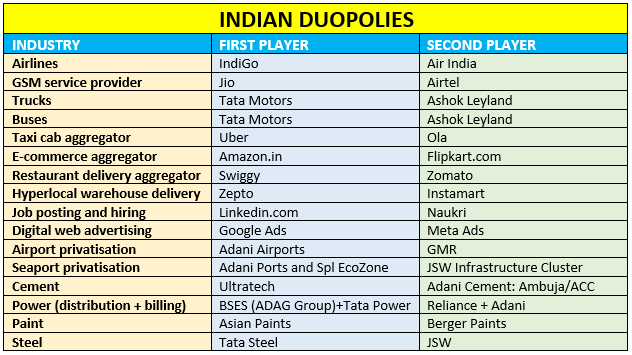
The Indian market: always a two-player game show
India may be diverse in culture, language, cuisine, and political slogans, but when it comes to industry structure, we’re as predictable as a daily soap plot twist.
Consider this glorious list:
- Telecom? Jio vs. Airtel
- Trucks? Tata Motors vs. Ashok Leyland
- Airport privatisation? Adani vs. GMR
- Cement? Ultratech vs. Adani Cement
- Paint? Asian Paints vs. Berger
- Steel? Tata Steel vs. JSW
- Job portals? LinkedIn vs. Naukri
- Digital ads? Google vs. Meta
Sure, these last ones are global giants, but India invites only two of them to dinner. Everyone else must sit outside the gate and honk.
It’s not a coincidence. It’s a pattern—no, an Indian tradition.
A short history of India’s two-player obsession
It all starts with our historical personality:
1. The socialist hangover
Modern India inherited a system where industries were centrally planned, licences were rationed, and the idea of “more competition” was considered as dangerous as more mosquitoes.
In the Licence Raj era, even if ten entrepreneurs wanted to start factories, the government would politely say:
“Beta, two are enough. The rest of you go do something creative like selling agarbatti.”
The mentality persists. Bureaucracy doesn’t like crowd control. More players = more files = more signatures = more chai.
Much easier to approve two big companies and keep life simple.
2. Policy confusion = Only the strongest survive
India’s regulatory environment can be a maze where you enter with a business plan and exit with trauma.
Startups begin enthusiastically—“We will disrupt the market!”—but by the second year, they are doing salary cuts and posting inspirational quotes on LinkedIn.
Eventually, only two survivors remain, crawling out of the battlefield holding market share charts like war trophies.
3. Consumers love stability… and discounts
Indian consumers want two things:
- The lowest price
- The best service
But they’re willing to accept only one of these at a time.
A new entrant cannot offer both. A duopoly can take turns.
That’s why we tolerate food delivery platforms charging ₹50 for delivery and ₹8 for packaging of the packaging of the packaging. Where will you go? Swiggy? Zomato? That’s it. Pick your poison.
Government apathy: the great facilitator
Government apathy in India is like gravity—you can’t see it, but everything falls because of it.
1. Policy by accident, not design
Most Indian sectors become duopolies not because the government planned it but because it forgot to plan anything.
Example:
Hyperlocal grocery delivery exploded because two companies (Zepto and Instamart) sprinted full speed into the market. The government noticed only when traffic jams started forming near dark stores.
2. Regulatory whack-a-mole
India regulates industries like a parent swatting mosquito—reactively, emotionally, and often after the mosquito has left. By the time policymakers wake up, only two companies have the stamina (or funding) to survive.
3. Love for “national champions”
Government likes big companies. They’re easier to deal with, like having one family doctor instead of 25 specialists. This is how airport and seaport privatisation ended up in the hands of two large conglomerates—Adani vs GMR for airports, Adani Ports vs JSW for seaports. Creating new players would require designing incentives, regulations, and long-term strategic frameworks—far too much hassle.
Why new businesses don’t arise in India
India has 1.4 billion people but only two meaningful players per industry. Why?
1. Funding is a Bollywood masala film
Investors in India behave like studio producers.
They fund only:
- sequels
- remakes
- spin-offs
- and anything starring a well-known corporate actor
A new business idea? Nobody wants to risk a flop. This is why India has:
- 47 copycat delivery apps,
- 80 fintech apps all doing UPI + cashback,
- and 100 startups competing to become the “Uber for cows” of something.
But eventually, two survive—and the rest write thought pieces on Medium.
2. India innovates… slowly
Innovation requires R&D, patience, and money—three things Indian industry experiences like solar eclipses: rare, brief, and mostly watched from a distance.
Most businesses enter Phase 1 full of optimism.
By Phase 2, they are doing cost-cutting.
By Phase 3, they have sold the company to one of the duopoly titans.
3. Infrastructure is designed for big players
India’s infrastructure—roads, ports, electricity, compliance—favours companies that can navigate labyrinthine procedures. Small players drown in paperwork before they even drown in losses. So naturally, two well-connected giants dominate.
The mathematics of duopoly in India
It works like this:
- One player gives good service but high prices.
- One player gives terrible service but low prices.
- Indians choose depending on the day, mood, and traffic.
Take airlines:
IndiGo is punctual. Air India serves nostalgia along with dal-chawal.
Take telecom:
Jio offers cheap data. Airtel offers stable networks.
Take food delivery:
Swiggy arrives faster. Zomato arrives with better jokes.
The rest of the companies? Eliminated like contestants on Bigg Boss.
Why India will continue having duopolies forever
Unless something drastic happens (like a meteor strike targeted at corporate boardrooms), the duopoly trend will continue.
1. Government won’t change
Because everything works “fine,” and by “fine,” we mean “nobody’s rioting yet.”
2. Consumers won’t change
Because they like the comfort of two familiar logos.
3. Investors won’t change
Because they need exit routes and exits require big buyers. The big buyers are the duopoly kings.
4. Entrepreneurs won’t change
Because they know the game:
Build startup → burn money → become #3 → run out of cash → get acquired by #1 or #2 → exit → give TEDx talk.
The deep cultural reason behind Indian duopolies
If you think Indian duopolies are purely economic, think again. It’s cultural.
Indians hate extremes:
- Not too big
- Not too small
- Not too crowded
- Not too empty
We also hate too many choices.
Put 12 options in front of an Indian shopper, and they will call the shopkeeper for advice:
“Bhaiya, which is best?”
Two choices?
Perfect.
Manageable.
Emotionally acceptable.
This is why arranged marriages traditionally worked: two families decide between two options—shaadi or no shaadi.
Duopolies today, duopolies tomorrow
Looking at the list from the uploaded document—a list that summarizes our entire economy like a two-column obituary—it is clear that India structurally gravitates towards duopoly models.
Industries die, industries get born, investors come and go, governments change, but the two-player rule remains as sacred as cricket and chai.
In the future, we may have:
- AI duopoly
- EV duopoly
- Renewable energy duopoly
- Space launch duopoly
- Online education duopoly
- Even astrology apps duopoly
Why?
Because India’s economic destiny is basically a tennis match—two players hitting the market back and forth while the rest of us sit in the stands eating overpriced popcorn.
India, the land of a billion dreams and two providers
India is a spectacular country with extraordinary talent, huge markets, and boundless potential. But somewhere along the way, our economic engine got configured to run efficiently… only with two cylinders.
It is not because Indians lack creativity, capability, or ambition.
It is because:
- government policies move slowly,
- capital flows cautiously,
- infrastructure supports giants,
- and consumer behaviour favours familiarity.
Thus, our industries continue to be shaped not by free markets but by a strange cocktail of bureaucracy, cultural psychology, funding patterns, and simple Indian pragmatism.
We will always be an economy where the final showdown ends with only two champions standing.
And honestly?
It works for us.
It’s predictable.
It’s stable.
It’s Indian.
And above all—it’s funny how accurate the uploaded file’s duopoly list is, and how it quietly summarises the entire Indian economy in one elegant two-column punchline.
Two players.
Thirteen industries.
One nation watching from the sidelines.
India: the world’s largest democracy, but the smallest competitive marketplace