
The (dis)comfort and cluelessness that we are rewarded with in India’s mismanaged salons is a good indicator what how the Indian economy is run. Snip snip
The salon next to my house is adorned with artificial grass on its floors and also on its walls. Maybe the owner is one of those Bangladeshi residents with a fake Aadhaar card gifted to her by Momota Banerjee and pretending to be a Hindu Indian. To make it more and unbearably garish, the owner of the joint has painted the walls a dirty ochre – the colour of potty after a night of junk food at a restaurant specialising in serving stale stuff. The owner – a lady behind on her rent by three months owing to lack of customers – is unable to find steady staff or even people who know their job. However, all this is no impediment to pricing a haircut for Rs 500.00. Her reasoning – she smiles and offers coffee with a hot towel for every customer.
In fact, India’s salons are the best places to highlight Indians’ total lack of civic and business sense. They are drunk on Suns-Caar, a vernacular name for cultural baggage from the India’s remotest villages brought over by members of extended joint families into India’s bric-a-brac, hodge-podge, unplanned cities. The logic: You have Suns-Caar – you have everything, even if you have no qualms in spewing water on somebody’s drawing room floor while rinsing your mouth after a burpful meal.
What does an Indian salon supposedly sell?
Relaxation – you are forever scared that the new guy will nick you or mess up your hair, pressure points.
Homeliness – every week there is a new face, with whom you are totally unfamiliar with and who doesn’t care about your comfort, in the least.
Cosmetics – you are more or less sure that the ingredients they use to cut costs are the cheapest Chinese knock offs that are available from the grey market.
Here we talk about the Hypocrisy Index: India’s overpriced salons and their glorious irrelevance to the economy. Step aside GDP, inflation, fiscal deficit, and unemployment. India has a far more reliable indicator of economic health — or lack thereof. It’s not tracked by the IMF, the World Bank, or even the Reserve Bank of India. In fact, it is entirely invisible to economists and policymakers, because they tend to focus on minor trivialities like interest rates and public debt.
Ladies and gentlemen, presenting: The Hypocrisy Index — as measured through India’s overpriced salons. If you ever want to understand India — not as a country but as a psychological condition — walk into any neighbourhood salon. If you don’t faint from the smell of burning hair, ammonia, and disappointment, you will come out enlightened.
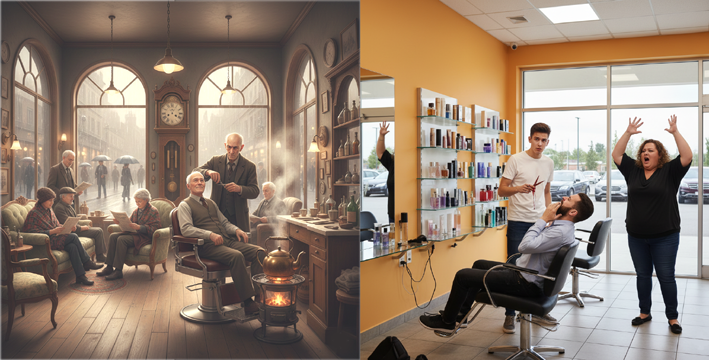
My own local salon, for example, is a sociological museum disguised as a business.
The floor is covered in artificial grass, presumably to give customers that “urban jungle” feeling — a reminder that the closest most Indians get to nature is a badly maintained terrace garden with plastic ferns. And the walls? Also covered in artificial grass. As if a drunk interior designer had one job: Make it look natural, but not too natural. Plastic natural.
To add texture, the salon owner has generously painted the remaining wall spaces in a striking shade of dirty ochre — the exact colour of what comes out of your stomach after a late-night binge at a questionable buffet restaurant that proudly advertises “Pure Veg Chinese Thali.”
It’s not décor. It’s a statement. A statement that screams: “We don’t know what we’re doing, but we’re charging premium rates.” Now, the owner — a perpetually stressed lady who is behind on rent by three months — cannot find staff. This is not surprising. The turnover rate at Indian salons rivals the attrition rate in Indian start-ups and marriages arranged after two minutes on Shaadi.com.
Every week, a new face appears behind the barber’s chair. Sometimes he looks like he’s from Rajasthan. Sometimes Bihar. Sometimes Nepal. Once, I’m convinced the guy was from a parallel universe. But this lack of skill, consistency, or even basic enthusiasm has no correlation to pricing.
A haircut costs ₹500.
Why? Because — and this is her unshakeable reasoning — “We offer coffee and a hot towel.”
That’s it. Not expertise. Not hygiene.
Not any guarantee that the stylist won’t leave you looking like you lost a bet.
Just coffee that tastes like instant regret and a hot towel that feels like it was microwaved alongside leftover momo chutney.
If India’s GDP ever collapses entirely, these salons will still charge ₹500 — because the hot towel is the last remaining symbol of civilisation.
Suns-Caar: The unlimited add-on pack that no economist has factored in
Indian salons are not just businesses. They are temples of Suns-Caar — the vernacular distortion of “Sanskar,” culturally transmitted behavioural software downloaded from remote villages into overcrowded cities. Suns-Caar is the belief that:
- Smiling is optional
- Expertise is unnecessary
- But self-righteousness is mandatory
Suns-Caar allows a man to rinse his mouth after a meal and spew the water onto the nearest drawing room floor without even blinking. It is the invisible force that ensures a salon worker will cough loudly behind your head while holding scissors.
It’s not rudeness.
It’s not ignorance.
It’s Suns-Caar.
What do Indian salons even sell? Salons worldwide sell grooming, hygiene, beauty, and confidence. Indian salons sell something far more complex.
Relaxation (Or the Threat of Decapitation): The promise: “Sir, relax.”
The reality: You are seated under blinding tube lights while a man who joined five minutes ago holds a razor close enough that you can smell the samosa he had for lunch.
Relaxation is impossible because:
- You don’t know him
- He doesn’t know what he’s doing
- And he doesn’t care
Every “pressure point massage” is an experiment, every stroke a gamble.
Barbers in India follow a simple logic:
If the customer winces, press harder.
In theory, salons are neighbourhood-friendly places.
In India, you are greeted with:
- A new barber every week
- Who doesn’t know your name
- Or your hairstyle
- Or the difference between “trim” and “semi bald”
Indian salons advertise familiarity like an arranged marriage advertisement.
But the reality is more like speed dating where every candidate is holding sharp objects.
The creams, gels, and magical potions used in Indian salons fall into specific categories:
- “Imported” (from a wholesale shop in Sadar Bazaar)
- “Organic” (meaning the packet is green)
- “Herbal” (because someone dipped a tulsi leaf in it once)
- “Chinese” (the holy grail of cost-cutting)
Every product smells vaguely like eucalyptus and broken dreams.
If you’re lucky, you will only get a rash that lasts two days. If you’re unlucky, your scalp will glow like a radioactive mango for a week.
Salons as economic indicators of national hypocrisy
Let’s break down why Indian salons reveal deep truths about our economy.
Pricing has nothing to do with value. Every salon charges premium rates because customers pay premium rates.
Not because of quality — India is the land where quality is a rumour — but because everyone desperately wants to look richer than they are.
Salons exploit this psychology ruthlessly. We live in a land where people will bargain with vegetable sellers for ₹3 but pay ₹1,200 for a facial made from questionable imported fruits. India’s informal economy runs on bluff. Salons operate on the same principle as politicians:
- Make big promises
- Deliver nothing
- Look confident while failing
Most salons barely break even. But they behave like five-star spas built on venture capital. Indian salons contribute nothing to real economic growth, but they contribute significantly to:
- local gossip
- male bonding
- dandruff
- and existential dread
The last major Indian salon innovation was “Head massage ₹50 extra.”
Everything else is price hikes.
No new business models.
No new services.
No customer loyalty programs.
Just the same three guys massaging your skull like they’re kneading dough.
Meanwhile, the prices rise faster than stock market scams.
Why are India’s salons so… this?
A combination of historical, cultural, economic, and cosmic factors:
Salon training in India is basically:
- Watch YouTube
- Mess up your customer as you learn
- Practice on one unwilling cousin
- Declare yourself a stylist
Skill shortages lead to epic disasters.
Ask any customer who came in for a trim and left looking like an undercooked coconut.
Anyone can start a salon.
No licences.
No health checks.
No required training.
No basic tests like “Do you know left from right?”
Salons are built anywhere:
- Basements
- Rooftops
- Above a pan shop
- Next to a drainage canal
- Inside what used to be a garage
Indian urban planning is a myth. Salons simply follow the same philosophy.
Owners think:
“If fancy people charge ₹800 for a haircut, I will too. I have artificial grass. That’s luxury.”
Giving customers coffee automatically adds ₹200 to the bill.
Even if the coffee tastes like heated mud.
Even if the hot towel smells faintly of yesterday’s customers.
Class signalling is everything. Despite all this, Indian salons never run out of disgruntled customers. Why? Because, alternatives are worse:
- Cutting hair at home leads to family fights
- Fancy salons charge more than monthly rent
- And YouTube DIY haircuts have a 90% disaster rate
So people keep returning, hoping that maybe — just maybe — this new unknown barber will understand. He won’t, but hope springs eternal.
The salon is India in a nutshell
Think about it. Indian salons represent:
- disorganisation
- unnecessary drama
- ambition without ability
- aesthetics without taste
- pricing without logic
- confidence without competence
- and service without service
They are the perfect metaphor for India’s economic and civic hypocrisy.
Everyone wants luxury.
No one wants to do the work.
Everyone wants high prices.
No one wants high quality.
Everyone wants staff.
No one wants to train staff.
And above all:
Everyone wants Suns-Caar.
Even if it means spitting on the drawing room floor.
Salons will never matter to the economy
India’s salons are not contributors to GDP.
They are contributors to comic relief.
Their purpose is spiritual:
To remind us never to expect too much from anything.
Not from the government.
Not from the economy.
Not from urban planning.
And certainly not from the man holding a razor over your throat while humming a Bhojpuri remix.
The hypocrisy index will remain high.
The prices will remain higher.
The service will remain nonexistent.
And Indians will keep going back for more coffee, more hot towels, and more hope.
Because in India, hope — like haircuts — is always overpriced.