
Illiterate and corrupt bureaucrat activity: What was once a lake, became “unused land” in planning documents and later “prime land” in real estate terminology. Instead of being revived or protected, the water body was progressively filled, levelled, and built over
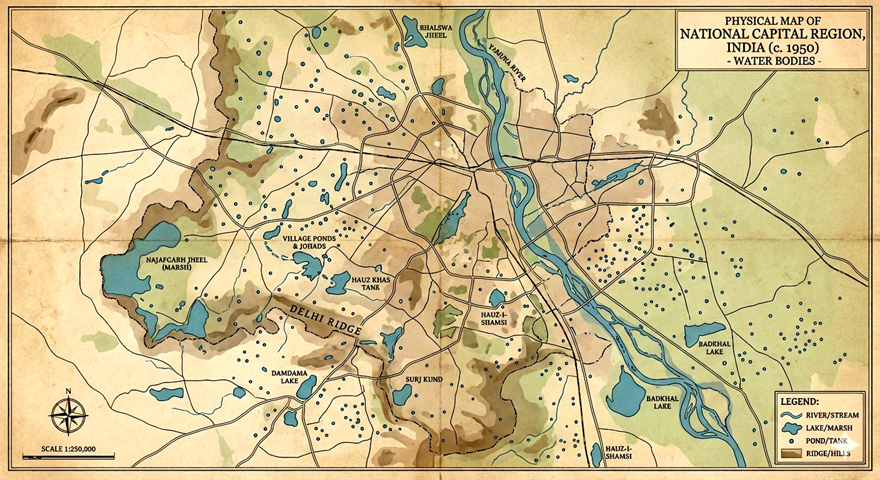
Delhi—one of the world’s oldest continuously inhabited cities—was once a landscape shaped by water. Long before multilane flyovers, metro pillars, and commercial real estate towers claimed the horizon, the National Capital Region was a mosaic of wetlands, seasonal lakes, stepwells, ponds (locally called johads), rivulets, and an intricate natural drainage system that kept the region breathing. This aquatic network didn’t merely store water; it created habitats. Birds, bees, butterflies, frogs, reptiles, and a host of microorganisms thrived in these green-blue corridors.
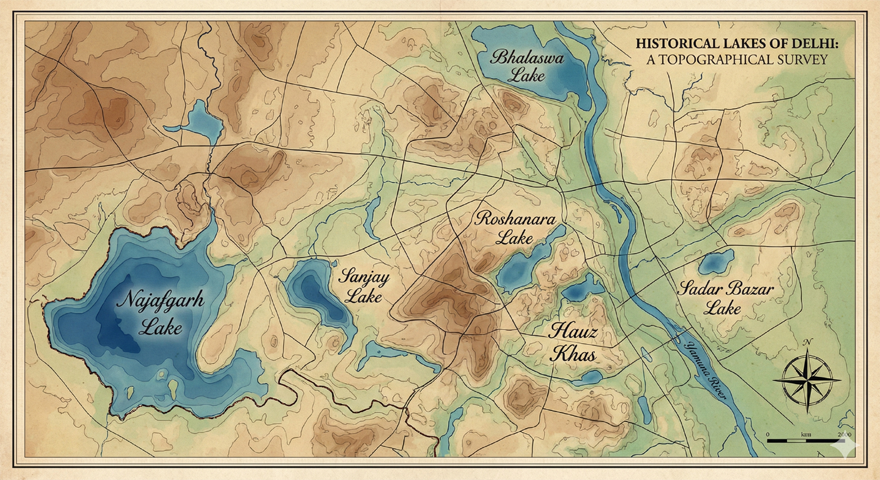
Among the many water bodies that dotted Delhi, the lake at Dhaula Kuan—today known as one of the city’s busiest traffic intersections—was once an idyllic wetland frequented by water birds. Its memory now lingers only in oral histories, old maps, and the recollections of an older generation that watched Delhi transform from a city of gardens and ponds to a city of concrete boxes.
Today, that entire ecological heritage stands almost erased. And behind the erasure lies an uncomfortable truth: rapid, unregulated construction driven by property speculation and the relentless demand for real estate. The ecosystem that once defined Delhi did not vanish on its own. It was built over—piece by piece—until nothing remained.
This article tells the story of what Delhi once was, how it lost its natural balance, and what this loss means for India’s capital going forward.
Delhi: A City Shaped by Water
Delhi’s geography is unique. It sits in a transitional ecological zone between the Thar Desert and the fertile Indo-Gangetic plains. Historically, water was precious, and the people who lived here—whether during the era of the Rajputs, Delhi Sultanate, Mughals, or the British—designed settlements around water bodies.
A Landscape of Lakes, Ponds, and Stepwells
Up until the mid-20th century, Delhi had: Hundreds of natural ponds, Seasonal lakes fed by monsoon rains, Wetlands near the Yamuna floodplains, Stepwells (Baolis) that stored and cooled water, Forest belts around the Ridge that acted as natural catchments, Water was not only stored—it was allowed to percolate into the ground, replenishing aquifers. Flora flourished, fauna flourished, and the city became a natural haven for biodiversity.
A Biodiversity Hotspot in the Heart of North India
The presence of water shaped the presence of wildlife:
Birds: herons, egrets, painted storks, flamingos, ducks, and migratory species from Central Asia.
Insects: butterflies, bees, and pollinators that sustained vegetation.
Amphibians: frogs—key indicators of a healthy ecosystem.
Reptiles: harmless grass snakes and water snakes that lived near tanks and wetlands.
Mammals: jackals, nilgai, and even leopards once roamed Delhi Ridge and its surrounding villages.
These were not rare or occasional sightings. They were a common part of the experience of living in Delhi.
Dhaula Kuan: From Lake to Flyover
Of all the water bodies that vanished, the transformation of Dhaula Kuan is perhaps the most symbolic.
A Lake in the Middle of Delhi Dhaula Kuan was once a depression that collected water during the monsoon, forming a lake large enough to attract: waterfowl, cranes, herons, ducks, migratory birds during winter. Its surrounding area was lush, with trees and undergrowth that sustained insects, reptiles, and small mammals.
What Went Wrong; Who killed Delhi’s lakes?
As Delhi expanded after Independence, two powerful forces collided:
1. Population growth
2. Real estate speculation
What was once a lake, became “unused land” in planning documents and later “prime land” in real estate terminology. Instead of being revived or protected, the water body was progressively filled, levelled, and built over. By the 1990s, the lake had disappeared under roads, commercial complexes, cantonment infrastructure, and eventually flyovers. Today, standing at Dhaula Kuan, one sees no trace of the ecosystem that supported life for centuries.
The Turning Point: How Corrupt Property Dealers Rewrote Delhi’s Ecology
It is no exaggeration to say that Delhi’s natural heritage began rapidly disappearing when property dealers entered the picture with political backing and little regulatory oversight. Three trends accelerated the collapse of the ecosystem:
1. Conversion of agricultural and village land into real estate
As Delhi villages urbanised, water bodies became “unclaimed land” ripe for construction. The easiest way to expand buildable area was to fill ponds and wetlands with debris.
2. Builders treating ponds as dumping grounds
Construction debris, mud, and garbage were systematically dumped into low-lying areas. Over time, the water bodies became shallow, then stagnant, then unusable—allowing builders to claim that these were “wastelands”.
3. Politically connected developers exploiting loopholes
Land meant for community use—including lakes—was often diverted for: apartment complexes, malls, banquet halls, unauthorized colonies. The combination of weak enforcement and the hunger for urban expansion proved disastrous.
The Ecological Collapse: What Delhi Lost
Loss of Birds: Bird migration patterns changed dramatically. Wetlands that once welcomed thousands of birds became parking lots and building foundations.
Disappearance of Bees and Butterflies: With loss of flowering shrubs, forest patches, and water sources, pollinators declined sharply. This had cascading effects on plant biodiversity.
Vanishing Frogs and Snakes: Frogs—which require moist, clean water—are among the first casualties of ecological disturbance. Their disappearance is always a warning sign. Water snakes, which prey on amphibians and insects, vanished soon after.
Heat Island Effect
Replacing lakes with concrete increased Delhi’s temperature by 2–4°C in several pockets. Where water once cooled entire neighbourhoods, heat now radiates day and night.
Falling Water Table: Wetlands help water seep into underground aquifers. Without them, groundwater extraction outpaced natural recharge. Delhi’s water table witnessed a dramatic decline across multiple zones.
Loss of Natural Flood Control
Ponds acted as buffers during heavy rains. Without them, stormwater rushes into roads and drains—overwhelming the system and causing urban flooding.
Tracing the Timeline of Destruction
1950s–1970s: Planned Expansion: Some water bodies were lost, but the city still maintained a balance.
1980s–1990s: Real Estate Boom: Property dealers became major power brokers. Illegal colonies mushroomed. Builders targeted wetlands because they were: cheap to acquire, easy to fill, unprotected by public memory. This decade marked the steepest ecological decline.
2000s–2020s: Infrastructure over Ecology
Delhi’s urban planning became infrastructure-heavy: flyovers, highways, metro corridors, large government complexes. Many projects ignored existing ecologies, choosing the fastest implementation path over sustainable design. By 2025, Delhi had lost over 90% of its historical water bodies.
The Cultural and Social Loss
Water bodies were not merely ecological zones—they were deeply woven into the social fabric of Delhi’s older villages and settlements.
Community Bonds: Children played around ponds. Villagers washed cattle and drew drinking water. Stepwells were social hubs.
Festivals and Rituals: Many traditional Hindu festivals, were conducted at tanks and lakes.
Identity and Memory
Old-timers in Delhi often recall a city where: the air was cooler, mornings were filled with bird calls, ponds reflected the moonlight, seasons had distinct smells—wet earth, flowering neem, spring blossoms. This lived experience has vanished for an entire generation.
Why Laws and Courts Could Not Save Delhi’s Water Bodies
Even though several court judgments attempted to protect lakes and wetlands, enforcement failed for several reasons: political pressure, ambiguous land records, multiple overlapping agencies, the ease of bribing lower-level officials actively seeking rent, a lack of ecological understanding in planning bodies. Water bodies disappeared faster than agencies could catalogue or protect them.
Can Delhi Be Restored? Lessons from Other Cities
Several global cities have revived lost water bodies:
Seoul restored the Cheonggyecheon stream, reviving biodiversity and cooling the city.
Singapore converted its concrete canals into living rivers under the ABC Waters Program.
London “daylighted” hidden rivers, bringing ecological health back to urban boroughs.
These cities succeeded because they reversed the fundamental planning assumption: water is not a hindrance to development—it is the foundation of a livable city.
What Delhi Needs
Delhi can still restore its ecosystem through:
1. Mapping all historical lakes and ponds using satellite and archival records
2. Stopping construction on all-natural drainage lines
3. Reclaiming encroached wetlands using legal and administrative force
4. Reviving ponds as part of storm water management
5. Creating urban biodiversity zones in place of unused concrete spaces
6. Community-led lake protection groups
7. Eco-sensitive urban planning for upcoming projects
The revival will not be easy—but it is possible.
A City That Forgot Its Water, Forgot Its Soul
Delhi did not lose its lakes and ponds by accident. It lost them because it allowed short-term profit to trump long-term survival. It allowed property dealers to redefine natural heritage as “real estate opportunity”. It allowed wetlands to be called wastelands.
But nature does not disappear quietly. Delhi now struggles with:
unbreathable air
extreme heat
water scarcity
flooding
loss of biodiversity
The symptoms are clear, the causes even clearer.
The disappearance of the Dhaula Kuan lake and other lakes in Delhi, is not just a story about one lost wetland—it is the story of what happens when a city abandons its ecological wisdom. If Delhi wants a liveable future, it must rebuild a relationship with the landscape it once inherited—one lake, one pond, one memory at a time. The past shows us what Delhi was. The future depends on what Delhi chooses to become.