Ukraine’s strategy invites comparison with Nazi Germany starving Britain. During WWII, German U-boats targeted British supply ships in an attempt to cut off fuel, food, and industrial materials. Berlin hoped that sustained disruption of shipping lanes would force Britain into economic collapse and subsequent surrender
When two sanctioned oil tankers—Kairos and Virat—were struck by Ukrainian naval drones in the Black Sea on November 29, the world received an unmistakable signal: Ukraine is attempting a new line of attack directly against Russia’s economic lifeline—its oil export system. By targeting vessels bound for Novorossiysk, one of Russia’s most crucial Black Sea oil terminals, Kyiv has announced that the battlefield has expanded far beyond trenches and artillery duels. The war has fully entered the era of air, land, and maritime drone-centric warfare.
For the first time in modern conflict history, a middle-income nation under assault is using a distributed mesh of drones—small, scalable, cheap, and AI-guided—to challenge the economic depth of a nuclear superpower. Whether Ukraine can “starve” the Russian mainland or significantly disrupt Russia’s oil export supply chain remains to be seen. But the strategic intent echoes some of the boldest blockade attempts in history.
A modern echo of WW2: The U-Boat analogy
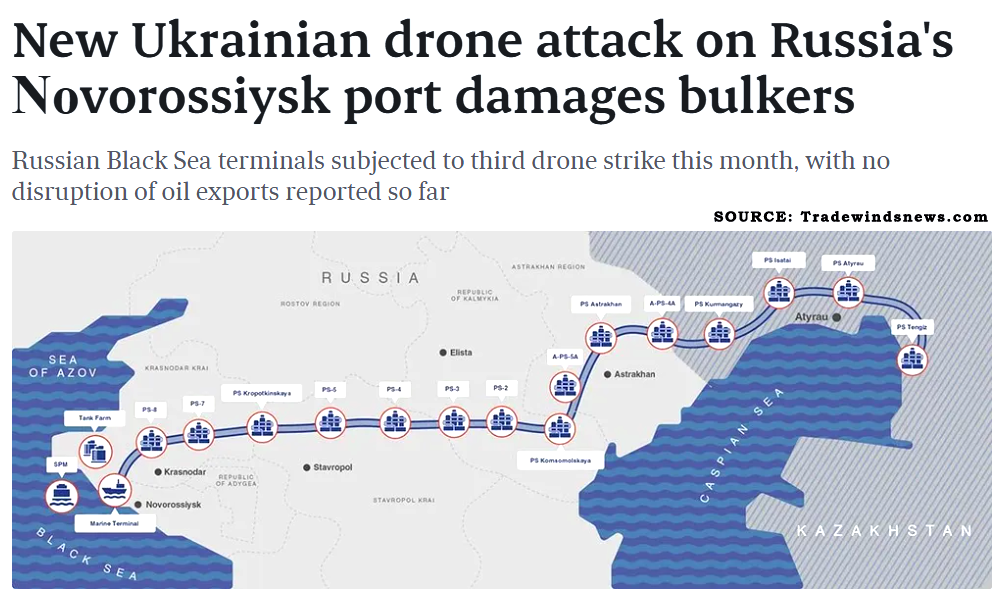
During WWII, German U-boats targeted British supply ships in an attempt to cut off fuel, food, and industrial materials. Berlin hoped that sustained disruption of shipping lanes would force Britain into economic collapse or surrender.
Ukraine’s strategy invites comparison. Instead of submarines, Ukraine uses:
- Unmanned surface vessels (USVs)
- Long-range unmanned aerial vehicles (UAVs)
- AI-guided autonomous maritime drones
And instead of targeting food or military supplies, the objective is to hit:
- Russia’s oil export infrastructure
- The “shadow fleet” of tankers bypassing sanctions
- Key terminals such as Novorossiysk
The parallel is striking: pressure through attrition of supply lines.
But the context is different.
- Germany sought a decisive blockade to starve Britain.
- Ukraine seeks incremental economic choking to complicate Russia’s war financing, raise insurance and shipping costs, and create operational unpredictability.
The aim is not total collapse, but steady pressure—death by a thousand cuts.
Why oil is Russia’s soft belly
Oil accounts for approximately:
- The majority of Russia’s export revenue
- A major share of its federal budget
- A substantial portion of its war financing capacity
Russia has sidestepped sanctions by creating a “shadow fleet”—old tankers with murky ownership structures, opaque insurance, and sanctioned operations. By targeting this fleet, Ukraine is not simply attacking maritime assets—it is attacking the architecture of Russia’s sanctions evasion ecosystem.
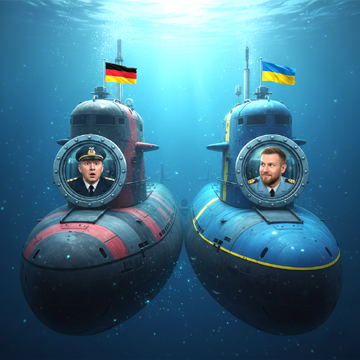
The Novorossiysk attack confirms this vulnerability. The suspension of loading operations by the Caspian Pipeline Consortium (CPC)—a major player in transporting Caspian oil—shows the seriousness of the disruption. Damaging a mooring point is not merely tactical; it touches on regional energy flows involving Kazakhstan and Azerbaijan as well.
Every single day that operations pause costs Russia revenue, credibility, and leverage.
Turkey’s concerns: A strategic wildcard
Turkey’s expression of concern about Ukrainian naval drones in the Black Sea adds a geopolitical dimension. Ankara controls the Bosphorus and Dardanelles and has a central role in defining security norms in the Black Sea.
Turkey’s worries stem from:
- Potential spillover of drone misfires
- Shipping insurance complications
- The risk of escalation drawing Turkey inadvertently closer to the conflict
- Protection of Turkish-flagged vessels
If Turkish or NATO shipping is accidentally hit, it could unravel the fragile equilibrium in the region.
Ukraine’s strategy must therefore operate within a narrow corridor: apply pressure on Russia, but not at the cost of losing support from strategic partners.
Ukraine’s drone warfare maturity: A case study for the world
Ukraine is now the global leader in practical, real-time drone warfare experimentation. The country has created an innovation ecosystem under crisis conditions—something few nations have accomplished.
Three domains, one doctrine: Integrated drone warfare
- Land Warfare
- FPV (first-person-view) drones destroy tanks, artillery, and infantry positions.
- Loitering munitions strike deep inside Russian lines.
- Air Warfare
- UAVs conduct intelligence, surveillance, and reconnaissance (ISR).
- Deep-strike drones hit airfields and critical infrastructure.
- Sea Warfare
- Maritime drones challenge the Black Sea Fleet.
- Naval drones strike oil terminals and commercial tankers.
This tri-domain integration is unprecedented. It offers a case study richer than any military exercise or simulation.
Even more notable is Ukraine’s shift from defense to offense:
- Operation Spiderweb (airborne drone strikes on Russian airfields in June 2025)
- Recent naval drone attacks in the Black Sea
- Constant drone raids on logistical hubs, fuel depots, and ports
Each operation has its own tactical structure, but together they form a coherent doctrine: use cheap, scalable drones to neutralize expensive, vulnerable assets.
Can Ukraine starve Russia’s mainland?
Realistically, no.
Russia’s mainland is vast, energy-rich, and has diversified internal supply routes. Starvation is not feasible.
But can Ukraine choke the oil export pipeline enough to hurt?
Yes—and it is already doing so.
Three pressure points Ukraine is exploiting:
- Shadow Fleet Vulnerability
Tankers operating with sub-standard systems cannot defend against fast, small naval drones. - Fixed Oil Infrastructure
Ports, mooring points, pipelines, and offshore platforms are impossible to relocate and expensive to repair. - Insurance and Shipping Risk Premiums
The cost of war-zone shipping increases dramatically when drones are involved. This could make Russian oil exports less competitive.
This strategy, even if it produces only partial disruption, forces Russia to expend resources on defense, convoy systems, naval patrols, and hardened infrastructure.
It is a war of economic erosion.
What can India learn from this?
India is watching the Ukraine war closely, because the battlefield technologies emerging from this conflict will define warfare in the 2030s and 2040s.
Here are the strategic lessons India must absorb—across doctrine, technology, and institutions.
1. Drones beat traditional platforms through cost asymmetry
Ukraine has demonstrated that:
- A $2,000 FPV drone can destroy a $2 million tank
- A $50,000 naval drone can damage a $50 million vessel
- A swarm of cheap drones can neutralize air defenses worth hundreds of millions
India must internalize this asymmetry.
Lesson for India:
Invest heavily in drone swarms, FPV units, anti-drone jammers, and AI-guided autonomous platforms across the Army, Navy, and Air Force.
2. Maritime drones are the future of littoral warfare
The Indian Ocean will increasingly see:
- Grey zone tactics
- Anonymous sabotage
- Anti-shipping drones launched from shore, air, or vessels
The Black Sea attacks are an early preview of maritime warfare between unequal forces.
Lesson for India:
Develop naval drones for:
- Port protection
- Offshore installation defense
- Anti-submarine roles using acoustic sensors
- Long-range unmanned kamikaze missions
The Indian Navy must integrate autonomous maritime vehicles into fleet doctrine.
3. Autonomous warfare requires a domestic innovation ecosystem
Ukraine’s rapid progress came from:
- Local engineers
- Volunteer drone builders
- Civilian-military tech collaborations
- Startups modifying commercial platforms
India’s defence ecosystem is still heavily centralized and procurement-centric.
Lesson for India:
Create a decentralized, mission-oriented innovation network:
- Encourage startups to prototype for the military
- Use battlefield feedback loops
- Allow rapid procurement of small platforms
- Simplify trials and approvals
A wartime innovation culture cannot be built overnight.
4. Fixed infrastructure will be the first target in future wars
India’s oil refineries, naval dockyards, and ports are vulnerable to drone swarms and autonomous boats.
The Novorossiysk attack reveals a key truth:
Ports are indefensible with only traditional systems.
Lesson for India:
Upgrade coastal defense with:
- AI-driven radar
- Layered anti-drone nets
- Autonomous patrol boats
- Underwater sensors
- Hardening of oil and LNG terminals
Protecting economic infrastructure is now as important as protecting military bases.
5. Civilian shipping must prepare for drone threats
India’s energy imports are heavily dependent on vulnerable shipping lanes around:
- Strait of Hormuz
- Bab el-Mandeb
- Malacca Strait
The Ukrainian tanker attacks show how quickly geopolitical risks can escalate.
Lesson for India:
Collaborate with the shipping industry to develop:
- Drone-warning systems
- Onboard jammers
- Hull-mounted anti-drone equipment
- Shared situational awareness networks
Civilian shipping cannot remain unprotected.
6. A new doctrine: Distributed autonomous warfare
Ukraine’s greatest innovation is the doctrine itself: use thousands of autonomous systems instead of a few centralized platforms.
India continues to invest heavily in:
- Large warships
- Conventional submarines
- Manned aircraft
These are essential—but vulnerable.
Lesson for India:
Adopt a hybrid doctrine:
- Manned assets supported by thousands of drones
- Swarm-based suppression
- Autonomous reconnaissance
- Low-cost deterrence
A $500 drone swarm can repel a $50 million intrusion attempt. Doctrine must evolve.
A turning point in global military thinking
Ukraine’s attacks on the Kairos, Virat, and the Novorossiysk oil terminal are not isolated incidents. They represent a broader shift in 21st-century warfare: the rise of the drone as the primary instrument of strategic pressure.
The question is not whether Ukraine can starve Russia—almost certainly not.
The real issue is whether Ukraine can:
- Increase Russia’s economic and operational costs
- Disrupt the shadow fleet
- Create long-term uncertainty in Russia’s export logistics
- Force Russia to deploy disproportionate resources for protection
If Kyiv continues with these strikes, it will force an expensive defensive realignment on Russia without deploying expensive assets of its own. That is the essence of asymmetric modern warfare.
For India, Ukraine is not just a war to observe—it is a preview of our future battlespace. The Indian military must absorb these lessons now, before similar tactics inevitably appear in the Indo-Pacific. The drone age has arrived, and Ukraine is writing its rulebook in real time. India would do well to read it carefully.