
India’s Nuclear Sector Pivot: From State Monopoly to Private Power. How can India avoid the pitfalls that the US, UK, France, Japan and Russia have encountered in things nuclear?
Prime Minister Narendra Modi’s announcement to open India’s tightly controlled nuclear sector to private investors marks one of the most significant economic and strategic decisions of the last few decades. This structural shift redefines India’s approach to power, technology, and national ambition, aiming for energy sovereignty and technological acceleration.
The Rationale for Privatization
For over 60 years, since the Atomic Energy Act of 1962, India’s civilian nuclear generation operated under a rigid state monopoly, viewed more as an extension of national security infrastructure than an economic frontier. Private enterprise was excluded due to law, suspicion, and a legacy of Nehruvian socialism, which equated state control with the national interest.
Modi’s reform tears through this legacy, publicly acknowledging that private capital and innovation are not threats, but tools of sovereignty. The goal is not to privatize nuclear weapons or strategic assets, but to target civilian nuclear power, energy generation, supply chains, engineering, research, and innovation under strict regulatory supervision.
Focus Areas and Modern Technology
The government’s primary focus includes the development of Bharat Small Reactors, Small Modular Reactors (SMRs), and advanced next-generation reactor technologies. SMRs are considered revolutionary globally because they:
- Require less land.
- Involve lower upfront capital.
- Can be deployed faster.
- Are inherently safer due to modern passive cooling and containment systems.
For a densely populated country like India, these features are essential. Private participation is expected to bring competition, speed, accountability, manufacturing depth, and integration with global innovation ecosystems.

💡 Energy Necessity and Strategic Autonomy
India’s current energy reality is a strategic contradiction, with rapid demand for round-the-clock, high-quality power for industrial expansion, data centers, and AI infrastructure.
Nuclear energy is clean, reliable, and scalable, providing stable base-load power and decoupling India’s economy from foreign fossil fuel suppliers. The ambition to reach 100 GW of nuclear capacity by 2047 is foundational to India’s dream of becoming a developed nation (Viksit Bharat).
The deeper story of this reform is sovereignty. By expanding domestic nuclear capacity, India reduces dependence on:
- Imported hydrocarbons.
- Western-controlled climate financing.
- Foreign technology chokepoints.
This is a move toward strategic autonomy through infrastructure.
Lessons from the Space Sector
Modi deliberately linked the nuclear reform to the successful transformation of India’s space ecosystem. For decades, the space sector was housed entirely within ISRO, achieving historic feats but operating under bureaucratic limitations. The entry of private players, like Skyroot and Agnikul, introduced agility, speed, risk-taking, and investor capital.
The simple message is: if private participation could democratize and accelerate space innovation, the nuclear sector should not remain trapped in 20th-century command-and-control structures.
🏛️ The Legislative Path
The announcement is anchored in concrete legislative planning. The government is preparing to table the Atomic Energy Bill, 2025 in the Winter Session of Parliament, along with amendments to the Atomic Energy Act, 1962 and the Civil Liability for Nuclear Damage (CLND) Act, 2010.
This legal architecture is crucial, as no serious private investor will engage in nuclear projects if liability laws are vague or punitive. By restructuring these laws, the government is signaling a commitment to long-term ecosystem building.
The overall strategy fits a broader pattern—Semiconductor push, Defence indigenization, Space privatization, and Digital public infrastructure—all tied together by the principle of sovereignty through capability. The move repositions the state from a monopolistic controller to a strategic regulator and enabler.
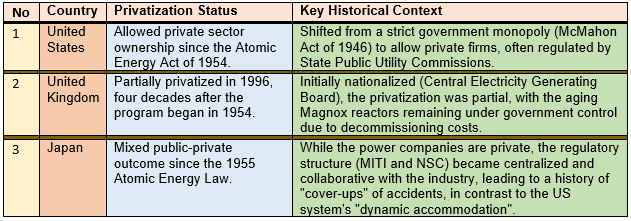
The US case, while suffering regulatory failure and high decommissioning costs for taxpayers, avoided “cover-ups” of accidents, unlike the Japanese case. The UK case of partial privatization has required government bail-outs for both the privatized and state-run entities, showing the difficulties of a “mixed” model. These case studies underscore the need for a robust legal and regulatory framework as India embarks on this reform.