
The earliest successful non-African populations appear to have carried mitochondrial DNA lineages known as M and N, along with Y-chromosome haplogroups such as F. These lineages are the ancestors of nearly all modern non-African populations. South Asia, Southeast Asia, and Oceania, were early centers of population expansion exiting India
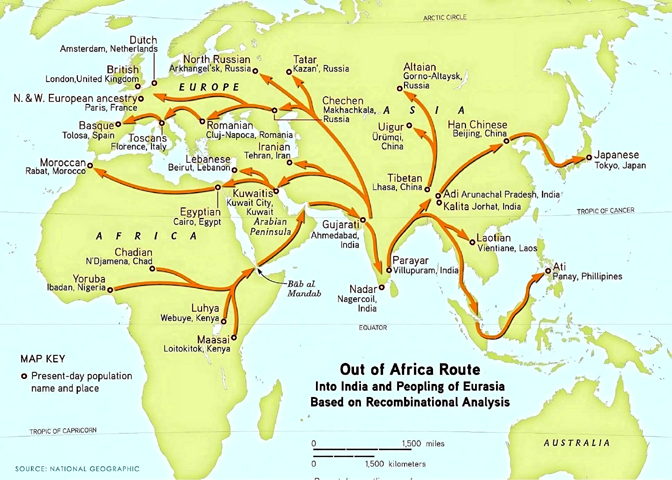
The story of how modern humans spread across the planet has long been told as a dramatic journey out of Africa into the great unknown. But in recent years, a growing body of genetic and archaeological research has begun to reshape that narrative in fascinating ways. Instead of a simple outward march across continents, the dispersal of Homo sapiens now appears to have involved pauses, bottlenecks, dead ends, and, crucially, key hubs. One such hub, increasingly emphasized in scientific discussions, is the Indian subcontinent. Far from being merely a corridor through which early humans passed, India may have played a central role in shaping the genetic heritage of all non-African populations alive today. This emerging perspective is rooted in findings from disciplines like population genetics and archaeogenetics, as well as large-scale initiatives such as the Human Genome Project.
The southern route and India’s early significance
The most widely accepted model of human dispersal begins with a relatively small group of modern humans leaving East Africa roughly 70,000 to 60,000 years ago. These early migrants likely crossed the Bab-el-Mandeb Strait into the Arabian Peninsula, then followed a coastal route along southern Iran before entering the Indian subcontinent, possibly via what is today Gujarat. This pathway is commonly referred to as the “Southern Route.” It stands in contrast to earlier theories that emphasized a northern migration through the Levant.
What makes this southern pathway particularly compelling is the genetic evidence associated with it. The earliest successful non-African populations appear to have carried mitochondrial DNA lineages known as M and N, along with Y-chromosome haplogroups such as F. These lineages are the ancestors of nearly all modern non-African populations. Importantly, the deepest and most diverse branches of these genetic markers are found today in South Asia, Southeast Asia, and Oceania, suggesting that these regions were not merely stepping stones, but early centers of population expansion.
India’s geographic position made it uniquely suited for this role. With access to coastal resources, varied ecological zones, and relatively stable climates compared to harsher northern regions, the subcontinent could support growing populations. Rather than a brief stopover, it may have been a place where early humans settled, diversified, and expanded. This is why some researchers now describe India as a “foundational population center” for non-African humans, a claim that, while still debated, is gaining traction in academic circles.
Expansion westward and eastward from India
Once established in the Indian subcontinent, human populations appear to have expanded in multiple directions. One branch moved westward toward Iran, Central Asia, and eventually Europe between roughly 45,000 and 35,000 years ago. This migration is associated with mitochondrial haplogroup U and Y-chromosome haplogroup R1, both of which are common in present-day European populations. Genetic studies have identified what is sometimes called “basal Eurasian ancestry” in ancient Near Eastern genomes, which may trace back to populations that had earlier connections with South Asia.
Another major wave moved eastward between 50,000 and 40,000 years ago, spreading into East Asia, Southeast Asia, and eventually Oceania. This expansion carried mitochondrial lineages M and R, along with Y-chromosome haplogroups such as C and K2b. These genetic signatures are still visible today among East Asian populations, as well as among Indigenous groups in Papua New Guinea and Australia. The presence of these lineages across such vast distances underscores the scale and success of these migrations.
What is striking is how these dispersals appear to radiate outward from a central zone rather than proceeding in a straight line from Africa to each region independently. This lends weight to the idea that India functioned as a major staging ground, a place where populations grew large enough to support further expansion. It also helps explain the genetic continuity observed across Eurasia, linking diverse populations through shared ancestral lineages that may have passed through South Asia.
The northern route and its apparent failure
Before the Southern Route gained prominence, many researchers focused on an earlier migration out of Africa via the Sinai Peninsula into the Levant. This “Northern Route” dates back to around 100,000 years ago and is supported by fossil evidence from sites in present-day Israel and surrounding regions. These early Homo sapiens populations coexisted with other hominins, including Neanderthals, in a complex and dynamic environment.
However, despite the presence of these early modern humans in the Levant, genetic evidence suggests that they did not contribute significantly to the ancestry of later Eurasian populations. Ancient DNA studies have found little to no continuity between these early groups and the populations that spread across Eurasia tens of thousands of years later. In other words, the Northern Route appears to have been a “failed migration”, an early attempt that did not leave a lasting genetic legacy.
One possible explanation is that these populations either died out due to environmental pressures or were absorbed into Neanderthal populations through interbreeding. While modern humans outside Africa do carry a small percentage of Neanderthal DNA, this admixture likely occurred later, after the successful southern dispersal. The absence of key mitochondrial lineages such as M and N in the Levantine fossils further supports the idea that this route did not give rise to modern non-African populations.
Genetic bottlenecks and the shaping of humanity
A crucial piece of evidence supporting the Southern Route model is the genetic bottleneck observed in modern human populations. Around 60,000 to 70,000 years ago, the human population appears to have gone through a period of severe reduction in numbers. This bottleneck is reflected in the relatively low genetic diversity among non-African populations compared to African ones.
Such a bottleneck is consistent with a small group of migrants leaving Africa and successfully establishing themselves along the southern coastal route. As these populations expanded and diversified, they carried with them a limited subset of the genetic variation present in Africa. Over time, mutations and adaptations led to the wide range of genetic diversity seen today, but the underlying structure still reflects that early bottleneck.
India’s role in this process becomes particularly significant when we consider the timing and distribution of genetic lineages. The diversity of haplogroups M and N in South Asia suggests that these lineages had time to evolve and diversify there before spreading further. This aligns well with the idea that India was not just a waypoint, but a region where early human populations stabilized and grew after the bottleneck.
Revisiting the narrative of human origins
The idea that India played a central role in human dispersal challenges older, more linear narratives of migration. It suggests a more complex picture in which different regions contributed in different ways at different times. Africa remains the cradle of humanity, but the story of how humans came to inhabit the rest of the world may be more interconnected than previously thought.
At the same time, it is important to approach such claims with caution. While the Southern Route model is strongly supported by current evidence, the field of human origins is constantly evolving. New discoveries, whether in the form of fossils, archaeological sites, or genetic data, have the potential to refine or even overturn existing theories. The notion of India as a “foundational population center” is an interpretation of available evidence, not an established fact beyond debate.
Why such narratives gain traction
The question “why was this hidden?” often arises in discussions of scientific findings that challenge established views. In reality, science is not a conspiracy but a process. Ideas gain acceptance based on evidence, and as new evidence emerges, theories are updated. The growing emphasis on the Southern Route and India’s role reflects advances in technology, particularly in DNA sequencing, rather than any deliberate suppression of information.
It is also worth noting that scientific narratives can be influenced by the availability of data. For many years, research was concentrated in Europe and the Near East, leading to models that emphasized those regions. As more studies are conducted in South Asia and other previously underrepresented areas, a more balanced and comprehensive picture is beginning to emerge.
A dynamic and evolving understanding
Ultimately, the story of human migration is not a fixed tale but an ongoing investigation. The Southern Route model, with India as a central hub, offers a compelling framework that integrates genetic, archaeological, and environmental evidence. It highlights the resilience and adaptability of early humans, who navigated diverse landscapes and overcame significant challenges to populate the globe.
What this perspective underscores is the shared heritage of all non-African humans. Whether in Europe, East Asia, or Oceania, populations are linked by common ancestral threads that may trace back to early communities in South Asia. This does not diminish the importance of other regions, but rather enriches our understanding of how interconnected human history truly is.
As research continues, new findings will undoubtedly add nuance to this picture. But for now, the idea of India as a key hub in the great human journey stands as a powerful reminder that the paths of our ancestors were neither simple nor singular. They were complex, branching, and deeply intertwined, much like humanity itself.