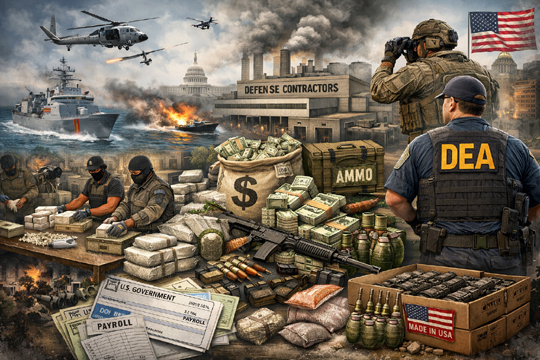
The United States sends just about enough military to dampen a few operations but keep the drug cartel activity going as supplying the DEA with salaries and guns is an ongoing business for ordnance manufacturers in the USA. That is a market that fuels the US economy
Few assertions about American power provoke as much visceral reaction as the claim that the United States military will relentlessly chase oil across the globe but will not unleash similar firepower against drug cartels that poison its own society. To critics, this looks like hypocrisy at best and complicity at worst. Why were entire countries invaded or bombed in the name of “energy security,” while cartel strongholds just south of the U.S. border remain largely untouched by conventional military force? Why do stealth bombers fly thousands of miles to strike deserts and oilfields, but not cartel compounds producing fentanyl that kills tens of thousands of Americans every year?
This argument often concludes with a darker insinuation: drugs, enforcement, and the Drug Enforcement Administration (DEA) form a business ecosystem too lucrative and politically sensitive to disrupt. Whether that claim is exaggerated or partially grounded in reality, it taps into a deep unease about how power, money, legality, and morality intersect in U.S. foreign and security policy.
The truth, as usual, is more complicated. The United States has historically treated oil and drugs as fundamentally different strategic problems, governed by different legal regimes, military doctrines, and political constraints. But that distinction is beginning to blur. The U.S. is quietly escalating its use of military force against drug trafficking networks, especially at sea and through advanced technologies, even as it avoids headline-grabbing “bomb them all” solutions on land.
Understanding why requires unpacking geopolitics, international law, sovereignty, economics, corruption, and the unintended consequences of brute force. This is not a story of simple cowardice or conspiracy. It is a story of how modern power actually works.
Oil and American Power: The Historical Pattern
Oil has occupied a unique position in U.S. strategic thinking since the Second World War. It is not merely a commodity but the bloodstream of the global economy. Control over energy flows translates into influence over allies, rivals, and markets. From this perspective, military interventions in oil-producing regions were never just about securing fuel for American cars or jets; they were about shaping the global system itself.
The Middle East offers the clearest example. U.S. involvement in Saudi Arabia, the Persian Gulf, Iraq, and beyond has consistently been justified in terms of regional stability, freedom of navigation, and preventing hostile powers from dominating energy resources. Even when moral arguments were invoked—democracy, human rights, weapons of mass destruction—oil remained the unspoken constant.
Crucially, these interventions were state-to-state conflicts or operations conducted within the framework of international war, alliances, and UN resolutions, however contested those justifications may have been. The enemy wore uniforms, controlled territory, flew flags, and sat in palaces or ministries. Conventional military power made sense in that context.
Oil wars, therefore, fit neatly into traditional military logic. You can bomb refineries, pipelines, air defenses, and armored divisions. You can occupy territory, impose sanctions, and negotiate treaties. The tools of war match the nature of the problem.
Drug cartels do not.
Drug Cartels Are Not States—and That Changes Everything
Drug cartels are transnational criminal enterprises, not sovereign states. They do not formally govern countries, sign treaties, or sit at the United Nations. They embed themselves inside existing societies, economies, and institutions, blurring the line between criminality and governance.
This distinction matters enormously. Bombing a cartel compound in Mexico is not the same as bombing a military base in Iraq. It is an act of violence inside a sovereign country that is, at least officially, a U.S. ally. Under international law, such an action would constitute a violation of sovereignty unless explicitly authorized by the host government.
Mexico, for historical, political, and cultural reasons, is deeply sensitive to U.S. military intervention. Memories of 19th-century invasions and territorial loss still shape national identity. No Mexican government, regardless of ideology, can openly permit U.S. bombs on its soil without risking political suicide.
Thus, the first and most important reason the U.S. does not simply bomb cartels is legal and diplomatic. Doing so would shatter relations with neighbors, destabilize governments, and potentially trigger wider conflict. Oil wars are fought far away; cartel wars would be fought next door.
Sovereignty, Law, and the Limits of Force
International law is often dismissed as a fig leaf for power politics, but in this case it genuinely constrains U.S. options. The use of force is legally permissible only in self-defense, with UN authorization, or with host-nation consent. While the U.S. has stretched these principles in the past, doing so against cartels in friendly countries would set a precedent with far-reaching consequences.
If Washington normalizes bombing criminal groups inside allied states, it implicitly legitimizes similar actions by other powers. Russia could claim the right to strike “criminal networks” in neighboring countries. China could justify military action against non-state actors abroad under the same logic. The erosion of sovereignty would not stop at drug cartels.
There is also the issue of proportionality. Cartels operate in dense urban environments. Their infrastructure is interwoven with civilian life—homes, businesses, farms, ports. Conventional airstrikes would almost inevitably kill civilians, creating humanitarian disasters and moral outrage that far outweigh any tactical gains.
Oil facilities, by contrast, are often isolated, industrial targets. Bombing them is destructive, but it does not usually involve the same level of civilian entanglement.
Asymmetrical Warfare and the Cartel Advantage
Even if legal and diplomatic obstacles were removed, bombing cartels would be militarily counterproductive. Cartels excel at asymmetrical warfare. They do not need to defeat the U.S. military; they only need to survive and retaliate indirectly.
Retaliation would not take the form of pitched battles but of terror. Kidnappings, assassinations, mass shootings, and propaganda campaigns would escalate dramatically. Cartels could target civilians, journalists, politicians, and even U.S. citizens abroad. They could flood the U.S. market with even more drugs or weaponize migration flows.
Unlike state adversaries, cartels have no capitals to defend and no populations to protect. Pain does not deter them in the same way it deters governments. In many cases, violence strengthens their grip by intimidating rivals and communities into submission.
History bears this out. The “kingpin strategy” of capturing or killing cartel leaders has repeatedly backfired. Removing a boss often creates power vacuums that splinter organizations into smaller, more ruthless factions. Violence increases, not decreases. Bombing would likely accelerate this dynamic on a catastrophic scale.
Corruption: The Hidden Shield
One of the most uncomfortable truths about the drug war is how deeply cartels are entangled with legitimate institutions. Police, customs officials, soldiers, judges, mayors, and politicians have all been compromised to varying degrees across Latin America. This does not mean entire states are “narco-states,” but it does mean that clean targeting is extraordinarily difficult.
A bomb does not discriminate between a cartel warehouse and a facility quietly used by compromised officials. Intelligence leaks are rampant; planned operations are often known to cartels in advance. The risk of hitting the wrong target—or the right target with the wrong political implications—is high.
In oil wars, the enemy is usually clearer. In drug wars, the enemy is embedded inside the very structures meant to fight it. That reality makes blunt force not only immoral but strategically reckless.
The Myth That the US Never Uses Force Against Cartels
The claim that the U.S. “never” uses military force against drug networks is increasingly outdated. What has changed is not the objective but the method. Rather than dramatic bombing campaigns, Washington has embraced quieter, more deniable forms of violence.
At sea, the shift is unmistakable. The U.S. Navy and Coast Guard have conducted lethal operations against drug-smuggling vessels in international waters, particularly in the Caribbean and eastern Pacific. These are not symbolic interdictions. Smuggling boats have been destroyed, crews detained or killed, and entire trafficking routes disrupted.
Maritime operations avoid the sovereignty problem because they occur outside national territories. They also target a critical chokepoint in the drug supply chain, where cartels are most vulnerable and civilians are least at risk.
From Criminals to “Narco-Terrorists”
Another significant shift has been rhetorical and legal: the designation of certain cartels and gangs as foreign terrorist organizations. This is not merely a label. It fundamentally changes the legal framework governing U.S. action.
Once designated as terrorists, these groups can be targeted under authorities originally designed for counterterrorism operations. Intelligence agencies gain broader latitude. Financial networks can be frozen more aggressively. Military assets can be deployed with fewer political constraints.
This does not mean carpet bombing is imminent, but it does signal a willingness to blur the line between crime and war. The drug trade is no longer treated solely as a law-enforcement issue; it is increasingly framed as a national security threat.
Operation Southern Spear and the New Drug War
Reports of operations such as “Operation Southern Spear” point to a new phase in U.S. strategy. Rather than massed troops or air raids, the focus is on technology: drones, autonomous systems, robotics, cyber tools, and precision strikes.
These capabilities allow the U.S. to disrupt drug networks with minimal visibility. Laboratories can be sabotaged. Logistics hubs can be crippled. Communications can be intercepted or manipulated. Financial flows can be choked off.
In some cases, authorized strikes on land-based infrastructure in neighboring regions have reportedly occurred, though details remain classified. The emphasis is on deniability and precision, not spectacle.
This is warfare adapted to the realities of the drug trade: invisible, continuous, and largely unacknowledged.
Why Not Just “Bomb Them All”?
The temptation to solve complex problems with overwhelming force is as old as warfare itself. But experience has taught U.S. planners some hard lessons.
First, killing leaders does not kill markets. As long as demand for drugs in the United States remains high, supply will adapt. New traffickers will emerge. New routes will be created. The economics of prohibition ensure resilience.
Second, large-scale violence generates political backlash. Images of bombed neighborhoods and dead civilians would erode U.S. legitimacy at home and abroad. Allies would distance themselves. Rivals would exploit the chaos.
Third, militarization risks turning criminal violence into insurgency. If cartels begin to see themselves as fighters against foreign aggression, they may adopt ideological narratives that attract recruits and justify even greater brutality.
In short, bombing would feel satisfying but solve nothing—and likely make everything worse.
Drugs, the DEA, and the “Business” Allegation
The most controversial part of the claim is the idea that drugs and enforcement constitute a business too entrenched to dismantle. There is some uncomfortable truth here, though it is often overstated.
The drug war has created massive bureaucracies, budgets, and careers. Law enforcement agencies, private contractors, surveillance firms, and even prisons benefit from a system of perpetual conflict. Complete victory would, paradoxically, undermine these structures.
However, this does not mean agencies like the DEA secretly want drugs to flow unchecked. It means they operate within political and economic constraints that favor management over eradication. The goal becomes containment, disruption, and damage control, not final resolution.
Oil wars, by contrast, promise clearer endpoints: regime change, deterrence, or control of resources. Drug wars promise endless complexity.
Demand: The Problem Washington Cannot Bomb
Ultimately, the greatest reason the U.S. does not bomb cartels is that the root of the problem lies at home. American demand for drugs fuels the entire system. Poverty, addiction, mental health crises, and social inequality create a market that no amount of foreign bombing can eliminate.
Until demand is addressed through public health approaches, economic reform, and social policy, supply-side violence will always be a game of whack-a-mole. Cartels know this. They bet on the inevitability of demand.
Military force can disrupt, but it cannot cure addiction.
Oil, Drugs, and the Nature of Power
The contrast between oil wars and drug wars reveals something fundamental about modern power. States are designed to fight other states. They struggle against networks, markets, and social phenomena.
Oil fits the old model of power politics. Drugs belong to the messy, decentralized world of globalization. Applying the same tools to both is a recipe for failure.
This does not mean the U.S. is innocent, nor that its choices are always moral. It means that simplistic narratives—“they bomb oil but protect drug dealers”—miss the deeper structural realities at play.
Conclusion: A War Without Parades
The U.S. military has historically chased oil with bombs because oil wars fit the grammar of traditional warfare. Drug cartels do not. They exist in the shadows, protected by sovereignty, corruption, economics, and the brutal logic of demand.
That does not mean the U.S. is doing nothing. It means the war is quieter, more technological, more legally complex, and far less visible. Ships are sunk, networks disrupted, and money flows frozen, even as the public sees little of it.
Drugs and enforcement may indeed form a business ecosystem, but it is one trapped in contradiction rather than conspiracy. The real taboo is not bombing cartels; it is confronting the social and economic foundations of the drug market itself.
Bombs can destroy oilfields. They cannot destroy addiction.