Donald Trump issued a public demand for allied countries to contribute naval forces to reopen and secure the Strait of Hormuz. Trump argued that countries dependent on Gulf energy should take responsibility for protecting their supply routes. Japan, Australia and China refuse outright
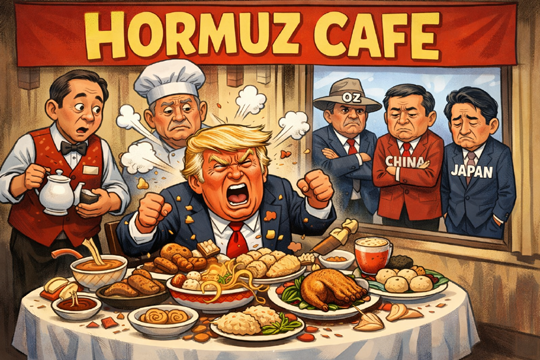
Donald Trump, who publicly demanded that other countries send naval vessels to help secure the waterway. His argument was blunt: countries that rely heavily on oil flowing through the Strait of Hormuz should take responsibility for protecting it. Yet the reaction from Washington’s allies was telling. Instead of rallying behind the United States, several key partners signaled reluctance or outright refusal to participate in the proposed maritime coalition. The episode has exposed a widening gap between American expectations of global leadership and the willingness of other nations to follow Washington’s lead in a highly volatile conflict.
The strategic importance of the Strait of Hormuz
The Strait of Hormuz is only about 33 kilometers wide at its narrowest point, yet it carries enormous strategic significance. Oil from major Gulf producers—including Saudi Arabia, Iraq, Kuwait, and the United Arab Emirates—must pass through this chokepoint before reaching global markets. Energy analysts estimate that nearly 20 percent of the world’s petroleum supply transits this narrow channel each day. In addition, large volumes of liquefied natural gas shipments, particularly from Qatar, also pass through the strait. As the waterway lies between Iran to the north and Oman and the United Arab Emirates to the south, it is geographically vulnerable to military disruption. Even small-scale attacks, naval mines, or drone strikes can cause insurers and shipping companies to halt traffic. That vulnerability has become painfully clear during the current crisis.
The Strait of Hormuz has long been one of the most strategically sensitive maritime corridors in the world. Roughly one-fifth of global oil supply flows through this narrow waterway between Iran and the Arabian Peninsula. Any disruption in the strait immediately sends shockwaves through global energy markets, shipping routes, insurance premiums, and geopolitical calculations. In recent weeks, escalating tensions involving the United States, Israel, and Iran have pushed the region toward a dangerous brink, and the strait has become the focal point of global anxiety.
The U.S.-Israeli war with Iran reshapes the region
The current turmoil began when the United States and Israel launched coordinated strikes against Iranian targets earlier this year. The conflict rapidly expanded into a broader confrontation across the Middle East. Israel has continued air and missile strikes not only in Iran but also in Lebanon and Gaza, targeting militant groups aligned with Tehran. Among the primary targets have been fighters from Hezbollah and Hamas. Iran, meanwhile, has responded with asymmetric tactics including drone strikes and indirect attacks through allied groups in the region. The conflict has not escalated into a full conventional war between major armies, but the ongoing strikes and counter-strikes have destabilized the entire Gulf region. The result has been widespread disruption to commercial shipping and aviation routes.
Trump demands a coalition to secure the strait
Amid the rising chaos, Donald Trump issued a public demand for allied countries to contribute naval forces to reopen and secure the Strait of Hormuz. Speaking aboard Air Force One while traveling from Florida to Washington, Trump argued that countries dependent on Gulf energy should take responsibility for protecting their supply routes. His comments were direct and characteristically blunt. Nations receiving energy from the Gulf, he argued, had an obligation to protect the waters from which their oil flows. Trump suggested that Washington had already contacted multiple governments in an effort to form a coalition to escort oil tankers through the strait. Yet the diplomatic response that followed was far from enthusiastic.
Japan declines to send ships
One of the first countries to respond was Japan, a major U.S. ally and one of the world’s largest importers of Middle Eastern oil. Japanese Prime Minister Sanae Takaichi addressed the issue in parliament, stating that Japan had no current plans to dispatch naval vessels to the region. The reason was partly constitutional. Japan’s post–Second World War constitution includes a war-renouncing clause that restricts the country’s ability to deploy military forces abroad. While Japan has gradually expanded its security role in recent years, sending naval escorts into a war zone remains politically and legally sensitive. Takaichi emphasized that Japan was still studying what actions might be possible within the limits of its legal framework but made clear that no decision had been made to send ships.
For Washington, the response was a significant disappointment.
Australia also refuses to participate
Another close American partner in the Indo-Pacific, Australia, quickly delivered a similar message. The government of Anthony Albanese indicated that it had not been asked to contribute naval vessels and had no plans to do so. Australian officials acknowledged the strategic importance of the Strait of Hormuz but stopped short of committing military resources to the effort. For Washington, this was another sign that its allies were reluctant to become directly involved in a conflict with Iran. Australia has historically been one of the United States’ most reliable military partners, often joining American-led operations in conflicts ranging from Iraq to Afghanistan. Its refusal in this case underscored the level of caution surrounding the current crisis.
Trump pressures China ahead of Beijing visit
In an unusual diplomatic move, Trump also turned his attention toward China. He suggested that Xi Jinping should help secure the Strait of Hormuz because China imports large quantities of oil through the corridor. Trump even hinted that he might postpone an upcoming visit to Beijing if China failed to cooperate. The comment carried a tone that many analysts interpreted as an attempt at pressure diplomacy. However, China’s foreign ministry did not immediately respond to the suggestion, and there was little indication that Beijing intended to deploy naval forces to the Gulf. China traditionally avoids direct involvement in Middle Eastern military conflicts, preferring diplomatic and economic engagement instead.
NATO allies remain cautious
Trump also warned that the future of North Atlantic Treaty Organization could suffer if European members failed to assist in reopening the strait. Despite the warning, European governments responded cautiously. The European Union has maintained a small maritime monitoring mission in the Gulf, but diplomats indicated that expanding it into a full escort operation in the Strait of Hormuz was unlikely. British Prime Minister Keir Starmer discussed the situation with Trump and Canadian Prime Minister Mark Carney, yet no immediate military commitments followed. European governments appear wary of becoming directly involved in a conflict that could escalate rapidly.
Energy markets react nervously
Financial markets quickly reflected the growing anxiety surrounding the strait. Brent crude prices rose above $104 per barrel as traders calculated the risk of a prolonged disruption to Gulf oil exports. Shipping insurers raised premiums for tankers traveling through the region, while some shipping companies began rerouting vessels or delaying voyages. Even a partial closure of the strait can have dramatic consequences for global energy prices, as the sheer volume of oil passing through it leaves few immediate alternatives. Energy-importing countries across Asia were particularly sensitive to the developments.
Air travel disruptions spread across the region
The conflict has also disrupted aviation routes across the Middle East. Major regional hubs such as Dubai, Doha, and Abu Dhabi have faced periodic closures or restrictions as military operations intensified. Thousands of flights have been cancelled, leaving tens of thousands of passengers stranded in airports across the region. Airlines have been forced to reroute flights to avoid potential missile or drone threats, adding hours to travel times and increasing fuel costs. In some cases, airlines have temporarily suspended flights to certain destinations altogether.
Drone attacks add to the instability
The conflict has increasingly involved drone warfare. Authorities in Dubai recently reported that a drone strike triggered a fire at a fuel storage facility near the airport, forcing a temporary suspension of flights. In Saudi Arabia’s eastern region, air defense systems reportedly intercepted dozens of drones within a short period. Although many of these attacks caused limited physical damage, they reinforced the sense that the region’s infrastructure remains vulnerable. Drone warfare has become one of the defining characteristics of modern Middle Eastern conflicts.
Climate advocates point to fossil fuel dependence
Amid the crisis, climate policy advocates have used the moment to highlight the risks associated with global dependence on fossil fuels. Simon Stiell, head of the United Nations Framework Convention on Climate Change, described the turmoil as a lesson in the dangers of relying heavily on oil. According to Stiell, fossil fuel dependency exposes nations to geopolitical shocks that can threaten economic stability and national security. His remarks reflected a broader argument within international climate policy: that transitioning toward renewable energy sources could reduce vulnerability to conflicts in oil-producing regions.
Iran rejects negotiation claims
Meanwhile, diplomatic tensions have continued to escalate. Trump has suggested that Iran may eventually seek negotiations with the United States. However, Iran’s foreign minister Abbas Araqchi publicly rejected those claims. He insisted that Iran had not requested a ceasefire and had not asked for negotiations. Instead, Araqchi emphasized that Iran was prepared to defend itself for as long as necessary. The statement signaled that Tehran has no immediate intention of backing down in the conflict.
The limits of American pressure
The reluctance of allies to join the proposed coalition reveals a broader shift in global politics. For decades, the United States could often assemble international coalitions relatively quickly when confronting a perceived security threat. However, the current crisis suggests that allies are becoming more cautious about entering conflicts initiated by Washington. Many governments are wary of being drawn into a prolonged war with Iran that could destabilize the entire Middle East.
A changing geopolitical landscape
The episode highlights the evolving nature of global power dynamics. Countries increasingly evaluate military commitments based on their own strategic interests rather than automatically aligning with American initiatives. Even close allies appear reluctant to deploy forces into a volatile region unless their national interests are directly threatened. This reflects the emergence of a more multipolar world in which Washington’s influence, though still immense, no longer guarantees immediate cooperation.
A moment of geopolitical hesitation
The crisis surrounding the Strait of Hormuz illustrates the fragile balance of power in today’s international system. The United States remains the most powerful military actor in the world, yet its calls for collective action do not always produce the response they once did. As the conflict involving Iran continues to unfold, the global community faces difficult choices about energy security, military involvement, and geopolitical stability. Whether a broader coalition eventually emerges to secure the strait remains uncertain. What is clear, however, is that the era when Washington could easily rally the world behind its initiatives may be gradually fading.