The Iraq war of 2003 began with a clear political decision by the United States under President George W. Bush to remove Saddam Hussein from power. The invasion began on 20 March 2003. Iran is almost four times larger than Iraq geographically and more than three times larger in population. The mountainous terrain alone would make a ground invasion far more difficult
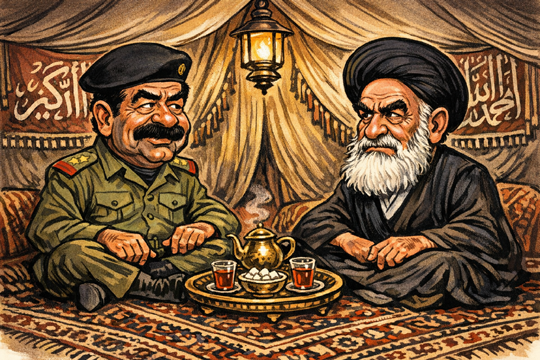
The United States’ war against Saddam Hussein’s Iraq in 2003 is one of the most extensively documented modern military campaigns. It involved a full-scale invasion, the deployment of hundreds of thousands of troops, thousands of aircraft, and a carefully orchestrated combination of air, land, and naval operations. The hypothetical or potential war with Iran, frequently discussed in strategic circles over the last two decades, would differ dramatically in scale, geography, weapons systems, and political consequences.
A comparison between the Iraq war and a potential Iran war is therefore not merely an exercise in historical reflection. It is a strategic analysis that reveals how the nature of warfare has evolved. Iraq was a weakened state emerging from sanctions and the aftermath of earlier wars, while Iran is a larger country with a stronger indigenous defense industry, asymmetric capabilities, and regional proxies.
To understand the difference, one must examine the conflicts step by step—beginning with political triggers, then moving through mobilization, deployment, weapons systems used, battlefield tactics, and eventual outcomes.
Political triggers and strategic objectives
The Iraq war of 2003 began with a clear political decision by the United States under President George W. Bush to remove Saddam Hussein from power. The official justification was that Iraq possessed weapons of mass destruction and posed a threat to international security. When diplomatic efforts collapsed, the United States issued Saddam Hussein an ultimatum to leave the country. He refused, and the invasion began on 20 March 2003.
The strategic objectives were straightforward:
- Destroy Iraq’s military capability.
- Capture Baghdad.
- Remove Saddam Hussein from power.
- Establish a new political order aligned with Western interests.
The potential conflict with Iran would likely arise from very different triggers. The most probable causes discussed by analysts include:
- Iran’s nuclear program
- Closure or threat to the Strait of Hormuz
- attacks by Iranian proxies
- direct confrontation with U.S. forces or allies in the region
Unlike Iraq, the goal of a war with Iran would probably not be a full occupation. Iran’s size and population make such an operation extremely difficult. Instead, the objectives would likely be limited:
- destruction of nuclear facilities
- crippling of military infrastructure
- deterrence through overwhelming force
Thus the political goals already diverge sharply between the two cases.
Geographic and demographic comparison
The military planning of any war begins with geography.
Iraq (2003)
- Population: about 25 million
- Area: 438,000 square kilometers
- Terrain: largely desert plains
- Strategic depth: limited
Iran (present)
- Population: about 85 million
- Area: 1.6 million square kilometers
- Terrain: mountains, deserts, urban centers
- Strategic depth: large
Iran is almost four times larger than Iraq geographically and more than three times larger in population. The mountainous terrain alone would make a ground invasion far more difficult.
Iraq’s desert terrain allowed armored formations and mechanized forces to move quickly toward Baghdad. Iran’s mountainous terrain favors defensive warfare, guerrilla tactics, and missile deployment.
This difference alone changes the nature of military planning.
Troop deployment
Iraq war troop deployment
The invasion of Iraq involved a massive coalition deployment.
Approximately 466,000 U.S. military personnel were mobilized for the invasion and early phases of the war.
The breakdown included:
- Ground forces: about 336,797 troops
- Air forces: about 64,246 personnel
- Naval forces: about 63,352 personnel
In addition to U.S. forces, coalition partners contributed troops:
- United Kingdom: about 50,000 troops
- Australia: about 2,000 troops
- Poland: several hundred special forces personnel
About 160,000 coalition troops entered Iraq during the initial invasion phase.
The Iraqi army itself had roughly 350,000 ground troops, including Republican Guard units and paramilitary forces.
Hypothetical troop deployment for a war with Iran
A war with Iran would almost certainly involve a different structure of deployment.
Strategic planners estimate several possibilities:
- Limited air campaign – fewer than 100,000 troops
- Regional containment war – 150,000–250,000 troops
- Full invasion – potentially more than 1 million troops
However, a full invasion is considered extremely unlikely. Occupying Iran would require more troops than the Iraq and Afghanistan wars combined.
Instead, the most realistic scenario involves:
- air and missile strikes
- naval operations in the Persian Gulf
- special forces raids
The United States would rely heavily on regional bases in Qatar, Bahrain, Kuwait, and the United Arab Emirates.
Air power and aircraft deployment
Aircraft used in the Iraq war
The Iraq war relied heavily on overwhelming air superiority.
Key aircraft included:
- F-15 Eagle
- F-16 Fighting Falcon
- F/A-18 Hornet
- B-1B Lancer bombers
- B-2 Spirit stealth bombers
- A-10 Thunderbolt II ground-attack aircraft
Thousands of sorties were flown during the initial invasion phase. Precision-guided munitions became a defining feature of the campaign.
The doctrine used was known as “shock and awe.”
This strategy aimed to paralyze Iraqi command structures through massive early bombardment.
Aircraft destroyed:
- air defense systems
- communication centers
- command bunkers
- military bases
Within days, Iraq’s air force ceased to function effectively.
Aircraft expected in a war with Iran
A war with Iran would depend even more on advanced air power.
Key aircraft would likely include:
- F-35 stealth fighters
- F-22 Raptor air superiority fighters
- B-2 Spirit stealth bombers
- B-52 strategic bombers
- carrier-based F/A-18 aircraft
In addition, drones would play a major role:
- MQ-9 Reaper drones
- stealth reconnaissance drones
- electronic warfare aircraft
Unlike Iraq, Iran possesses a more complex air defense network and significant missile capabilities. Suppressing these systems would be a major priority.
Naval forces and maritime warfare
Naval operations in the Iraq war
During the Iraq war, the U.S. Navy deployed aircraft carrier strike groups in the Persian Gulf and the Mediterranean.
These naval forces provided:
- cruise missile strikes
- air support
- logistical support
Tomahawk cruise missiles were fired from ships and submarines to destroy Iraqi command centers and radar installations.
The Iraqi navy was relatively weak and posed little threat.
Naval warfare in a conflict with Iran
Naval warfare would be far more significant in a conflict with Iran.
Iran has invested heavily in asymmetric naval warfare, including:
- fast attack boats
- anti-ship missiles
- naval mines
- coastal missile batteries
The strategic focus would be the Strait of Hormuz, through which a significant percentage of the world’s oil supply passes.
Iran could attempt to disrupt shipping using mines and missile strikes.
The U.S. response would involve:
- mine-clearing operations
- carrier strike groups
- submarine warfare
Thus the maritime dimension would be far more intense than in Iraq.
Missile warfare and long-range strikes
Iraq in 2003 had limited missile capability.
Although Saddam Hussein possessed Scud missiles during earlier conflicts, his missile forces were largely degraded by sanctions and inspections.
Iran, by contrast, has developed one of the largest missile arsenals in the Middle East.
Iranian missiles include:
- Shahab-3 ballistic missiles
- Sejjil medium-range missiles
- cruise missiles
These weapons could target:
- U.S. bases in the Gulf
- Israeli territory
- oil infrastructure
Therefore missile warfare would play a far larger role in a conflict with Iran.
Ground invasion and armored warfare
Iraq ground campaign
The ground invasion of Iraq began simultaneously with the air campaign.
Major formations included:
- U.S. Army 3rd Infantry Division
- U.S. Marine Expeditionary Force
- British armored units
Armored vehicles included:
- M1A1 Abrams tanks
- Bradley fighting vehicles
- Challenger 2 tanks (UK)
Coalition forces advanced rapidly from Kuwait toward Baghdad.
Within three weeks, Baghdad fell and Saddam Hussein’s government collapsed.
The speed of the advance surprised many analysts.
Ground warfare in Iran
A ground invasion of Iran would be vastly more complicated.
Iran’s defense strategy emphasizes:
- mountain defense
- guerrilla warfare
- decentralized command
Iran’s Revolutionary Guard Corps (IRGC) is trained in asymmetric warfare.
Urban combat in cities like Tehran, Isfahan, and Mashhad would be extremely difficult.
Thus the United States would likely avoid a full-scale invasion unless absolutely necessary.
Weapons and technology used
Weapons in the Iraq war
Key weapons included:
- Tomahawk cruise missiles
- JDAM precision bombs
- cluster munitions
- armored tanks and artillery
Precision-guided weapons became central to the campaign.
Advanced satellite navigation allowed bombs to hit targets with unprecedented accuracy.
Weapons likely in a war with Iran
Modern warfare has evolved significantly since 2003.
A war with Iran would include:
- cyber warfare
- hypersonic weapons
- drone swarms
- electronic warfare
Cyber attacks could target:
- power grids
- communications networks
- banking systems
Thus the battlefield would extend beyond traditional military domains.
Casualties and human cost
The Iraq war caused enormous casualties.
American forces suffered about 4,500 deaths and more than 32,000 wounded during the conflict.
Civilian casualties were far higher.
Some estimates suggest hundreds of thousands of civilian deaths over the course of the war.
In the first four weeks alone, between 11,000 and 15,000 Iraqis were killed.
A war with Iran could produce even higher casualties due to:
- larger population
- missile warfare
- regional escalation
Neighboring countries might also become involved.
Political outcomes
Iraq war results
The immediate result of the Iraq war was the overthrow of Saddam Hussein.
However, the aftermath proved far more complicated.
The war produced:
- insurgency
- sectarian conflict
- emergence of ISIS
The United States withdrew its forces in 2011 after nearly a decade of occupation.
The political stability that planners expected did not materialize.
Possible outcomes of an Iran war
The outcomes of a war with Iran would be highly uncertain.
Possible scenarios include:
- Destruction of nuclear facilities but survival of the regime
- Regional war involving Israel and Gulf states
- Closure of the Strait of Hormuz and global economic crisis
Because Iran has a strong national identity and significant military capacity, regime collapse is far less certain than in Iraq.
Strategic lessons
The comparison between Iraq and Iran reveals several key lessons.
First, technological superiority does not guarantee political success.
The United States won the military phase of the Iraq war rapidly but struggled to stabilize the country afterward.
Second, geography and population matter enormously.
Iran’s size and terrain make it far harder to defeat through conventional invasion.
Third, modern warfare increasingly involves multiple domains:
- air
- sea
- land
- cyber
- space
Future conflicts will combine these dimensions simultaneously.
Superimposing the two wars
The Iraq war was a conventional invasion aimed at regime change, conducted with overwhelming air power and large ground forces. Within weeks, Saddam Hussein’s government collapsed and coalition forces occupied Baghdad.
A war with Iran would be fundamentally different. Iran’s larger geography, stronger military, missile capabilities, and regional alliances would make it a far more complex and dangerous conflict.
While the Iraq war demonstrated the extraordinary military power of the United States, it also revealed the limits of that power when confronted with political and social realities on the ground.
Any future confrontation with Iran would likely avoid the mistakes of the Iraq invasion. Instead of a massive ground campaign, it would rely on precision strikes, naval control, cyber warfare, and regional alliances.
Yet even with these advantages, the risks would be enormous. A conflict with Iran could reshape the Middle East, disrupt global energy markets, and create consequences far beyond those witnessed during the Iraq war.