
How do tour operators and HORECA establishments maintain quality in India? Do they follow systems and processes or do they just ride the wave and survive? What insights does data provide?
Meetings, Incentives, Conferences and Exhibitions (MICE) are back—and they matter far more than just event-venue bookings. Globally the market has rebounded strongly from the pandemic slump and entered a sustained growth phase; in India, MICE is emerging as a high-value engine for hotels, restaurants, transport, destination management companies (DMCs) and an enormous ecosystem of small service providers. This article maps the current scale and growth of the MICE and HoReCa sectors, explains how revenue flows through India’s tour-operator and hospitality supply chains, describes legitimacy and informality challenges, names reputable Indian and global players, summarises useful global innovations to borrow, assesses infrastructure and legal support in India (what’s missing and why), and gives practical recommendations for Indian companies that want to capture the opportunity.
Market size and growth — global and India
The global MICE market is large and growing: recent industry estimates place the global MICE market near USD 870–925 billion in the mid-2020s, with projected expansion toward ~USD 1.3–1.5 trillion by 2030, implying a multi-percent CAGR (analysts range between ~7–9% depending on timeframe and scope). These numbers reflect recovery in corporate travel, a surge in exhibitions and trade shows, and increasing demand for hybrid formats and international association meetings. Grand View Research+1
India’s MICE market figures vary by source (a function of definitions and coverage), but the consensus is that India is a fast-growing market within Asia. One market study estimated the India MICE market at USD 110.3 billion in 2024, with a forecast to reach USD 183.1 billion by 2033 (CAGR c.5.2%); another reputable dataset estimated India MICE revenue at about USD 49.4 billion in 2024 with a higher projected CAGR (~13.2% to 2030). The variance stems from whether the reports include linked travel, broader corporate travel and exhibition supply-chain revenues. Either way, India’s MICE opportunity is material and expanding. IMARC Group+1
At the same time, India’s HoReCa (Hotels, Restaurants, Cafés) sector is large and modernising: market research houses put the India HoReCa market in the hundreds of billions of USD regionally (estimates near USD 250 billion+ for 2024 in some reports), with multi-year CAGR in the mid-single digits to low-double digits depending on segments (full-service hotels, organised restaurants, cloud kitchens, etc.). That makes the hospitality sector an essential conduit for MICE spend. Market Research Future+1
How MICE spend flows into tour operators and HoReCa
MICE events are high-spend, high-margin and concentrated in short time windows—perfect for turbo-charging occupancy, F&B sales and ancillary services:
- Hotels and venues. Large conferences and exhibitions generate bulk room nights, group dining blocks and banquet business that lift occupancy and average daily rate (ADR) across urban centres. Premium MICE weeks often sustain full hotels and premium banquet revenues in secondary cities that otherwise see lower weekday demand. (See national MICE revenue estimates and hotel chain reporting.) Grand View Research+1
- Tour operators / DMCs. Incentive programmes and corporate group travel are usually designed and delivered by tour operators or DMCs that package transfers, local experiences, niche activities and group logistics. These players capture margins on transport, curated experiences (culinary, cultural, adventure) and onsite handling.
- F&B and allied vendors. Exhibitions and meetings place large F&B orders, create demand for on-demand catering, hire local transport fleets, and require AV/production vendors—providing steady short-term work to MSMEs and suppliers in the HoReCa supply chain.
- Exhibitor service ecosystem. Stand fabrication, graphics, logistics, storage and freight for trade fairs are recurring revenue streams that keep local logistics players and skilled temporary labour busy year-round.
Because per-attendee MICE spend is multiples of leisure spend, even modest growth in event numbers or average spend per attendee translates into outsized incremental revenue for tour operators and hospitality providers.
Formal vs informal: registration, taxes and leakages
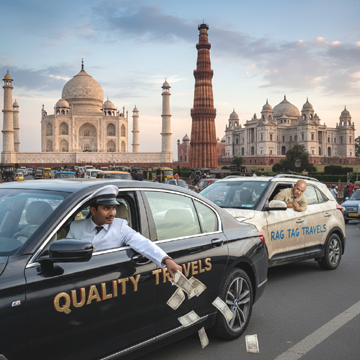
A major structural feature of India’s tourism and HoReCa economy is informality. Industry reporting based on government and survey sources indicates a very high share of informal workers in tourism and hospitality—one widely cited press summary put the informal employment share in Indian tourism at ~84%, concentrated among drivers, small restaurant staff, guides and temporary exhibition workers. This matters because cash-based, unregistered activity leads to tax leakage, variable service standards and vulnerability for workers. Deccan Chronicle+1
On the “legitimate” side, the Ministry of Tourism runs the NIDHI (National Integrated Database of Hospitality Industry) portal and a recognition scheme for travel agents, tour operators, transport operators and hospitality units. Thousands of operators are registered on NIDHI and related state directories—this is a baseline for compliant suppliers—yet registration is voluntary and does not capture the long tail of micro-operators that operate off-books. Strengthening incentives for registration and linking it to procurement and payment systems is therefore essential to convert informal value into traceable, taxable business. NIDHI+1
Practical implication: Large organisers, multinational exhibitors and corporate travel buyers mostly work with registered, GST-compliant hotels and vendors; the risk of poor quality or compliance arises when organisers subcontract work into cash-heavy, informal supply chains. Tackling this leakage requires a combination of procurement discipline (insist on GST invoices), digital payments and capacity building in the micro-supplier base.
Reputable Indian players and global leaders
Hotel groups and HoReCa operators: Taj Hotels (Indian Hotels Co. Ltd), Oberoi, ITC Hotels, Lemon Tree, Taj and major international flags operating in India (Marriott, Hyatt, Accor) are commonly chosen for MICE because of service standards, certified meeting spaces and corporate procurement acceptance. These brands also invest in MICE-ready inventory and sustainability practices. IMARC Group+1
Exhibition organisers: India hosts strong local and multinational organisers—Reed Exhibitions India (RX), Informa Markets, Messe Frankfurt India—who bring international show formats and buyer networks to Indian trade fairs. These organisers raise the quality bar for exhibitors and attract foreign buyers. rxglobal.com+2in.messefrankfurt.com+2
Tour operators / DMCs: A mixture of pan-India brands and regional specialist DMCs deliver incentive programmes and group handling; many reputable companies are listed on the Ministry’s NIDHI directory and on industry platforms. NIDHI+1
Global leaders and why they lead
- Reed Exhibitions / RX and Informa Markets. Scale, vertical portfolios, data and exhibitor services give them strong market positions globally and improved buyer-seller matchmaking. rxglobal.com+1
- MCI Group, CWT Meetings & Events, Maritz, Freeman. These meeting and incentive specialists succeeded by building end-to-end logistics capabilities, technology for registration and analytics, and multinational corporate relationships—allowing them to underwrite complex, multi-market programmes. Maritz+1
What made these leaders reach the top: capital to underwrite large events, technology stacks (registration, apps, analytics), global sales teams and the ability to standardise quality across markets.
Global trends that India should scale up
- Hybrid & micro-session models. Mixing scaled-down in-person attendance with high-quality virtual streams, plus satellite micro-events, extends reach and reduces travel carbon footprints—while retaining sponsorship value. Grand View Research
- Sustainable / green events. Carbon-lite logistics, certification of venues, eliminating single-use plastics and local sourcing of F&B are procurement filters increasingly demanded by MNC buyers.
- Data-driven ROI & personalization. AI-enabled matchmaking (attendee → exhibitor), lead-scoring dashboards, and post-event analytics turn subjective value into measurable ROI—critical for exhibitor renewals.
- Experience-driven incentives. Incentive travel that uses authentic local culture, food and community-based experiences commands premium pricing and multiple cross-sell opportunities for tour operators.
- Vertical digital marketplaces. Platforms that aggregate suppliers (stand builders, AV, transport) reduce friction and formalise formerly cash-heavy subcontracts.
India already shows pilots of many of these trends; scaling will require investment in technology, green credentials and training.
Infrastructure, laws and policy support
NIDHI provides a national registry for tourism enterprises—a positive step for visibility and formalisation. The Ministry of Tourism and state governments run event promotion programmes and incentives for conventions (MICE offices in states, convention bureaus). GST, regulatory frameworks and safety guidelines apply to hospitality and travel businesses. NIDHI+1
Gaps and challenges
- Venue capacity and last-mile infrastructure. While metros (Delhi, Mumbai, Bengaluru, Hyderabad, Chennai) have modern convention centres and international hotels, many tier-2 and tier-3 cities lack world-class MICE venues, integrated transport (airport-city links) and clustering of hotels near venues. This limits distribution of MICE economic benefits across regions.
- Fragmented supplier compliance. A long tail of micro-suppliers remains unregistered or under-documented, complicating procurement and risk management for large organisers. The voluntary nature of recognition (NIDHI) limits rapid formalisation.
- Workforce skill gaps. Event-management skills, specialised AV and production crews, and formal training in sustainable event operations are in short supply relative to the scale of demand—pushing organisers to rely on informal labour.
- Tax and payment friction. Cash payments and barter arrangements in parts of the supply chain reduce traceability. Mandating GST compliance for major event suppliers and integrating digital payment requirements into procurement can help.
- Limited standardized certifications. While some global green-certification standards exist, their India adoption is uneven; more venue-level certification and publicly visible sustainability credentials would boost multinational buyer confidence.
Why these gaps persist: Structural reasons include the predominance of MSMEs in the supply chain (small suppliers find compliance costs burdensome), fragmented state-level ecosystems, skills shortages, and historically uneven public investment in convention infrastructure outside major metros.
Recommendations for Indian companies
- Formalise and insist on traceable procurement. Hotels, DMCs and exhibition organisers should require GST invoices and digital payments from subcontractors; bundle compliance into vendor contracts and make it a precondition for participation.
- Productise scalable incentive packages. DMCs and tour operators should build repeatable, branded incentive products that can be sold as turnkey packages to corporate buyers—documented itineraries, insurance, sustainability notes and backup plans.
- Invest in event-tech and data. Even mid-sized organisers should acquire registration platforms, mobile apps and exhibitor ROI dashboards to demonstrate measurable outcomes to buyers and sponsors.
- Upskill the workforce. Partner with hospitality institutes, local governments and international associations to create certificate programmes for event operations, sustainable event management and AV production.
- Cluster micro-suppliers into compliant consortia. Industry chambers and large organisers should help micro-vendors form registered clusters (shared invoicing, pooled insurance and standard H&S training) so procurement can source compliant vendor bundles instead of relying on cash subcontracts.
- Green credentials as a differentiator. Early adoption of sustainable event practices—waste management, local F&B sourcing, offsetting—will help Indian venues win multinational events and premium corporate contracts.
- Advocate public-private investment in tier-2 infrastructure. Industry associations should push for convention centres near airports, improved city access and funding models (PPP) for regional MICE infrastructure to broaden geographic reach.
High-value employment generator
MICE is not just another tourism segment: it is high-value, repeatable and rich in linkages to hotels, F&B, transport and the wider tourism supply chain. India has the demand and a growing supply of high-quality hotels, exhibition organisers and DMCs—but to fully harvest the MICE dividend the country must shrink the informal tail, build venue and last-mile infrastructure outside the big metros, and upgrade digital and sustainability capabilities across suppliers. The companies that invest in compliance, productisation and technology—while partnering to professionalize micro-suppliers—will win the premium business and help convert India’s informal MICE economy into a traceable, tax-paying and globally competitive industry.
Selected sources IMARC – India MICE Market Size, 2024–2033. IMARC Group
Grand View Research – India MICE Market 2024–2030 (high-growth scenario). Grand View Research
Grand View Research / Mordor Intelligence – Global MICE market size and growth. Grand View Research+1
MarketResearchFuture / MRFR – India HoReCa market estimates. Market Research Future
Ministry of Tourism (NIDHI directory) and PIB notes on India MICE statistics. NIDHI+1
Press reporting on informality in India’s tourism labour force (summary reporting referencing ILO/data). Deccan Chronicle+1