
Continued erosion of Delhi’s ecological resilience by powerful local vested interests is the fundamental cause of the chronic public health catastrophe
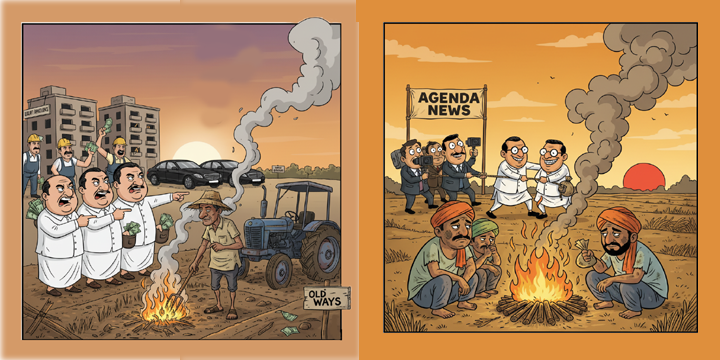
Delhi, the National Capital Territory (NCT), has transitioned from an urban area grappling with severe, localized pollution in the late 20th century to a metropolitan region facing a chronic, unprecedented air quality emergency in the 21st century. This exponential escalation, particularly since the mid-2000s, cannot be adequately explained by focusing solely on cyclical regional factors like crop residue burning (CRB). Analysis of long-term environmental data, hydrological patterns, and land-use dynamics reveals that the primary driver of this crisis is a structural, internal failure: the systematic decimation of Delhi’s natural ecological infrastructure, specifically the Aravalli mountain range and surrounding green belts. This destruction, fueled by unchecked real estate expansion and mining, has removed the city’s critical natural defense mechanisms, leading to increased atmospheric stagnation, accelerated desertification, and massive fugitive dust generation linked to severe groundwater depletion. While CRB contributes significantly during specific seasonal peaks, the continued erosion of Delhi’s ecological resilience by powerful local interests is the fundamental cause of the chronic public health catastrophe.
The Inflection Point—Documenting the Unprecedented Escalation (Post-2000)
1.1. Historical Precedence vs. Modern Chronic Crisis
Air pollution has been a recognized issue in Delhi for decades. In the 1980s, the issue of air and water quality began entering the Supreme Court’s agenda.1 By the 1990s, Delhi already ranked among the world’s worst urban environments for air quality, prompting efforts such as the relocation of several small and medium-sized industries.1 Evidence indicates that smog and harmful particles resulting from farmers burning crops in neighboring states have been a factor in the region since the 1980s.2 This history confirms that high levels of air pollution, along with the practice of stubble burning, were pre-existing conditions during the latter half of the 20th century.
The nature of the crisis, however, underwent a profound escalation after the mid-2000s. Prior to this period, high air pollution zones were typically confined to busy central and South Delhi areas. Following the mid-2000s, this “dirty air” began to spread geographically, impacting “even cleaner residential areas” 1, correlating directly with the explosive, poorly regulated expansion of the National Capital Region (NCR). The average concentration of fine particulate matter PM 2.5 across Delhi over a 15-year period (2007–2021) remained exceptionally high at 125 \pm 86 \mu g/m^3, ranging up to 985 \mu g/m^3.3 During severe episodes, such as the “Great Smog of Delhi” in November 2016, PM2.5 and PM10 levels spiked far beyond acceptable limits, hitting 999 micrograms per cubic meter, vastly exceeding the stipulated 24-hour peak limits of 15 and 60 micrograms per cubic meter, respectively.2 This chronic severity defines the modern crisis as one of unprecedented scope compared to earlier decades.
1.2. Health and Ecological Impact Metrics
The consequences of this sustained, high level of PM2.5 exposure are profound and widespread. PM2.5 particles, which are roughly 30 times smaller than a human hair and originate from sources including construction dust, vehicle exhaust, and industrial emissions, penetrate deep into the human body, affecting multiple organ systems and entering the bloodstream.4 Research conducted by institutions including IIT Delhi revealed alarming connections between exposure to high PM2.5 levels and adverse pregnancy outcomes. Pregnant women exposed to this toxicity face a 70% higher risk of premature delivery, and the risk of low birth weight increases by 40%.4 Data from the National Family Health Survey (NFHS-5) indicates that 13% of babies in India were born prematurely between 2019 and 2021, a figure experts attribute partly to the toxic air.4 Globally, air pollution is responsible for nearly 4.2 million premature deaths annually, with India alone attributing approximately 600,000 deaths to this environmental factor.5 The pervasive spread of chronic pollution across the region, indicated by the contamination of formerly clean areas, signifies a breakdown in the city’s ability to disperse pollutants, leading to a profound, measurable burden on public health.
Discounting the Stubble Burning False Narrative
2.1. Stubble Burning: A Pre-Existing Condition Used as a Scapegoat
The narrative attributing Delhi’s pollution solely or primarily to crop residue burning (CRB) relies on a selective interpretation of environmental data. Farmers in Punjab and Haryana have been setting fire to paddy straw since at least the late 1980s.6 This establishes CRB as a perennial, recurring factor, not a novel driver of the chronic, unprecedented escalation seen in the 21st century.
The intense public focus on CRB serves a distinct political purpose. Targeting the remote agricultural practices of farmers allows local municipal and state authorities to deflect responsibility away from highly profitable, politically connected, and proximate sources of pollution within the urban agglomeration, such as construction dust, vehicular emissions, and industrial discharges.7 The difficulties inherent in arresting or prosecuting millions of distant farmers ensures that this problem can be perpetually debated without requiring structural changes in local governance or enforcement.
2.2. The Policy-Induced Shift in Burning Intensity
Although CRB is historically prevalent, its impact has been inadvertently amplified by state policy aimed at water conservation. In 2009, the “Sub-soil Water Preservation Act” was implemented in Punjab, delaying the transplantation and sowing of paddy to preserve groundwater. While intended to mitigate depletion (a process that itself remains severe, with groundwater storage depleting at 29.2 mm yr^{-1 8), the policy compressed the harvest window. This shift delayed the peak burning period for paddy stubble, pushing it further into November.6
This temporal shift proved ecologically detrimental. Post-2010, there was a 21% increase in paddy CRB fires over Punjab and Haryana.8 Crucially, the delayed timing now coincides directly with the onset of the most unfavorable meteorological conditions in the Delhi basin: low wind speeds, low Planetary Boundary Layer Height (PBLH), and temperature inversions.3 These conditions trap pollutants near the surface, dramatically reducing atmospheric dispersion. The increased frequency of CRB fires now occurs precisely when the atmosphere is least capable of clearing the smog, resulting in a disproportionately higher impact on Delhi’s air quality and intensifying the seasonal crisis.8 The attempt to conserve one resource (groundwater) directly exacerbated another crisis (air quality) by poorly aligning emission timing with meteorological stability.
2.3. Quantitative Contribution and Localization
Source apportionment studies provide clarity regarding CRB’s true contribution. Modeling frameworks suggest that the maximum daily mean contribution of CRB to air pollution in Delhi during the peak months of October and November is typically around 30–35%.10 This confirms CRB as a significant seasonal factor.
However, international research utilizing air mass trajectories and advanced monitoring has suggested that CRB holds a “relatively lower contribution than previously thought to the Delhi National Capital Region (NCR)” core, especially when compared to its overwhelming impact in the rural and semi-urban source regions of Punjab and Haryana.11 When compared to year-round local sources, CRB’s influence is time-bound. Source inventories covering Delhi’s airshed indicate that vehicle exhaust, road and construction dust, and industries consistently account for the majority of the continuous PM2.5 load.12 Thus, while controlling CRB is necessary, the obsession with this factor serves to distract from the larger, structural, and year-round mechanisms operating within the NCR itself.
Aravalli — Destruction of Delhi’s Green Wall
3.1. The Ecological Function of the Aravalli Range
The Aravalli mountain range is recognized as the essential ecological lifeline for Delhi and the greater NCR. Functioning as a critical natural defense, the Aravallis regulate the region’s climate. They are instrumental in guiding monsoon clouds eastwards, nurturing the sub-Himalayan rivers, and, crucially, protecting the fertile alluvial river valleys (including the Gangetic and para-Indus) from the assault of cold westerly winds originating in Central Asia during the winter months.13 Furthermore, the range is fundamental to local hydrology, facilitating crucial groundwater recharge.14
3.2. Quantitative Evidence of Decimation by Real Estate
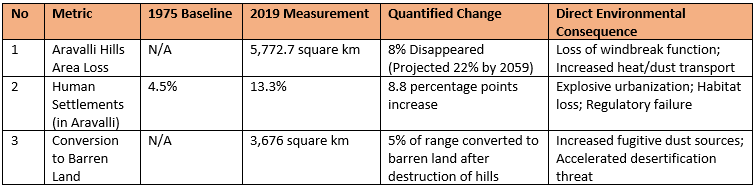
The capacity of the Aravallis to perform these vital ecosystem services has been catastrophically compromised by illegal mining, encroachment, and explosive urbanization.14 Satellite imagery and land-use analysis from 1975 to 2019 confirm that approximately 8% (5,772.7 square kilometers) of the Aravalli hills have physically disappeared.16 This systematic flattening is directly attributable to the demands of the real estate sector. The observed conversion of land use reveals startling metrics: human settlements within the range increased from 4.5% in 1975 to 13.3% in 2019.16 Even more critically for dust generation, approximately 5% (3,676 square kilometers) of the hills were flattened and converted into barren land, providing vast new exposed areas susceptible to wind erosion.17 Should this rate of “explosive” urbanization and unchecked mining continue, researchers project the total loss of the Aravalli area will rise to approximately 22% by 2059.17
The following table summarizes the documented ecological degradation of this vital natural infrastructure:
Ecological Degradation of the Aravalli Range and Impact on NCR (1975–2019)
3.3. The Desertification and Dust Gateway
The physical destruction of the Aravalli hills has removed Delhi’s natural barrier against the Thar Desert. Research confirms that the destruction has opened a “gateway,” enabling the desert to expand towards the NCR.16 This alteration results in a permanently “more dusty and arid landscape,” directly contributing large quantities of long-range fugitive dust to the city.17
Furthermore, the construction industry actively feeds this cycle. The mountain range is rich in minerals such as silica sand, gravel, and rose-coloured quartz.14 Illegal quarrying and mining operations, often involving the extraction of construction materials, generate significant Respirable Particulate Matter (RPM), contributing substantially to regional air pollution.16 The destruction of the Aravallis thus has a triple negative effect: it generates the raw material for air pollution (dust/gravel), it creates barren land susceptible to desertification (increasing long-range dust), and it removes the natural topographical structure necessary to modulate climate and air flow.
The Local Pollution Machine—Real Estate, Dust, and Water Depletion
4.1. The Continuous Urban Dust Factory
Within Delhi, the continuous pace of construction and demolition (C&D) activities establishes a persistent, year-round pollution source. Source apportionment studies highlight the significant influence of construction and road dust.5 While the share of dust influence reduces in the winter months (ranging from 6–15%), it constitutes a major burden during the summer, where it accounts for up to 31–34% of the pollution load.19
The elemental composition of PM2.5 particles provides further confirmation of this source. Scientists analyzing the particulate matter frequently record the abundance of crustal elements such as Aluminum (Al), Iron (Fe), Titanium (Ti), and Calcium (Ca). These elements are explicitly attributed to mineral and soil dust originating from local sources, including construction sites, paved or unpaved roads, and the exposure of degraded land.20 The severity of C&D dust is acknowledged by regulatory measures, as evidenced by the mandatory imposition of bans on non-essential construction work when the city’s air quality deteriorates to the ‘Severe’ category under the Graded Response Action Plan (GRAP Stage 3).21
4.2. Groundwater Depletion: The Mechanism of Fugitive Dust Generation
A critical, often overlooked mechanism connecting real estate development to air pollution involves the regional hydrogeological crisis. Rapid urbanization has led to immense water demand, causing groundwater levels in Delhi to decline steadily. Analysis of groundwater data from 2001 to 2020 projects a catastrophic drop in groundwater levels, potentially falling from 13.22 meters in 2021 to 33.33 meters by 2040.22
This depletion exacerbates pollution by increasing the availability of fugitive dust. Water is essential to keep surface soil moist, stable, and less susceptible to aerosolization. When the water table drops significantly, the land surface dries out. This dry, disturbed soil, whether from construction sites, illegal mining pits, or the newly created barren land in the degraded Aravallis 16, easily turns into airborne PM2.5 and PM10.20 Therefore, the act of construction and the urban demands it represents create a negative feedback loop: development requires water, leading to depletion; depletion dries the soil and exposed earth, generating massive amounts of dust; and this dust is inhaled by the population.
4.3. Urban Form and Atmospheric Stagnation
The rapid and dense urban construction not only generates pollution through dust but also impedes the natural ventilation of the city. Delhi’s topography is already predisposed to accumulating smog, often described as a “semi-enclosed basin” where pollutants are trapped, particularly during winter temperature inversions that prevent vertical mixing.9
The widespread, vertical proliferation of high-rise buildings and settlements in the NCR, fueled by real estate demand 23, serves as a physical barrier. These dense structures obstruct cross-ventilation and the free flow of fresh air, exacerbating the natural tendency for smog to pool and stagnate near the surface. This effect modifies the local microclimate, effectively trapping the generated pollutants (from vehicles, industry, and construction dust) and preventing their dispersion, turning the region into a bowl of highly concentrated toxic air.
The Political Economy of Air Quality—Regulatory Capture and Deflection
5.1. The Nexus of Builders and Politicians
The central tenet that pollution is exacerbated by a political-economic alliance benefiting from construction is strongly supported by the persistent failure of environmental regulation. The continuous construction boom generates massive wealth, supporting the local and state economy, and simultaneously feeds political funds.24 This profitability incentivizes the sustained destruction of natural assets like the Aravallis.
Illegal mining operations extract resources vital for this construction industry, such as gravel, rock phosphate, and “Badarpur sand”.14 The operation of the mining mafia and developers in the Aravalli range continues despite explicit bans imposed by the apex court.16 This flagrant and long-term violation of the law demonstrates a structural indifference, suggesting a widespread contempt for environmental regulation that is enabled by the immense financial rewards inherent in unchecked development.17
5.2. Regulatory Failure and Non-Enforcement
The long-running legal battle over the protection of the Delhi Ridge—an integral part of the Aravalli system—exemplifies this regulatory capture. Despite the Delhi Development Authority declaring the Ridge a ‘Reserve Forest’ in 1994, unauthorized construction, encroachment, and illegal mining continued, necessitating Public Interest Litigation in 2015.15 The consistent failure to enforce these judicial and regulatory protections highlights that the economic interests served by development often supersede the imperative of environmental conservation and public health.
The disproportionate focus on CRB further confirms this political dynamic. The seasonal bans on construction under GRAP 21 are temporary measures that offer high visibility but do not halt the permanent ecological damage underway in the Aravallis or address the fundamental issue of groundwater depletion. The relentless pursuit of growth by the real estate-mining nexus, even in defiance of Supreme Court orders, proves that powerful local polluters maintain effective immunity, directing public scrutiny toward diffuse, geographically removed sources.
Path Forward—Rebuilding the Ecological Resilience
6.1. Synthesis of Causality
The data unequivocally demonstrates that Delhi’s unprecedented 21st century air pollution crisis is rooted in a fundamental, systemic failure of urban governance that prioritizes immediate real estate profit over ecological and hydrological sustainability. While crop residue burning remains a crucial seasonal exacerbator, the primary mechanisms driving chronic, city-wide hazardous air quality are internal and structural:
- Ecological Decimation: The quantified 8% destruction of the Aravalli range has removed Delhi’s vital natural barrier, facilitating desertification and increasing the inflow of dust and arid air, while simultaneously supporting environmentally destructive mining.16
- Hydrological Collapse: Unchecked urbanization and groundwater extraction have lowered the water table dramatically, resulting in dry, susceptible soil that easily becomes aerosolized fugitive dust.20
- Atmospheric Stagnation: The proliferation of dense, high-rise developments physically obstructs ventilation, compounding the city’s natural topographical disadvantage and trapping pollutants near the surface.9
The structural profitability of the construction-mining nexus and the resultant failure to enforce environmental laws represent a clear case of regulatory capture. This explains why the focus remains disproportionately on external factors like stubble burning, thereby avoiding accountability for the chronic and persistent local pollution drivers.
6.2. Policy Recommendations for Structural Change
Addressing the pollution emergency requires a radical shift from reactive, seasonal controls (like GRAP Stage 3 restrictions on vehicles and intermittent construction bans 21) to structural, ecological restoration and robust enforcement against local polluters.
- Mandatory Ecological Restoration: Immediate and permanent enforcement of all existing legal protections for the Aravalli range and the Delhi Ridge is required.15 This must be complemented by ambitious, nature-based solutions (NBS) such as the proposed 1,400 kilometer long and 5 kilometer wide Green Wall of Aravalli.13 This project must focus on planting 1.35 billion native trees to restore degraded land, acting as a permanent buffer against the Thar Desert and pollution.
- Groundwater Stabilization and Dust Control: Given the clear link between water depletion and fugitive dust, urgent policy interventions are necessary to restore aquifers. These include rationing power supply for extraction, mandatory metering of groundwater usage, and funding artificial recharge projects to stabilize soil moisture and mitigate dust generation.26
- Governance Reform against Regulatory Capture: Institutionalizing robust judicial and independent oversight is critical to counteract the documented failure to enforce laws against the profitable real estate and mining sectors.15 This includes ensuring that penalties levied on high-volume, continuous local polluters are commensurate with the economic and health burden they impose on the population.
Works cited
- Timeline of pollution in Delhi – Timelines, accessed on November 11, 2025, https://timelines.issarice.com/wiki/Timeline_of_pollution_in_Delhi
- Air pollution in Delhi – Wikipedia, accessed on November 11, 2025, https://en.wikipedia.org/wiki/Air_pollution_in_Delhi
- Trends and Variability of PM2.5 at Different Time Scales over Delhi: Long-term Analysis 2007–2021 – Aerosol and Air Quality Research, accessed on November 11, 2025, https://aaqr.org/articles/aaqr-22-04-ssea-0191.pdf
- How Delhi’s toxic air is putting pregnant women and their babies at high risk, accessed on November 11, 2025, https://www.indiatoday.in/health/story/how-delhi-toxic-air-pollution-is-putting-pregnant-women-and-their-babies-at-high-risk-2813728-2025-11-05
- New study shows dominance of local air pollution sources in Delhi | University of Surrey, accessed on November 11, 2025, https://www.surrey.ac.uk/news/new-study-shows-dominance-local-air-pollution-sources-delhi
- STUBBLE BURNING IN NORTH INDIA: DEFOGGING THE FACTS, accessed on November 11, 2025, https://sprf.in/wp-content/uploads/2024/12/Stubble-Burning-in-North-India.-Defogging-the-Facts.pdf
- Decadal Analysis of Delhi’s Air Pollution Crisis: Unraveling the Contributors – arXiv, accessed on November 11, 2025, https://arxiv.org/html/2506.24087v1
- Long term influence of groundwater preservation policy on stubble burning and air pollution over North-West India – PMC, accessed on November 11, 2025, https://pmc.ncbi.nlm.nih.gov/articles/PMC8825838/
- Air Pollution in a Bowl- Understanding Delhi’s Topographical Disadvantage, accessed on November 11, 2025, https://www.vajiraoinstitute.com/upsc-ias-current-affairs/air-pollution-in-a-bowl-understanding-delhis-topographical-disadvantage.aspx
- Stubble-burning activities in north-western India in 2021: Contribution to air pollution in Delhi – PubMed Central, accessed on November 11, 2025, https://pmc.ncbi.nlm.nih.gov/articles/PMC10275965/
- High PM2.5 Levels in Delhi-NCR Largely Independent of Punjab-Haryana Crop Fires – An Analysis of Observations Across a Network of 30 Sites | Research Institute for Humanity and Nature, accessed on November 11, 2025, https://www.chikyu.ac.jp/rihn_e/news/detail/547/
- What Is Polluting Delhi’s Air? A Review from 1990 to 2022 – Urban Emissions, accessed on November 11, 2025, https://urbanemissions.info/wp-content/uploads/docs/2023-02-MDPI-Sus-DelhiAQ-Review.pdf
- ARAVALLI – Ministry of Environment, Forest and Climate Change, accessed on November 11, 2025, https://moef.gov.in/storage/tender/COMPENDIUM_OF_DISTRICTS_IN_ARAVALLI_LANDSCAPE.pdf
- Plunder of the Aravallis risks lives in north India, accessed on November 11, 2025, https://india.mongabay.com/2018/11/plunder-of-the-aravallis-risks-lives-in-north-india/
- AN ANALYSIS OF THE DELHI RIDGE CASE, accessed on November 11, 2025, https://ijirl.com/wp-content/uploads/2023/11/AN-ANALYSIS-OF-THE-DELHI-RIDGE-CASE.pdf
- Critical Threats Facing the Aravallis – Drishti IAS, accessed on November 11, 2025, https://www.drishtiias.com/daily-updates/daily-news-analysis/critical-threats-facing-the-aravallis
- 8% of Aravali hills gone since 1975, 22% loss likely by 2059: Study | Gurgaon News, accessed on November 11, 2025, https://timesofindia.indiatimes.com/city/gurgaon/8-of-aravali-hills-gone-since-1975-22-loss-likely-by-2059-study/articleshow/101075306.cms
- Why Illegal Mining in the Aravalli Hills Should Scare Delhi and Its Neighbours, accessed on November 11, 2025, https://science.thewire.in/environment/why-illegal-mining-in-the-aravalli-hills-should-scare-delhi-and-its-neighbours/
- Inventory of major point air pollution sources in Delhi, accessed on November 11, 2025, https://www.dpcc.delhigovt.nic.in/uploads/news/ae9ce818bf8b9e12ddb90177ce3108c7.pdf
- Elemental Composition and Sources of Fine Particulate Matter (PM2.5) in Delhi, India – NIH, accessed on November 11, 2025, https://pmc.ncbi.nlm.nih.gov/articles/PMC9995727/
- Delhi Pollution: Centre invokes GRAP Stage 3 curbs in NCR. What is open and what is closed?, accessed on November 11, 2025, https://m.economictimes.com/news/india/delhi-pollution-centre-invokes-grap-stage-3-curbs-in-ncr-what-is-open-and-what-is-closed/articleshow/125239982.cms
- Predictions of Groundwater Variations Using Regression Analysis in Delhi – ssrg-journals, accessed on November 11, 2025, https://www.internationaljournalssrg.org/IJCE/paper-details?Id=728
- ENHANCING HEAT RESILIENCE OF AFFORDABLE HOUSING IN DELHI NCR THROUGH CROSS VENTILATION – Granthaalayah Publications and Printers, accessed on November 11, 2025, https://www.granthaalayahpublication.org/Arts-Journal/ShodhKosh/article/download/2253/2102/14492
- Delhi Industrial Policy (2025-2035) Department of Industries, accessed on November 11, 2025, https://industries.delhi.gov.in/sites/default/files/Industries/circulars-orders/draftpolicy.pdf
- Nature-Based Solutions for Delhi’s Pollution Crisis – Daily Pioneer, accessed on November 11, 2025, https://www.dailypioneer.com/2025/columnists/nature-based-solutions-for-delhi-s-pollution-crisis.html
Addressing Groundwater Depletion Crisis in India: Institutionalizing Rights and Technological Innovations – EAC-PM, accessed on November 11, 2025, https://eacpm.gov.in/wp-content/uploads/2024/05/Addressing_Groundwater_Depletion_in_India.pdf