
Expectations of monetary tightening signal that the Singapore government is not willing to allow inflation to erode economic stability. This dual approach, fiscal support combined with monetary discipline, has long been a hallmark of Singapore’s economic governance. It ensures that short-term relief does not come at the cost of long-term macroeconomic credibility
Singapore continues to demonstrate its characteristic blend of resilience, strategic foresight, and technocratic governance as it navigates a complex global environment marked by geopolitical tensions, inflationary pressures, and shifting supply chains. Over the past ten days, a series of policy announcements, infrastructure updates, and financial sector signals have reinforced the city-state’s position as one of the world’s most sophisticated economic and infrastructure ecosystems.
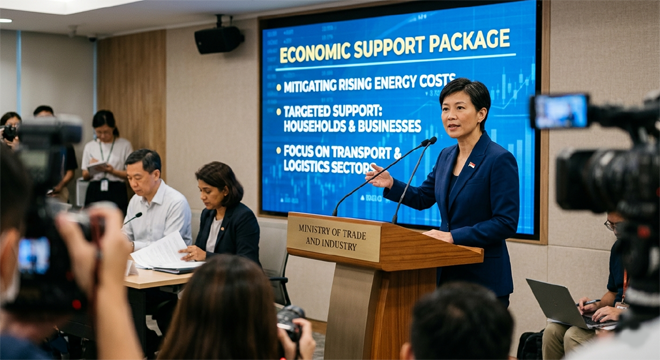
At the heart of recent developments is the government’s proactive response to rising global energy prices triggered by geopolitical tensions in the Middle East. Singapore, being heavily dependent on imports for energy and raw materials, remains particularly sensitive to such shocks. The announcement of a substantial economic support package reflects both urgency and prudence. Rather than waiting for economic dislocation to deepen, policymakers have moved swiftly to cushion households and businesses, especially those in transport and logistics, which form the backbone of Singapore’s trade-oriented economy.
Simultaneously, expectations of monetary tightening signal that the government is not willing to allow inflation to erode economic stability. This dual approach, fiscal support combined with monetary discipline, has long been a hallmark of Singapore’s economic governance. It ensures that short-term relief does not come at the cost of long-term macroeconomic credibility.
Beyond immediate economic management, Singapore’s infrastructure and engineering sectors continue to reflect long-term strategic planning. The steady rollout of construction projects, rail expansions, and smart infrastructure initiatives underscores a commitment to sustained growth. Even as some projects face delays due to engineering complexity, the overall pipeline remains robust, suggesting that Singapore is not retreating from its long-term development ambitions.
Fiscal intervention and monetary strategy in a high-inflation world
The recent announcement of a S$1 billion support package marks one of the most significant short-term interventions by the Singapore government in recent months. The package is designed to offset the impact of rising energy costs, which have cascading effects across industries. Fuel subsidies for transport workers, increased corporate tax rebates, and direct cash support for households are targeted measures that aim to stabilize both consumption and production.
Such interventions are particularly critical in Singapore’s context, where cost structures are highly sensitive to global price movements. Logistics, aviation, and shipping industries, all crucial to Singapore’s economic identity, are directly affected by fluctuations in fuel prices. By cushioning these sectors, the government is effectively safeguarding the broader economy.
At the same time, the anticipated tightening by the Monetary Authority of Singapore reflects a careful balancing act. Unlike many central banks that rely primarily on interest rate adjustments, Singapore uses its exchange rate as the primary monetary policy tool. By allowing the Singapore dollar to appreciate, policymakers can mitigate imported inflation without excessively dampening domestic economic activity.
This approach has several advantages. A stronger currency reduces the cost of imports, thereby directly addressing inflationary pressures. However, it also presents challenges for export-oriented industries, which may face reduced competitiveness in global markets. The fact that Singapore is willing to accept this trade-off indicates a prioritization of price stability and long-term economic credibility.
Together, fiscal and monetary measures illustrate a coordinated policy framework that is both responsive and forward-looking. This is particularly important in an era where global economic shocks are becoming more frequent and unpredictable.
Infrastructure development as a pillar of long-term growth
Infrastructure has always been central to Singapore’s development strategy, and recent updates reaffirm its continued importance. Despite global uncertainties, the city-state is maintaining a strong pipeline of construction and engineering projects. These range from urban redevelopment initiatives to large-scale coastal protection plans, each contributing to economic resilience and future capacity.
One of the most notable aspects of Singapore’s infrastructure strategy is its emphasis on integration. Rather than treating projects in isolation, planners are increasingly focusing on how different systems, transport, housing, utilities, and digital networks, can work together seamlessly. This holistic approach not only improves efficiency but also enhances the overall quality of urban life.
The ongoing development of new land parcels under the Government Land Sales programme is a case in point. By carefully managing land supply, Singapore ensures a steady flow of construction activity while also addressing housing demand. This has a stabilizing effect on both the real estate market and the broader economy.
In parallel, long-term projects such as coastal protection initiatives highlight Singapore’s commitment to sustainability and climate resilience. These projects are not merely defensive measures but are also seen as opportunities to create new economic and residential spaces. The integration of environmental considerations into infrastructure planning reflects a forward-looking mindset that anticipates future challenges.
Engineering complexity, however, remains a key challenge. Projects often involve working within densely built environments, requiring innovative construction techniques and meticulous planning. While this can lead to delays, it also drives advancements in engineering capabilities, further strengthening Singapore’s position as a leader in urban infrastructure development.
The rise of smart infrastructure and digital engineering
A defining feature of Singapore’s current infrastructure strategy is the increasing integration of digital technologies. The concept of “smart infrastructure” is no longer aspirational; it is becoming a practical reality across multiple sectors. Events such as Geo Connect Asia have highlighted the growing importance of geospatial technologies, artificial intelligence, and data analytics in infrastructure planning and execution.
Digital twins, virtual replicas of physical assets, are being used to simulate and optimize infrastructure systems. This allows planners to identify potential issues before they arise, reducing costs and improving efficiency. Similarly, the use of AI in construction is enabling more precise project management, from resource allocation to risk assessment.
These developments are part of a broader shift toward data-driven decision-making. In a city as densely populated as Singapore, even small improvements in efficiency can have significant impacts. By leveraging technology, Singapore is able to maximize the utility of its limited land and resources.
The implications for the engineering sector are profound. Traditional skills are being complemented by expertise in data science and digital systems. This is creating new opportunities for innovation while also requiring a rethinking of workforce development and training.
Moreover, the integration of digital technologies enhances Singapore’s attractiveness as an investment destination. Investors are increasingly looking for markets that offer not only physical infrastructure but also advanced digital capabilities. By positioning itself at the forefront of this trend, Singapore is strengthening its competitive advantage in the global economy.
Railways and MRT: Expansion amid complexity
Singapore’s rail network remains one of the most critical components of its infrastructure system. Recent developments highlight both progress and challenges in this sector. The expansion of the Mass Rapid Transit (MRT) network continues, with new lines and extensions aimed at improving connectivity and reducing congestion.
The Jurong Region Line is a key example. As Singapore’s seventh MRT line, it is designed to serve the western region, connecting residential areas with industrial and commercial hubs. However, the project has faced delays due to engineering complexities and the challenges of constructing elevated tracks in densely populated areas.
While delays are not uncommon in large infrastructure projects, they do have implications for cost and planning. Nevertheless, they also highlight the sophistication of Singapore’s engineering standards, which prioritize safety and long-term reliability over speed.
Another significant development is the transition toward integrated rail depots, exemplified by the East Coast Integrated Depot. This facility is designed to serve multiple MRT lines, optimizing land use and improving operational efficiency. Such innovations are crucial in a land-scarce environment, where every square meter must be utilized effectively.
Overall, the rail sector reflects a balance between ambition and pragmatism. While expansion is essential to meet growing demand, it must be carefully managed to ensure sustainability and reliability.
Roads, urban mobility, and last-mile connectivity
While railways form the backbone of Singapore’s public transport system, roads and urban mobility solutions play an equally important role. Recent developments indicate a continued focus on enhancing connectivity through both traditional and innovative means.
One of the key trends is the integration of pedestrian and cycling infrastructure into the broader transport network. This reflects a shift toward more sustainable and inclusive mobility solutions. By encouraging walking and cycling, Singapore aims to reduce congestion and improve public health, while also lowering its carbon footprint.
Infrastructure projects such as pedestrian-cycling links and road enhancements are designed to complement the MRT network, providing seamless last-mile connectivity. This integrated approach ensures that different modes of transport work together effectively, rather than competing with each other.
At the same time, Singapore continues to invest in smart traffic management systems. These systems use real-time data to optimize traffic flow, reduce congestion, and improve safety. The use of technology in road management is another example of Singapore’s commitment to innovation in infrastructure.
However, challenges remain. Balancing the needs of different road users, drivers, cyclists, and pedestrians, requires careful planning and coordination. Additionally, the increasing complexity of urban mobility systems necessitates continuous investment in both infrastructure and technology.
Despite these challenges, Singapore’s approach to urban mobility remains one of the most advanced in the world, combining efficiency, sustainability, and user-centric design.
Singapore as a regional infrastructure and financial hub
Beyond its domestic developments, Singapore continues to play a pivotal role as a regional hub for infrastructure financing and project development. Its well-developed financial system, transparent regulatory environment, and strategic location make it an attractive base for investors and developers.
In recent days, Singapore has hosted discussions and roadshows related to infrastructure financing, highlighting its role as a gateway for capital flows into Asia. This includes investments in railways, roads, and other critical infrastructure across the region.
The country’s ability to attract such activity is closely linked to the strength of its banking sector. Financial institutions in Singapore are not only well-capitalized but also highly innovative, offering a wide range of products and services tailored to infrastructure projects.
Moreover, Singapore’s emphasis on sustainability and green finance is further enhancing its appeal. Investors are increasingly looking for opportunities that align with environmental, social, and governance (ESG) criteria. By positioning itself as a leader in green finance, Singapore is tapping into a growing pool of capital.
This dual role, as both a developer of domestic infrastructure and a financier of regional projects, creates a virtuous cycle. Domestic expertise enhances international credibility, while international activity brings in capital and knowledge that can be applied locally.
Resilience through integration and innovation
The developments of the past ten days provide a snapshot of Singapore’s broader trajectory. Faced with global uncertainties, the city-state is leveraging its strengths, strong governance, advanced infrastructure, and a robust financial system, to maintain stability and drive growth.
The coordinated use of fiscal and monetary policy demonstrates a commitment to economic resilience. Meanwhile, ongoing investments in infrastructure and technology underscore a long-term vision that goes beyond immediate challenges.
Perhaps the most striking aspect of Singapore’s approach is its emphasis on integration. Whether it is the alignment of economic policies, the coordination of infrastructure systems, or the fusion of physical and digital technologies, Singapore consistently seeks to create synergies that enhance overall performance.
This integrated approach not only addresses current needs but also prepares the country for future challenges. As global dynamics continue to evolve, Singapore’s ability to adapt and innovate will remain its greatest asset.
In a world where uncertainty is the only constant, Singapore offers a compelling example of how strategic planning, disciplined execution, and technological innovation can come together to create a resilient and forward-looking economy.