Pakistan, in this narrative, played the enthusiastic stage manager. The lights were on, the curtains were pressed, the microphones worked, and the snacks were plentiful. Everything was in place except, perhaps, a genuine expectation that the lead actors would suddenly improvise peace
Pakistan, apparently and briefly stood at the centre of global diplomacy, hosting what many hoped could become a turning point in one of the world’s most entrenched geopolitical rivalries. Yet, after nearly 21 hours of intense negotiations, the outcome was starkly simple, no agreement between USA and Iran. Well, an agreement was never supposed to happen as Pakistan acted like what it always was, the yes man of the USA following orders to conduct a Punch and Judy show of an international summit for reaching a ceasefire at the Strait of Hormuz. Well, the USA has always and historically kept wars alive to feed its armament industry engine. It does not want to win any wars. The USA will keep getting its soldiers killed and mercenary contractors rewarded but it will keep conflict alive. How else can they sell fighter aircrafts, ammunitions, bunker busters etc every month of the calendar?
Pakistan had its moment in the global spotlight, brief, blinding, and slightly bewildering, like a stage actor accidentally pushed into the lead role because the main cast missed their flight. For a few dramatic hours, Islamabad transformed into the diplomatic equivalent of a five-star wedding venue where nobody really knows the bride and groom, but everyone is very interested in the catering.
Delegations from the United States and Iran arrived with the seriousness of people who have read far too many briefing notes and far too few human emotions. The agenda was grand: tensions, ceasefires, strategic waterways, possibly the fate of the Strait of Hormuz, you know, small talk. And then, after 21 hours of what one assumes involved a great deal of tea, polite nodding, and aggressively neutral facial expressions, the result emerged with the elegance of a deflated balloon: no agreement. Which, depending on your level of cynicism, was either a diplomatic failure or a spectacularly successful rehearsal of something that was never meant to open on Broadway.
The grand diplomatic circus arrives in town
If diplomacy is theatre, then this particular event was less Shakespeare and more Punch and Judy, with slightly better tailoring and significantly higher hotel bills.
Pakistan, in this narrative, played the enthusiastic stage manager. The lights were on, the curtains were pressed, the microphones worked, and the snacks were plentiful. Everything was in place except, perhaps, a genuine expectation that the lead actors would suddenly improvise peace.
Because let’s be honest: when two long-time geopolitical adversaries sit down for talks, the odds of a breakthrough are roughly equivalent to two rival cricket fans calmly agreeing on who is the better captain. Pakistan’s role, as critics might say, resembled that of the “yes man”, a dependable ally ready to host, facilitate, and nod at the appropriate intervals. But even that role requires skill. It’s not easy to look important while serving mineral water to people who might fundamentally disagree about the shape of reality.
The choreography was impeccable. Motorcades glided through secured roads. Security personnel stood in formation like ornamental chess pieces. Hotel staff achieved the impossible, appearing invisible while managing everything from dinner courses to fresh towels, which, in diplomatic terms, are apparently critical infrastructure. Meanwhile, the actual negotiations unfolded behind closed doors, where words like “framework,” “confidence-building,” and “constructive engagement” were probably used with the frequency of commas.
And yet, beneath the polished surface, there was an unspoken understanding: this might not go anywhere.
When everyone knows the ending but shows up anyway
There’s a peculiar charm to events where the ending is widely suspected in advance. It’s like attending a movie where you already know the hero won’t die, but you still buy popcorn just in case. The talks between the United States and Iran carried that exact energy. Officially, they were about de-escalation, stability, and maybe even a ceasefire discussion linked to the Strait of Hormuz. Unofficially, they were about showing up.
Showing up matters in diplomacy. It signals willingness, even if not readiness. It creates headlines, even if not history. But the deeper critique, often whispered, sometimes shouted, is that such meetings can resemble elaborate performances. The idea being that certain global powers prefer a state of controlled tension rather than decisive resolution.
Now, that’s a provocative claim, and one that deserves careful handling. It is true that defence industries exist, and it is also true that geopolitical rivalries can be prolonged. But to suggest that wars are intentionally sustained purely as a business model oversimplifies a very complicated reality involving security concerns, alliances, domestic politics, and, yes, economics.
Still, satire thrives in that grey area. Because from a distance, the optics can look suspiciously theatrical: meetings without outcomes, tensions without closure, and an endless loop of “we remain committed to dialogue” statements that sound like they were written by a committee of extremely polite robots. Meanwhile, the metaphorical cash registers, whether in arms manufacturing, logistics, or diplomacy itself, continue to ring.
The economics of handshakes, tea, and absolutely nothing happening
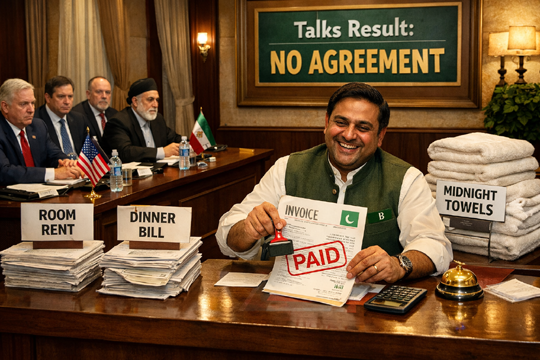
Let us pause for a moment to appreciate the true winners of the summit: the invisible army of service providers. While diplomats debated the future of geopolitics, someone was billing for conference room rentals. Someone else was itemising beverages. Somewhere, a spreadsheet proudly listed “fresh towels” under essential expenditures. And why not? If global tension must persist, at least let it support the hospitality industry.
Pakistan, in this scenario, emerges as the quietly satisfied host. No agreement? That’s unfortunate. But the rooms were booked, the meals were served, and the invoices, one hopes, were settled promptly. There is something beautifully mundane about this contrast. On one side, existential questions about regional stability. On the other, a waiter wondering if Table 3 would like more naan.
This is the duality of diplomacy: grand ambitions resting on very practical logistics.
And perhaps that is Pakistan’s understated victory. Not in brokering peace, but in successfully hosting the possibility of it. In a world where even conversations are hard to arrange, providing a venue is no small achievement.
The myth of decisive victories in modern conflicts
One of the more biting claims in the narrative is that certain powers do not actually want to “win” wars. Instead, the argument goes, they prefer prolonged engagements that sustain industries and influence. It’s a compelling idea, almost cinematic in its simplicity. But reality, as usual, is messier.
Modern conflicts are rarely about clear victories. They are entangled in alliances, economics, public opinion, and unpredictable consequences. Winning is not always defined and losing is often rebranded. That said, the perception of endless conflict does exist. News cycles repeat familiar patterns: escalation, condemnation, negotiation, stalemate. Rinse, repeat. And in that repetition, satire finds fertile ground.
Because if conflicts seem never-ending, one begins to wonder whether the system itself is designed to sustain them. Not necessarily out of malice, but because inertia is powerful and change is risky.
From that perspective, a failed negotiation is not an anomaly, it is part of the rhythm.
Pakistan’s moment: spotlight, selfies, and subtle satisfaction
For Pakistan, this episode was less about outcomes and more about optics. For a brief window, Islamabad was the place where global headlines converged. Cameras flashed. Analysts analysed. Commentators commented on other commentators. It was, in short, a moment. And moments matter. They shape perception, and perception influences relevance. In international relations, being seen as a place where things happen, even if those things lead to nothing, has its own value. Pakistan demonstrated that it could host, manage, and facilitate high-level talks. That it could provide the stage, even if it could not write the script. And perhaps that is enough. Because in the long run, diplomacy is not just about agreements. It is about positioning. About being part of the conversation, even when the conversation goes nowhere.
The art of leaving without saying much
The departure of delegations after the talks was, predictably, dignified. Statements were issued. Gratitude was expressed. Phrases like “constructive discussions” and “continuing engagement” made their customary appearance. No one slammed doors. No one dramatically declared failure. Diplomacy, after all, prefers understatement. But the subtext was clear: nothing had changed. And yet, something had. Because even unsuccessful talks add to the narrative. They create reference points for future discussions. They establish patterns, expectations, and, occasionally, cautionary tales. In that sense, leaving without an agreement is not the end, it is a comma.
Much ado about something that looked like nothing
At first glance, the entire episode might seem like a grand exercise in futility. Leaders met, talked, and left without resolving anything. But look closer, and it becomes a story about process rather than outcome. Pakistan gained visibility. The United States and Iran maintained dialogue. The world watched, speculated, and moved on. And somewhere in Islamabad, a hotel accountant closed the books on a very interesting week. The satire writes itself: a high-stakes diplomatic summit that produced no agreement but plenty of receipts. Yet, beneath the humour lies a more serious truth. Diplomacy is rarely linear. It is messy, repetitive, and often inconclusive. Progress, when it happens, is incremental and fragile. So yes, there was no agreement. But there was a meeting. And sometimes, in the strange theatre of global politics, that is the entire show.