
Research cited by global organizations such as World Health Organization and UNICEF indicates that menstrual hygiene outcomes depend more on hygiene practices, water access, and education than on the material itself. Poor washing habits make any product unsafe; good practices make most products safe
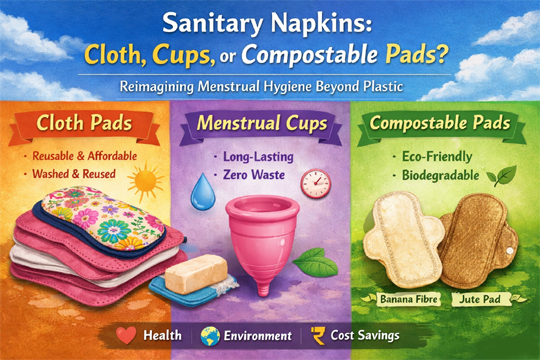
The global sanitary products industry has spent decades selling one powerful narrative: modern equals disposable, and disposable equals safe. That storyline, fueled by glossy advertising, celebrity endorsements, and supply chains that resemble an investment bank’s deal pipeline more than a public health intervention, has shaped how billions of women think about menstruation. Yet, history—and increasingly, science—suggests the story is far more nuanced. Across communities, particularly in resource-constrained settings, cloth-based menstrual products are not relics of poverty but tools of resilience, affordability, and sustainability. Initiatives like Samarpan’s promotion of reusable cloth pads are attempting to reset the conversation: menstruation is not about brand loyalty; it is about dignity, health, environment, and economic agency. The debate now spans not only cloth versus disposable, but also menstrual cups, banana fibre pads, jute innovations, and biodegradable technologies. The stakes are enormous, touching Insurance costs for health systems, household Credit patterns, environmental Recovery budgets, and even municipal waste management Loans tied to urban infrastructure.
Why cloth is returning to the conversation
Reusable cloth pads are not a new invention. For centuries, societies across Asia, Africa, and Europe used cloth in various forms for menstrual management. The industrial revolution and petrochemical boom of the twentieth century merely replaced one material with another, introducing plastic polymers that improved absorption but created a waste crisis. Today, as sustainability pressures mount, cloth is re-entering the mainstream, backed by evidence rather than nostalgia. Research cited by global organizations such as World Health Organization and UNICEF indicates that menstrual hygiene outcomes depend more on hygiene practices, water access, and education than on the material itself. Poor washing habits make any product unsafe; good practices make most products safe. Samarpan’s model—providing six reusable pads with a two-to-three-year lifespan and practical training—aligns with that evidence-based approach. It reframes menstrual hygiene as behavior change supported by tools, not as a retail transaction driven by advertising budgets.
Economics, affordability, and the household balance sheet
For families living on tight margins, menstruation is not merely a biological event; it is a recurring financial obligation. Disposable pads can cost ₹30–₹50 per cycle for low-cost brands and far more for premium variants. Over years, this becomes a significant expenditure—comparable to school Classes fees or Gas/Electricity bills in some rural households. Samarpan estimates savings of ₹1,200–₹1,500 over four years per girl using reusable cloth pads. Multiply that across millions, and the macroeconomic implications become clear: reduced consumption of imported raw materials, improved household liquidity, and potential reallocation of spending toward education or nutrition. Development economists at institutions like World Bank have long argued that small cost reductions in essential goods can create disproportionate welfare gains among low-income populations. Menstrual products are now entering that conversation alongside microfinance Loans and subsidized Insurance schemes.
Consulting firms have also begun quantifying these ripple effects. Reports from McKinsey & Company, Deloitte, and PwC highlight how women’s economic participation rises when barriers to hygiene and health are reduced. A missed school day or workplace absence due to lack of menstrual products carries productivity costs that exceed the price of the product itself. Thus, the cloth-versus-disposable debate is not trivial—it intersects with national GDP growth trajectories and labor force participation metrics.
Health considerations: myths, fears, and evidence
One of the most persistent misconceptions is that cloth is inherently unhygienic. In reality, dermatologists often note that synthetic pads can cause irritation, rashes, or allergic reactions in some users due to fragrances and chemical treatments. Cloth, when properly washed, rinsed, sun-dried, and stored, can be gentler on the skin. The real risk lies in damp storage, inadequate drying, or contaminated water sources. This is why Samarpan emphasizes education alongside distribution—teaching washing techniques, stain removal, and sun exposure to ensure microbial safety.
Critics raise legitimate concerns: heavy flow saturation, leak anxiety, and the inconvenience of carrying used cloth outside the home. These are real user experience issues, not ideological objections. Modern disposable pads use engineered absorbent cores that lock fluid away from the skin, offering dryness and psychological comfort. However, innovation in reusable pads—multiple layers, leak-proof backing, snap buttons—has narrowed the performance gap. Ultimately, product choice should remain user-centric rather than advocacy-centric. Menstrual hygiene is not a courtroom battle where an Attorney or Lawyer argues for one material; it is a personal decision shaped by lifestyle, infrastructure, and cultural context.
Environmental math: plastic, landfills, and climate costs
Every disposable pad contains plastic components that can take hundreds of years to decompose. A single user may discard thousands in a lifetime. Municipal waste systems—already strained—must handle this non-biodegradable load. Environmental economists estimate that the lifecycle cost of plastic menstrual waste includes landfill management, incineration emissions, and potential groundwater contamination. Governments face growing Recovery expenditures tied to waste remediation, sometimes financed through sovereign Loans or municipal bonds. When one girl using reusable pads prevents over 75 disposables per year from entering landfills, the aggregate impact across communities becomes substantial.
The climate dimension is equally compelling. Manufacturing disposable pads requires petrochemicals, energy-intensive processes, and global shipping networks—activities linked to carbon emissions. Cloth pads, particularly those produced locally, reduce transportation footprints and support circular economies. This aligns with sustainability frameworks promoted by global think tanks and business chambers such as the Confederation of Indian Industry and Federation of Indian Chambers of Commerce & Industry, which emphasize localized manufacturing for resilience and environmental gains.
Practical barriers: water, privacy, and infrastructure
Despite benefits, reusable cloth adoption faces structural barriers. Access to clean water and soap remains inconsistent in many schools. Drying cloth openly in sunlight can be socially restricted due to stigma. Carrying used pads during long school hours may cause embarrassment. These challenges underscore a crucial insight: menstrual solutions cannot be separated from infrastructure development. Investments in school sanitation, private changing spaces, and water supply are as important as product distribution. Governments often prioritize hardware—building toilets—without funding behavior change campaigns or maintenance budgets. Without systemic support, even the best products fail.
This is where cross-sector collaboration becomes essential. NGOs, local governments, and corporate CSR programs can coordinate Training sessions, community awareness drives, and supply chains. Corporate Hosting of educational workshops, Conference Call coordination among stakeholders, and digital Software platforms for monitoring distribution can transform scattered interventions into scalable programs. Menstrual health, once considered a niche social issue, now intersects with governance efficiency and public service delivery metrics.
Menstrual cups: the sustainability wildcard
Some advocates argue that menstrual cups outperform both cloth and disposable pads in sustainability and cost-effectiveness. Made from medical-grade silicone, cups can last up to a decade, dramatically reducing waste and long-term expenditure. They also eliminate the need to carry used materials. However, cups require comfort with insertion, access to clean water for rinsing, and sometimes cultural acceptance that varies widely. Adoption rates remain uneven, particularly among younger adolescents or communities with taboos around internal products. Thus, while cups represent a powerful option, they are not universally suitable. A pluralistic approach—offering cloth pads, cups, and biodegradable disposables—respects user diversity.
Biodegradable innovation: banana fibre and jute pads
Emerging technologies are reshaping the disposable segment itself. Banana fibre pads use agricultural waste from banana cultivation to create absorbent cores that decompose within months. Jute-based pads leverage natural plant fibers with strong absorption capacity. Companies such as Saathi, Saukhyam, and Kiah are pioneering these alternatives. Meanwhile, research institutions like Indian Jute Industries’ Research Association are developing jute pulp technologies to replace imported wood pulp. These innovations demonstrate that sustainability does not require abandoning disposables entirely; it requires redesigning them.
Global comparisons reveal similar trends. In East Africa, social enterprises produce banana fibre pads locally, creating employment while reducing waste. In Europe, compostable menstrual products are entering premium markets, driven by environmentally conscious consumers willing to pay more. The lesson is clear: technology, culture, and economics interact differently across contexts, so no single solution dominates globally.
Stigma, education, and the psychology of menstruation
Perhaps the greatest barrier to menstrual health is not material but mindset. Shame, secrecy, and misinformation persist across societies. Girls may skip school during periods due to fear of staining clothes or teasing. Open conversations—like those conducted in Samarpan sessions—can transform anxiety into confidence. Education about the menstrual cycle, hygiene practices, and product options empowers girls to make informed choices. Behavioral change experts note that peer discussions often influence adoption more than advertising campaigns. When girls see friends successfully using cloth pads or cups, skepticism fades.
Educational interventions can also connect menstruation to broader health awareness—nutrition, anemia prevention, and reproductive health Treatment. In some programs, menstrual education sessions include discussions on puberty, mental health, and self-esteem, creating holistic adolescent health platforms. These integrated approaches deliver outcomes far beyond hygiene alone.
Financial ecosystems: microenterprises and livelihoods
Reusable pad initiatives can also stimulate local economies. Women’s self-help groups producing cloth pads create income opportunities, reducing dependence on external supply chains. Microenterprises may access microcredit Loans, insurance coverage, and skill development programs. Some projects even integrate digital payment systems for distribution tracking and Credit scoring. Social enterprises occasionally partner with an investment bank or philanthropic foundation to scale production. Thus, menstrual health interventions can evolve into livelihood ecosystems, blending social impact with entrepreneurship.
The financial dimension extends further. Reduced spending on disposables frees household funds for education or health insurance premiums. Governments may redirect subsidy budgets toward infrastructure rather than recurring product procurement. Development finance institutions increasingly view menstrual health as part of gender equity investments, linking it to workforce participation and economic growth.
Addressing criticisms honestly
Critiques of cloth pads deserve serious consideration. Heavy flow management, odor concerns, and washing difficulties are real experiences for some users. Blood stains can be challenging to remove without proper techniques such as cold-water rinsing before washing. Lack of privacy for drying remains a barrier in conservative households. Advocates must acknowledge these realities rather than dismiss them. Product design improvements—faster drying fabrics, darker colors, antimicrobial layers—are ongoing. Choice architecture is crucial: offering multiple product types allows users to switch depending on circumstances, such as using disposables during travel and cloth at home.
Menstrual health advocacy should avoid ideological rigidity. The goal is not to win a material debate but to expand safe, affordable options. Just as healthcare includes multiple Treatment pathways—medication, therapy, Rehab—the menstrual ecosystem can include cloth, cups, biodegradable pads, and disposables.
Policy implications and the role of governments
Government programs distributing free disposable pads have expanded access but also created massive waste streams. Policymakers face a dilemma: ensure hygiene access without environmental damage. Hybrid models may offer solutions—subsidizing reusable products, investing in sanitation infrastructure, and supporting biodegradable manufacturing. Public procurement policies could prioritize eco-friendly materials, stimulating domestic industries such as banana fibre processing and jute cultivation. Data from government repositories show that adolescent health outcomes improve when menstrual education accompanies product distribution, reinforcing the importance of integrated policies.
International development agencies increasingly frame menstrual health within gender equality and climate agendas. Funding streams once dedicated solely to sanitation now include menstrual initiatives. Grants, Donations, and philanthropic partnerships support pilot programs that, if successful, can scale nationally.
Technology, communication, and the future
Digital platforms are transforming awareness campaigns. Mobile apps provide cycle tracking, hygiene tips, and peer support communities. NGOs conduct virtual Training through Conference Call sessions and webinars, reaching remote regions without travel costs. Software dashboards track distribution metrics, user feedback, and supply chain efficiency. Social media storytelling humanizes the issue, replacing shame with solidarity. Technology does not replace community engagement but amplifies it.
Emerging research explores advanced materials—biopolymers, nanofiber absorption layers, and antimicrobial coatings. Universities collaborate with startups to design products that combine the comfort of disposables with the sustainability of cloth. The future menstrual product may look entirely different from today’s options.
Beyond hygiene: dignity, agency, and gender equality
At its core, the menstrual conversation is about dignity. Access to safe products enables girls to attend school, participate in sports, and pursue ambitions without interruption. Confidence during adolescence influences career trajectories, education outcomes, and self-perception. Gender equality goals—from workforce participation to leadership representation—are subtly linked to menstrual health access. When a girl no longer worries about leaks or stigma, she focuses on learning, creativity, and aspiration.
Programs like Samarpan’s demonstrate that small interventions can create large social ripples. Fifteen thousand girls reached is not merely a statistic; it represents thousands of households shifting perceptions. Community norms evolve gradually, but once changed, they persist across generations.
Choice, not dogma
The menstrual hygiene landscape is entering a new era. Disposable pads are no longer the uncontested default; cloth, cups, and biodegradable innovations are reshaping options. Evidence shows that hygiene depends more on education and infrastructure than material alone. Environmental pressures demand alternatives to plastic-heavy products. Economic realities push families toward cost-effective solutions. Cultural contexts influence acceptance of different products. Therefore, the future lies not in promoting one universal solution but in enabling informed choice.
Whether a girl uses a reusable cloth pad, a menstrual cup, a banana fibre disposable, or a conventional pad, the objective remains the same: safety, comfort, dignity, and sustainability. Advocacy must remain empathetic, science-based, and inclusive. Menstrual health is not merely a consumer decision—it is a public health priority, an environmental challenge, and a gender equity imperative. And sometimes, as Samarpan’s work suggests, the simplest material—cloth—can spark the most profound transformation.