
Government schemes reimburse up to ₹2 lakhs per domestic patent application and up to ₹5 lakhs for international filings, with institutions receiving fee concessions as high as 80 percent. Filing itself can cost barely more than a weekend utility bill for gas/electricity

The patent gold rush nobody wants to talk about: If innovation were a Bollywood plot, India would currently be stuck in a montage sequence: professors filling forms, administrators signing reimbursement papers, and finance offices celebrating subsidy credits like lottery wins. Somewhere between a Conference Call and a celebratory dinner, the original purpose of research quietly slips out the back door. The uncomfortable question now surfacing across policy circles is blunt: are Indian universities gaming the patent system? Or worse, are we incentivizing them to do exactly that? Consider the startling comparisons circulating in academic and industry circles. Private universities such as Galgotias University, Lovely Professional University, Jain University, Mahaveer University, and Amity University have reported patent filing volumes that dwarf those of the prestigious Indian Institutes of Technology combined. On paper, this sounds like a revolution—India’s knowledge economy finally exploding with creativity. But scratch beneath the glossy brochures and you encounter a different narrative: filings without prosecution, patents without grants, and innovation without products. In any other sector—Insurance, Loans, Mortgage, or investment bank compliance—such metrics inflation would trigger forensic audits, Attorneys, Lawyers, and perhaps even criminal investigations. In higher education, it often triggers rankings glory.
How incentives turned into a business model
The mechanics are seductively simple. Government schemes reimburse up to ₹2 lakh per domestic patent application and up to ₹5 lakh for international filings, with institutions receiving fee concessions as high as 80 percent. Filing itself can cost barely more than a weekend utility bill for gas/electricity. Add another incentive layer: the national ranking framework rewards institutions for higher patent counts. The result is an economic arbitrage opportunity so obvious it could be taught in MBA Classes. File a patent, claim reimbursement, improve ranking, attract more students, collect tuition, and repeat the cycle. From a finance perspective, the return on investment can exceed 100 times. Any venture capitalist or Trading desk analyst would call that alpha. The problem is that innovation is not supposed to behave like speculative Trading. According to analyses by institutions such as World Intellectual Property Organization and consulting firms like McKinsey & Company and Boston Consulting Group, high-performing innovation ecosystems correlate incentives with outcomes, grants, commercialization, licensing revenue, startup formation, not raw filings. When filings become the target, filings become the product.
The uncomfortable data gap between filing and grant
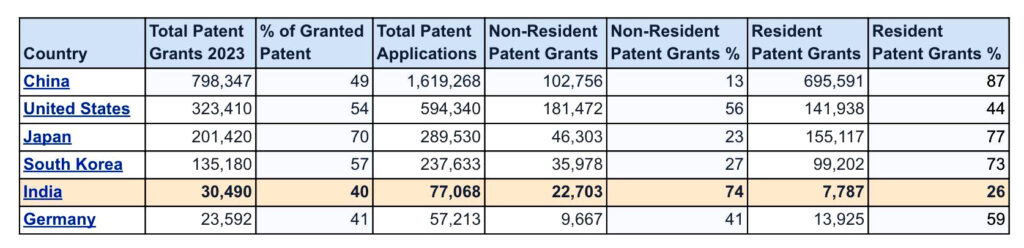
India ranks among the world’s top countries in patent applications, yet its grant rate lags behind innovation leaders. While countries such as Japan, South Korea, and the United States demonstrate significantly higher grant ratios, India struggles with lower conversion from filing to approval. Experts at OECD and the World Bank have repeatedly emphasized that patent quality, not quantity, drives economic growth. A patent that becomes a commercial product can generate employment, exports, and technological sovereignty. A patent that sits abandoned after filing generates little beyond reimbursement receipts. The distinction is crucial. Filing numbers can be inflated with minimal technical rigor. Granting requires novelty, industrial applicability, and legal defensibility—standards that demand real research investment. The gap between the two exposes systemic distortion.
Rankings, reputation, and the student recruitment machine
University rankings function like Credit ratings for institutions. A higher rank signals prestige, attracting applicants and tuition revenue. When patent filings are counted heavily, the incentive to inflate numbers becomes irresistible. Marketing departments transform filing counts into glossy advertisements: “1,000+ patents filed.” For a student choosing a Degree program, the claim sounds impressive. Parents equate patent counts with academic excellence, much like investors equate revenue growth with corporate success. But without grants or commercialization, the claim resembles a startup boasting user signups without revenue. Education becomes a sales funnel. Students are effectively financing the patent subsidy loop through tuition fees. In extreme cases, faculty may even be encouraged, or pressured, to file patents on incremental or trivial ideas. Some describe internal workshops that feel less like research seminars and more like administrative Training Classes on how to complete patent forms efficiently. The risk is reputational erosion. If students eventually realize that institutional claims lack substance, the trust deficit could be severe, triggering long-term Recovery challenges for the entire sector.
The international comparison India should pay attention to
Innovation powerhouses did not reach their positions by subsidizing paperwork. In South Korea, universities collaborate tightly with conglomerates, ensuring patents are tied to industrial demand. In the United States, technology transfer offices often operate like venture incubators, focusing on licensing revenue and startup creation. Japan’s system integrates industry funding with academic research agendas. Reports from NITI Aayog and India’s Department for Promotion of Industry and Internal Trade highlight the need for stronger commercialization pathways, yet incentives still disproportionately reward filings. Even bilateral agencies such as Asian Development Bank have recommended linking public research funding to measurable economic outcomes. India’s demographic dividend demands not just innovation activity but innovation impact. Filing without translation into products is like Cord Blood stored without ever being used for Treatment—technically impressive but economically dormant.
When subsidies distort behavior across sectors
Economists have seen this movie before. In agriculture, minimum support prices sometimes distort crop choices. In finance, poorly designed incentives contributed to mortgage crises. In healthcare, reimbursement models have historically influenced treatment decisions. When incentives reward the wrong metric, behavior follows. Higher education is not immune. The patent subsidy environment risks creating a moral hazard. Institutions may prioritize filings because they generate immediate financial Transfer benefits, while commercialization requires long-term risk and investment. From a governance perspective, this resembles insurance fraud dynamics: the Claim is easier to process than verifying the underlying event. Yet universities are supposed to be temples of knowledge, not subsidy arbitrage centers. Regulatory bodies such as University Grants Commission and All India Council for Technical Education face the challenge of balancing encouragement with accountability.
The hidden cost to real innovation
The tragedy is not financial waste alone. The deeper cost is opportunity loss. When faculty time is spent generating low-value patents, genuine research suffers. Laboratories that could be pursuing breakthrough technologies—advanced materials, clean energy, biomedical devices—may instead focus on incremental filings. Students trained in such environments may graduate with impressive CV bullet points but limited research depth. The long-term national innovation capacity weakens. Global competitiveness depends on patents that survive legal scrutiny, attract investors, and enter markets. A patent that never progresses beyond filing is like a startup pitch deck that never secures funding. In sectors like Software, biotechnology, or renewable energy, commercialization speed determines global leadership. India cannot afford to substitute paperwork volume for technological progress.
Commercialization is the missing link
Successful ecosystems treat patents as assets, not trophies. Universities in the United States generate billions in licensing revenue annually. Technology Transfer offices negotiate with corporations, venture funds, and startups. Faculty entrepreneurs receive equity stakes. Investors evaluate intellectual property like collateral in a Mortgage. Legal teams ensure enforceability. Commercialization becomes a multidisciplinary effort involving Lawyers, Attorneys, engineers, and financiers. India’s ecosystem remains fragmented. Industry–academia collaboration is improving but still inconsistent. Without industry partners, patents struggle to reach market readiness. Reports from industry chambers such as Confederation of Indian Industry emphasize that companies often find university patents difficult to commercialize due to insufficient prototyping or validation. Bridging this gap requires investment in prototyping labs, incubation centers, and translational research—not just filing incentives.
Policy reforms that could change the game
Experts increasingly advocate shifting reimbursement from filing to grant stage. Such a reform would align incentives with quality. Additional rewards could be tied to licensing revenue, startup formation, or industrial adoption. Caps on annual reimbursements per institution could prevent excessive concentration. Independent audits of filing-to-grant ratios would identify anomalies. Rankings frameworks should weigh granted patents and commercialization outcomes more heavily than raw filings. Governments could also fund industry collaboration grants where companies co-invest in university research. These approaches mirror international best practices documented by organizations like the OECD and World Bank. Innovation policy must move from quantity to quality. Otherwise, India risks building a statistical illusion rather than a technological powerhouse.
The ethical dimension universities cannot ignore
Beyond economics lies ethics. Universities carry societal trust. Parents invest life savings, sometimes taking Loans or pledging assets, believing education will secure their children’s future. Students commit years of effort, hoping for career opportunities. If institutional claims exaggerate innovation performance, the moral consequences are serious. Education is not merely a market transaction; it is a social contract. Misaligned incentives that encourage superficial achievements undermine that contract. Faculty morale may also suffer if genuine research receives less recognition than administrative filing volume. Over time, talented researchers may migrate to institutions with stronger research cultures, weakening the system further. Reputation, once damaged, requires years of Recovery.
Innovation is not paperwork—it is impact
The core message is simple yet profound: innovation is not a form you fill; it is a product you build. A patent should represent a technological leap, not a reimbursement opportunity. Countries that dominate global innovation treat patents as instruments of economic transformation. India stands at a pivotal moment. With its demographic scale, entrepreneurial energy, and growing digital infrastructure, it has the potential to lead in emerging technologies—from AI Software to green energy systems. But potential alone is insufficient. Policy design must reward outcomes, universities must prioritize depth over volume, and students must demand substance over marketing slogans. Otherwise, the risk is that innovation will metaphorically hang itself—strangled by bureaucracy, incentives, and misplaced metrics—while subsidy money quietly flows into institutional accounts. The question is not whether India can innovate. It is whether India will choose to measure what truly matters.