
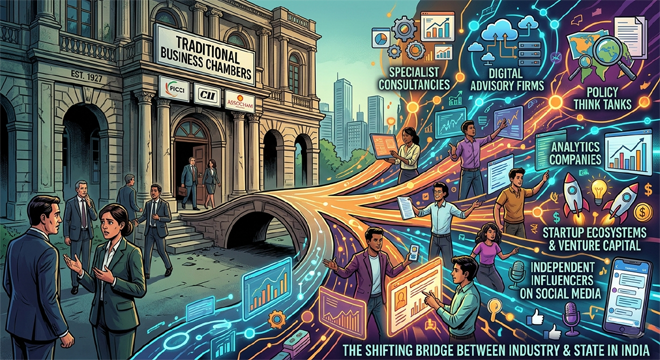
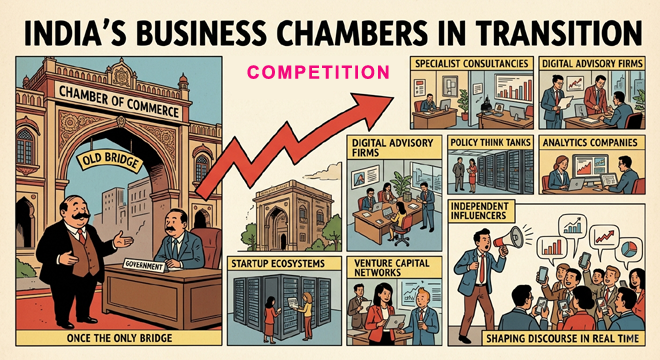
Digital transformation in life and the corporate sector has forced India’s traditional business chambers into a difficult and often uncomfortable transition. They are no longer the only bridge between industry and the state. They are now competing with specialist consultancies, digital advisory firms, policy think tanks, analytics companies, startup ecosystems, venture capital networks and even independent influencers on social media who shape business discourse in real time
What do FICCI, CII and Assocham sell? Is it a service for government relations and outreach? Is it sponsorship slots at government-B2B events? Is it delegate fees for business delegations to other countries or delegate fees for foreign companies for visits to Indian Central and State governments? Do they sell anything else? Well, not much it seems. So, their inventory for revenue is limited. These items for sale used to fly off the shelf in an age before the Internet raised it head. However, business chambers are struggling to retain their exclusivity and their revenue in this digital age where information in gigabytes is downloaded and shared in a flash.
That’s what they used to sell – information. They used to have a monopoly over it. The way they stored it and exchanged it for revenue was in archaic form. None of the business chambers invested in a hard core ERP such as SAP or even Oracle, when they had been at their peak. They could have done it with a tie-up with these companies given the leverage they enjoyed before 2000 AD. Well, they didn’t. As a result, the thought processes in the corridors of business chambers still rest on manual Excel sheets and similar work flows.
After 1947, organizations such as Federation of Indian Chambers of Commerce and Industry, Confederation of Indian Industry, and Associated Chambers of Commerce and Industry of India were innovations in the public policy domain. They functioned as the nerve centres of Indian business influence. They were the corridors through which industrialists met ministers, exporters found overseas buyers, and regulatory information flowed into the private sector. Membership in such chambers was once considered almost essential for corporate legitimacy. Their annual general meetings attracted cabinet ministers, ambassadors, bankers, economists and industrial families. In a slower, paper-driven economy, business chambers were indispensable because they controlled access, to information, networks, bureaucratic channels and policy visibility.
That era has fundamentally changed.
CII uses ERP and CRM ecosystems to manage membership subscriptions, billing, and fee management, event registrations and attendee tracking, internal finance, HR, and supply chain operations, outbound communication and member outreach. FICCI uses enterprise-grade IT systems, including ERP software, to manage its internal finance, human resources, membership databases, and event operations. However, if I were to ask “how many publicly listed companies in India export carbon black to South American countries; name the countries, ticket sizes and the importing companies.” There would be no response, as such an investment does not exist in any business chamber in India, today. Well, it should have been.
The rise of the internet, smartphones, digital communications, social media and real-time data systems has dismantled many of the monopolies that chambers once enjoyed. Information that earlier took weeks to circulate through printed newsletters, policy circulars or chamber briefings is now available instantly through government portals, LinkedIn updates, WhatsApp groups, online gazettes, YouTube policy explainers and AI-powered research tools. Companies no longer need to wait for chamber intermediaries to understand tax reforms, export incentives or industrial regulations. The internet democratized information, reduced search costs for business partners and enabled direct engagement between businesses and the government.
This transformation has forced India’s traditional chambers into a difficult and often uncomfortable transition. They are no longer the only bridge between industry and the state. They are now competing with specialist consultancies, digital advisory firms, policy think tanks, analytics companies, startup ecosystems, venture capital networks and even independent influencers on social media who shape business discourse in real time. And do they have teams to combat this situation? Your guess is as good as mine. In fact, the same teams which lead workflow in the 1990s are still at the helm in 2026. This vast repertoire needs some external inputs for team building, lean management and other areas.
The transformation is particularly visible in the changing nature of lobbying itself. Twenty years ago, the role of a “government relations specialist” barely existed in Indian corporations outside a few regulated sectors. Today, almost every major company has a dedicated vice-president or director for government relations. Smaller companies use agile consultants and politically connected field operators who can directly interface with state and central government departments. Digital communications, online filing systems and direct bureaucratic interfaces have weakened the need for collective representation through traditional chambers.
This shift is not unique to India. Across the world, traditional trade associations and chambers of commerce are confronting similar questions about relevance in a digitally connected economy. But in India, the challenge is amplified because the economy itself is undergoing a rapid transformation. India’s ambitions of becoming a multi-trillion-dollar economy are tied to artificial intelligence, Industry 4.0, logistics modernization, fintech, renewable energy, semiconductor manufacturing, digital public infrastructure and global supply chain integration. These sectors move at internet speed. Legacy chambers, structured around committee systems, hierarchical reporting and slow consensus-building, often struggle to keep pace.
More than serving companies to get their point across, business chambers in India should lead with ideas and concepts and get member companies to participate. For instance, aggregator companies such as Ola, OYO, Zepto, Booking.com do not feel any value in subscribing to bizcham activities. Therefore, business chambers in India should put together a pilot project such as Bharat Taxi, roll out the regulations and the business model instead of playing catch up. What about city planning. Business chambers in India should be leading the charge in asking state governments such as Bengal, Andhra and Tamil Nadu to allow them to form a team of architects, civil engineers, town planners, GIS geographers, water flow specialists, wind tunnel specialists, road planners, sociologists and logistics experts to renovate cities such as Kolkata, Amravati and Chennai. When new political will is available as in these states, bizcham onslaught and initiative should step in without delay. These could be projects worth thousands of crores.
Networking as the bizchams understand it from the 1990s is dead. Now, networking happens on social media and ends at the conference venue. To FICCI, CII and Assocham networking begins with the conference venue with paper based visiting cards. No kosher.
The internet has also dramatically changed the culture of networking. Earlier, elite access mattered enormously. Business leaders attended chamber dinners, trade delegations and conferences because physical proximity created influence. Today, relationships are initiated on digital platforms, negotiations happen on video calls, and international partnerships are often established without a single in-person meeting. LinkedIn has become as important as the ballroom conference. Zoom has replaced many boardroom interactions. Virtual trade fairs are often more cost-effective than physical exhibitions. A startup founder from Coimbatore or Indore can directly pitch to a global investor over a video conference without waiting for a chamber-organized delegation. In short, now networking is FLAT. Networking B2B and B2C happens all at once through social media.
Consequently, the traditional social prestige associated with chambers has diluted. There was a time when heading a chamber like FICCI or ASSOCHAM represented enormous influence within India’s political economy. Chamber presidents were seen as spokespersons for Indian business itself. While such positions still carry prestige, influence today is fragmented across technology founders, venture capitalists, digital entrepreneurs, multinational corporate lobbyists, policy consultants, social media economists and startup networks. Such exclusivity can come back. It can be done through building a brand. Unfortunately, the teams at FICCI, CII and Assocham today can build a new logo, but have no clue about building a brand, which can be independently sold for at least Rs 500 crore. Answer these questions: How valuable is the identity card of any Indian bizcham in the job market as compared to IBM, Oracle, Microsoft, Alphabet or similar companies’ ID cards? How proud are bizcham employees? How able are they to undertake independent decision making in the absence of their boss? These intangibles speak a lot.
Another challenge comes from specialization. Generic chambers that once represented all sectors now face intense competition from niche industry bodies. Organizations dedicated specifically to information technology, auto components, fintech, pharmaceuticals, renewable energy or e-commerce often provide far more relevant and technically sophisticated advocacy than large umbrella chambers. A technology company may find greater value in sector-specific data from a digital economy association than in generalized industrial policy debates.
The emergence of these specialist institutions has weakened the broad-based influence once enjoyed by older chambers. At the same time, internal rivalries within India’s chamber ecosystem have historically diluted influence. The emergence of CII as a more monetized organization than FICCI and Assocham challenged the older legacy culture associated with some traditional chambers. FICCI developed depth over CII’s ready monetization. Both lagged behind in certain areas. Over time, corporations began evaluating chambers not merely on prestige but on measurable deliverables, research quality, government access, international partnerships, policy responsiveness and implementation capability. This is where Indian bizchams failed.
Team building skills and creation of digital assets
Traditional Indian business chambers are sitting on significant institutional strength, yet their financial scale remains modest when compared to the size and complexity of the Indian economy. Federation of Indian Chambers of Commerce & Industry roughly generates around Rs 230 crore annually, while Confederation of Indian Industry does nearly Rs 450 crore a year, and ASSOCHAM clocks roughly Rs 65 crore annually. In an economy aspiring to become a multi-trillion-dollar global powerhouse, these figures indicate that the traditional chamber model built around conferences, memberships and lobbying has reached a plateau. Leveraging only physical assets and networking events is increasingly passé in a digital-first economy where knowledge, data and specialised advisory ecosystems create far greater long-term value.
Business chambers are fundamentally knowledge organisations, and their future growth depends on how effectively they monetise intellectual capital. Instead of relying disproportionately on annual summits, sponsorships and physical outreach, chambers must create an inventory of premium digital assets that can continuously generate revenue. These could include sectoral intelligence platforms, digital trade databases, policy dashboards, MSME learning ecosystems, AI-enabled business advisory platforms, export readiness tools, research subscriptions, compliance intelligence products and curated industry knowledge vaults. High-quality digital assets have the advantage of scalability, recurring subscriptions and global accessibility, allowing Indian chambers to build influence far beyond Delhi or Mumbai.
Each chamber must also sharply define its unique selling proposition rather than competing in overlapping spaces. FICCI can position itself as India’s premier policy and government interface platform, CII can deepen its role in industrial transformation and manufacturing competitiveness, while ASSOCHAM can specialise in emerging businesses, regional enterprise ecosystems and SME acceleration. A country as vast and commercially diverse as India should logically support chambers generating annual revenues in the range of Rs 1,000 crore to Rs 2,000 crore each. Such scale is achievable only when chambers transition from event-centric institutions into hybrid digital knowledge corporations with strong consulting, analytics and training verticals.
Team building is therefore not merely a managerial necessity but a strategic survival skill for modern business chambers. The platoon-style leadership culture of FICCI, based on outreach, institutional memory and knowledge base construction, remains a valuable asset. However, decades of accumulated expertise must now be combined with professional consulting frameworks, technology integration and specialised organisational capability building. This is where firms such as Royalle Corporation can play an important role by helping institutions strengthen team building structures, leadership alignment, consulting capabilities and digital transformation strategies with Lean Management techniques. In the coming decade, the chambers that successfully combine institutional legacy with agile digital thinking will emerge as the true strategic nerve centres of Indian industry.
The collapse of the information monopoly
Perhaps the biggest disruption caused by the internet was the destruction of the information monopoly. Before widespread digitization, chambers acted as repositories of commercial intelligence. They maintained printed directories, trade statistics, import-export information, legal updates and sectoral reports. Membership provided access to information that was otherwise difficult to obtain.
Today, such information is available almost instantly through public and private digital platforms. Government ministries upload draft policies online. Parliamentary proceedings are streamed live. Regulatory filings are searchable. Export-import data can be purchased in real time. AI systems can summarize policy documents within minutes. International databases provide market intelligence at scale.
As a result, chambers have been forced to rethink their value proposition.
And they are yet to re-think their sales inventory. You can only earn more if you sell more.
Merely circulating information is no longer enough. The new demand is for interpretation, analytics, implementation strategy and predictive insight. Businesses today are not looking for printed reports; they are looking for actionable intelligence. They want to know how policy changes will affect supply chains, taxation, labour costs, logistics or consumer demand. This requires chambers to function less like clerical institutions and more like strategic consulting organizations.
The internet has simultaneously empowered governments. Earlier, chambers often acted as intermediaries because bureaucratic systems were opaque and difficult to navigate. Today, digital governance systems have enabled more direct interaction between companies and regulators not counting direct connection with the public – beneficiaries of public policy programmes. Portals for GST, customs, environmental clearances, labour compliance and corporate filings reduce dependency on intermediaries.
This has altered the balance of power. Chambers can no longer depend solely on access politics. Their relevance increasingly depends on the quality of their analysis and their ability to aggregate industry feedback rapidly and credibly.
The new economy also rewards speed. Digital businesses evolve quickly. Regulatory frameworks for artificial intelligence, data protection, digital payments, cybersecurity and platform economies change rapidly. Traditional chamber structures, which often rely on committees, lengthy consultations and formal resolutions, struggle against the faster decision-making culture of technology firms.
Consequently, many chambers are attempting to reinvent themselves as knowledge institutions and implementation partners rather than mere lobbying organizations. They are creating specialized councils for digital commerce, fintech, renewable energy, ESG compliance, data governance and startup ecosystems. They organize webinars instead of only conferences. They host digital training sessions for MSMEs. They publish sector-specific policy papers that attempt to influence regulation in emerging industries. However, these can never replace the value from implementing projects, which bizchams ought to be doing just to stay relevant if not to win.
The shift from lobbying to knowledge architecture is significant. Modern chambers increasingly position themselves as think tanks capable of generating primary and secondary research. Instead of simply petitioning government ministries, they seek to influence public discourse through white papers, market forecasts and operational recommendations.
This evolution mirrors broader changes in corporate governance and management. Modern corporations themselves are becoming flatter, leaner and more process-driven. Hierarchical pyramid structures are giving way to decentralized systems that emphasize delegation, measurable outcomes and digital workflows. The rise of lean management techniques has influenced how institutions think about organizational efficiency.
In many ways, the future survival of chambers depends on whether they can adapt to this new philosophy. Organizations that remain trapped in legacy cultures of protocol, hierarchy and ceremonial networking risk irrelevance. Those that embrace digital transformation, analytics and agile decision-making may continue to play an important role in India’s economic evolution.
The challenge is not simply technological. It is cultural.
Traditional chambers were built around relationship management. The new economy demands ecosystem management. Relationships remain important, but ecosystems are powered by data, technology, speed and adaptability. A chamber today must understand artificial intelligence, cloud computing, cybersecurity, digital commerce, logistics automation and sustainability frameworks with the same sophistication that it once understood tariffs and industrial licensing.
This requires a new type of leadership within chambers themselves. Employees cannot function merely as policy coordinators or event managers. They increasingly need operational understanding of industries, supply chains, consumer markets and technology systems. A chamber representing agriculture, logistics or manufacturing must deeply understand how those sectors are being reshaped by digital tools.
From networking clubs to digital ecosystem builders
One of the most dramatic transformations in the post-internet era is the changing nature of networking itself. Traditional business chambers were once essentially elite networking clubs. Their value came from facilitating introductions. Industrialists met bureaucrats. Exporters met overseas buyers. Diplomats met local manufacturers. Conferences and annual meetings were important because they provided rare opportunities for face-to-face interaction.
The internet shattered the scarcity that made such networking valuable.
Today, digital platforms allow companies to directly identify suppliers, distributors, investors and customers across geographies. B2B marketplaces, LinkedIn, industry databases and AI-powered business intelligence tools have dramatically reduced the cost of finding commercial partners. Startups can raise capital through online networks. MSMEs can reach international buyers through digital trade platforms. Entrepreneurs no longer require institutional gatekeepers in the same way.
This has forced chambers to evolve from passive facilitators into active “matchmakers.” Instead of merely hosting events, modern chambers increasingly use customer relationship management systems, analytics platforms and sectoral databases to proactively connect businesses with relevant opportunities. The role has shifted from event management to ecosystem curation.
Virtual engagement has become central to this transformation. Hybrid conferences, digital trade fairs and virtual B2B meetings are now standard practice. These platforms offer enormous advantages. They reduce travel costs, democratize participation and expand global reach. A small business in a tier-two Indian city can now interact with overseas buyers or policymakers without the expense of international travel.
The COVID-19 pandemic accelerated this transition dramatically. Chambers that had previously depended heavily on physical conferences were forced to digitize rapidly. Webinars replaced seminars. Virtual summits replaced trade missions. Digital collaboration tools became essential for member engagement.
At the same time, digital networking introduced new forms of competition. Chambers are no longer competing only with each other. They compete with technology platforms, consulting firms, accelerators, incubators and online business communities. A founder today may gain more value from a curated Slack community or a specialized LinkedIn network than from attending a traditional chamber meeting.
Therefore, chambers increasingly need to provide something deeper than access. They need to provide trust, verification, policy insight and strategic value.
This is where the concept of “phygital” engagement becomes important. Despite digital transformation, trust remains a fundamentally human construct. Large transactions, long-term partnerships and strategic collaborations still benefit from physical interaction. Modern chambers therefore attempt to combine digital convenience with human relationship-building.
The future business chamber is likely to operate as a hybrid institution. It will provide digital services, analytics and virtual networking while simultaneously offering curated physical interactions that deepen trust and strategic collaboration.
This hybrid approach is particularly relevant in India, where business culture still places significant importance on personal relationships. Even in a digitized economy, reputation and trust remain central to commercial decision-making. Chambers that can blend technology with relationship-building may continue to retain influence.
Another area where chambers are attempting reinvention is SME digitization. India’s small and medium enterprises face enormous pressure to modernize. E-commerce, digital payments, cloud computing, AI-powered marketing and cybersecurity are becoming essential business capabilities. Yet many SMEs lack the expertise or resources to navigate these transitions independently.
This creates an opportunity for chambers to reposition themselves as digital transformation partners. Instead of merely advocating for policy changes, they can actively train businesses in technology adoption. Workshops on AI marketing, CRM systems, cybersecurity, export digitization and data analytics are increasingly becoming core chamber activities.
The ability to help MSMEs integrate into global supply chains may become one of the most important functions of chambers in the coming decade. Global manufacturing and trade networks are increasingly data-driven. Suppliers are evaluated through digital compliance systems, ESG reporting frameworks and real-time logistics visibility. Chambers that can help smaller firms navigate these systems will provide tangible economic value.
The internet has also transformed advocacy itself. Earlier, chambers relied heavily on anecdotal evidence, manual surveys and physical consultations. Modern advocacy increasingly depends on data analytics. Digital platforms allow chambers to gather member feedback in real time, track industry sentiment and generate evidence-based policy recommendations.
Governments themselves increasingly expect such sophistication. Policymakers dealing with digital commerce, data protection, fintech regulation or AI governance require highly technical inputs. Generic lobbying is insufficient. Chambers must now provide granular analysis supported by data.
This evolution is pushing chambers closer to the role of think tanks and consulting firms. Research quality, policy analytics and implementation expertise are becoming central to institutional relevance.
The rise of AI, IoT and the new digital economy
The broader technological transformation reshaping chambers is rooted in the evolution of the internet itself. The early internet primarily connected people and information. The next phase connects devices, systems and machines. The Internet of Things, artificial intelligence, automation and data analytics are fundamentally altering how businesses operate.
This transformation has enormous implications for industry associations and chambers.
The internet is no longer simply a communication tool. It has become the operating system of the global economy. Smartphones overtook desktops as the dominant access point for digital engagement years ago. Mobile-first and increasingly mobile-only business models now dominate consumer interaction. Businesses are expected to operate in real time, across devices and across geographies.
This shift has changed marketing, logistics, customer engagement and operational management. Traditional chambers, built around slower industrial-era rhythms, must adapt to businesses that now function in continuous digital cycles.
The rise of artificial intelligence further accelerates this challenge. AI systems can analyze customer behaviour, automate workflows, optimize logistics and generate predictive insights. Businesses increasingly expect support institutions to understand these technologies at a strategic level.
For chambers, this means developing expertise far beyond conventional industrial policy. They need to understand cybersecurity frameworks, cloud ecosystems, AI governance, platform economics and digital infrastructure.
The rise of digital advertising also reflects broader structural changes. Internet advertising became highly concentrated around technology giants because of their superior data capabilities and personalization systems. This concentration reshaped how businesses market themselves and engage consumers.
Traditional chambers once played an important role in trade promotion and business visibility. Today, digital marketing agencies, social media platforms and analytics companies dominate this space. Therefore, chambers attempting to remain relevant must integrate digital communications deeply into their operations.
This includes social media engagement, online brand building, digital research dissemination and virtual community management. Chambers can no longer operate as inward-looking institutions communicating through formal circulars and annual conferences. They must function as dynamic digital brands.
The rise of web chat, collaborative platforms and remote work has similarly changed organizational culture. Younger generations entering the workforce prefer instant communication, flexible collaboration and digital interaction. Chambers that continue operating through rigid bureaucratic structures may struggle to attract talent or engage modern businesses effectively.
AI-enabled services are becoming another frontier. Some chambers are experimenting with chatbots for member services, automated onboarding systems and digital certificate issuance. Electronic certificates of origin, digital registries and online compliance systems significantly reduce friction in trade processes.
The future chamber may increasingly resemble a technology platform rather than a traditional association.
This transformation also creates opportunities for India specifically. India’s digital public infrastructure, including systems such as digital identity, digital payments and online governance, has created one of the world’s most extensive digital ecosystems. Chambers capable of leveraging these systems can potentially provide highly scalable services to businesses across sectors.
The globalization of business further strengthens the need for digitally capable chambers. International trade is increasingly platform-driven. Global buyers demand real-time compliance visibility, ESG reporting and digital integration. Chambers can play a valuable role in helping Indian businesses meet these expectations.
Virtual trade missions and online B2B platforms have become particularly important. Earlier, export promotion required costly international delegations. Today, businesses can showcase products globally through digital platforms. Chambers that facilitate such access can significantly expand opportunities for smaller enterprises.
At the same time, globalization has intensified competition among chambers themselves. Indian businesses today interact directly with international think tanks, consulting firms, technology vendors and trade organizations. Domestic chambers must therefore compete globally in terms of knowledge quality and service capability.
This requires institutional reinvention at multiple levels, technology adoption, talent development, organizational culture and strategic orientation.
Re-engineering chambers for the future economy
The future relevance of institutions such as FICCI, CII and ASSOCHAM may ultimately depend on whether they can transform themselves from legacy lobbying organizations into dynamic business intelligence and implementation ecosystems, offering live pilot projects.
This requires re-engineering at a structural level.
First, chambers need to become far more operationally knowledgeable about the industries they represent. Policy advocacy alone is insufficient. Employees and researchers must deeply understand supply chains, manufacturing systems, rural markets, logistics networks, fintech ecosystems, agri-tech transformation and consumer behaviour. Next, bizcham teams should be read in to consulting knowledge and skills.
India’s economy is changing too rapidly for generalized expertise to remain effective. Rural markets are evolving through e-commerce and digital payments. Logistics systems are being transformed by automation and data analytics. Agriculture is increasingly influenced by technology platforms, climate considerations and precision farming tools. Chambers that lack ground-level understanding risk producing irrelevant policy recommendations.
This points toward a major organizational challenge: training.
Many traditional chambers historically recruited people with backgrounds in economics, public policy or administration. While these skills remain important, future chambers require multidisciplinary talent. Data scientists, technology specialists, supply chain analysts, sustainability experts and digital strategists will become increasingly essential.
The chamber of the future may resemble a hybrid between a consulting firm, research institution, technology platform and advocacy organization.
Generating serviceable business data could become one of the most valuable functions of chambers. India still suffers from significant data fragmentation across sectors, especially in MSMEs, agriculture, logistics and rural consumption. Chambers that build reliable business intelligence platforms could provide enormous value to both industry and government.
This is particularly important because policymaking increasingly depends on data-driven decision-making. Governments today seek measurable outcomes, predictive models and operational roadmaps rather than abstract policy demands. Chambers capable of producing credible analytics will have greater influence.
Brand transformation is equally critical. India’s business chambers need to reposition themselves globally. Historically, chambers derived prestige from political proximity and industrial lineage. In the future, prestige will increasingly derive from intellectual credibility, technological sophistication and global relevance.
The comparison with globally respected brands is instructive. Organizations that transformed national industrial reputations did so by combining quality, innovation and strategic communication. India’s chambers must similarly reposition Indian business in global perception, not merely as cost-competitive but as innovative, technologically capable and strategically reliable.
Digital branding therefore becomes essential. Chambers need strong global online visibility, social media engagement, multilingual communication strategies and participation in international digital forums.
Internally, organizational culture requires transformation as well. Traditional hierarchical systems often slow innovation. Modern institutions increasingly rely on flatter structures, delegation and process-driven management. Empowering teams, reducing bureaucratic bottlenecks and encouraging experimentation are essential for institutional agility.
Lean management principles are particularly relevant here. Institutions that depend excessively on personal intervention often struggle to scale. Building systems and processes that function efficiently without constant top-level oversight creates resilience and adaptability.
This philosophy also applies to talent development. Employees must continuously acquire new skills and apply them in dynamic contexts. Chambers should create environments where learning, experimentation and cross-functional collaboration become embedded organizational practices.
Closer engagement with industry is another requirement. Chamber personnel cannot remain detached policy professionals. Regular internships, field exposure and industry immersion can significantly improve institutional understanding. Employees representing sectors should experience operational realities directly.
The future chamber must also move beyond abstract policy advocacy toward implementation-oriented engagement. India’s development challenges often stem not from lack of policy but from weak execution. Chambers can play a meaningful role in supporting implementation at state and local levels.
Cluster development, skill ecosystems, smart urban planning, logistics integration and industrial infrastructure are areas where chambers can contribute significantly. This requires long-term engagement rather than event-based visibility.
India’s ambitions in manufacturing, renewable energy, semiconductors, electric mobility and digital infrastructure create enormous opportunities for chambers willing to evolve. They can become facilitators of industrial transformation rather than merely commentators on policy.
The internet destroyed the old monopoly model of business chambers. But it also created the possibility of a far more dynamic role.
In the industrial era, chambers were intermediaries of access. In the digital era, they must become intermediaries of intelligence, trust, execution and transformation.
That transition is difficult because it requires abandoning comfortable legacy structures. Yet institutions that adapt can remain deeply relevant. The future belongs not to ceremonial lobbying bodies but to agile, knowledge-driven ecosystems capable of helping businesses navigate technological disruption, regulatory complexity and global competition.
India’s business chambers stand at precisely that crossroads today.

The author, Debasish Roy is Founder & CEO, Royalle Corporation, a consulting practice he has been leading since 2005. He holds diplomas from Universities of Michigan and Harvard on public policy and its effects on both government and state’s beneficiaries. Debasish Roy has held positions of Country Manager, Commerce One, VP – Projects, InfoPlanet Technologies, Director General – Jute Federation of India, Director – American Chamber of Commerce, Director – Nexharvest and Head of Content at Brand Capital of the Times of India Group
The views expressed in this article are the author’s own