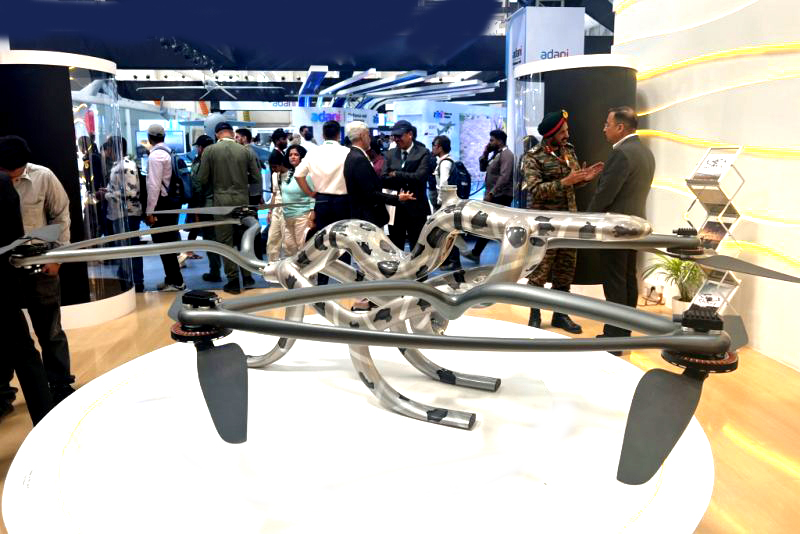
Raphe mPhibr is looking at a greater production capacity to churn out 150 to 2400 high-altitude heavy lift drones for military and other logistics besides at least 3600 rotorcrafts every year
By Debasish Roy
Indian drone manufacturer Raphe mPhibr, a key player in India’s indigenous defence tech sector, has secured $100 million in fresh funding. This is the largest corpus of private raising of funds in the country’s drone industry till now. General Catalyst, a venture capital firm, led the round with participation from Think Investments, Amal Parikh, and several other funds. Till date, Raphe mPhibr has reached $145 million.
Raphe mPhibr’s is likely to use the money to boost its end-to-end capabilities in aircraft design, engineering, and production. This is an upcoming industry with lot of employment opportunities. The company plans to enhance its facilities to better meet India’s growing demand for homegrown aerospace technologies, aligning itself with the government’s Aatmanirbhar Bharat and Make in India initiatives.
Raphe mPhibr manufactures anything from drone swarms to maritime reconnaissance assets. However, there is no video or picture of the company’s facilities neither in public view nor with DronePages.
Founded in 2016, Raphe mPhibr offers the following defence-grade UAVs:
-mR10: A drone swarm platform for coordinated missions
-mR20: Designed for high-altitude logistics delivery
-Bharat Drone: A man-portable surveillance solution
-X8: Built for maritime patrol and reconnaissance
Raphe mPhibr was established by Vikash Mishra and Vivek Mishra, two qualified engineers in aerospace and engineering. Vikash is an MIT-trained aerospace engineer with experience at Idaho National Laboratory and CERN, while Vivek holds a PhD from Georgia Tech and has worked extensively in bio-inspired algorithms and sensor networks.
The company operates an aerospace manufacturing campus, staffed by over 600 employees, with specialised departments in aerodynamics, structural mechanics, thermodynamics, materials science, and electronics. It claims to have logged over one million km of flight across its platforms and developed more than 100 unique intellectual properties.
Its manufacturing capabilities include facilities for metal processing, composite materials, engine development, and military-grade electronics, enabling it to build equipment that performs in extreme conditions — ranging from deserts to high-altitude mountains and marine environments.