
Over decades, the two countries made sharply different strategic choices about how to grow their economies and build national capability. Pakistan always chose to buy what it needed from abroad; but India, often stubbornly and inefficiently, chose to try and build it at home
When India and Pakistan emerged as independent nations in 1947, they began their journeys from roughly the same starting line—scarred by Partition, short of capital, burdened by poverty, and uncertain of their place in the world. Yet over the decades, the two countries made sharply different strategic choices about how to grow their economies and build national capability. One country largely chose to buy what it needed from abroad; the other, often stubbornly and inefficiently, chose to try and build it at home. The consequences of those choices are now visible everywhere—from factories and farms to software parks and fighter aircraft.
Buying everything vs building everything
In the 1960s and 1970s, Pakistan pursued a model that relied heavily on imports and foreign alliances. Military hardware came largely from the United States and later from China. Civilian industries, too, leaned on imports or assembly-based manufacturing rather than deep industrialization. The logic was simple: why reinvent the wheel when powerful allies could supply ready-made solutions?
India took a very different, and far more painful, path. Inspired by a mix of socialist planning, post-colonial self-reliance, and Cold War non-alignment, India attempted to build almost everything domestically—steel plants, heavy machinery, public sector banks, power utilities, aircraft, ships, space launch vehicles, and even computers. The results were often inefficient, slow, and technologically outdated. India’s bureaucracy became infamous. Its industries were protected, complacent, and frequently uncompetitive.
But there was a crucial difference: India was learning how to make things.
Learning is expensive. It involves failure, wasted money, delays, and embarrassment. India paid that price repeatedly. Pakistan largely avoided it—by outsourcing capability to allies.
Where those choices led to
Fast-forward to today. India, despite its many problems, has a busy, diversified economy. It is active—sometimes clumsily, sometimes impressively—in almost every major industry: pharmaceuticals, automobiles, steel, IT services, space technology, electronics, renewable energy, shipbuilding, and increasingly, defence manufacturing.
Pakistan, by contrast, finds itself economically brittle. Its industrial base is narrow. Its exports are limited and low-value. Agriculture, once its backbone, struggles with productivity, water stress, and mismanagement. Food insecurity is no longer a theoretical risk but a lived reality for many citizens. The country lurches from one IMF bailout to another, trapped in a cycle of debt, inflation, and political instability.
This divergence did not happen overnight, nor can it be explained by a single policy or leader. But the underlying philosophy—buying capability versus building capability—runs like a fault line through both national stories.
The F-16 as a symbol
Nothing illustrates this contrast more starkly than Pakistan’s continued reliance on the F-16 fighter jet.
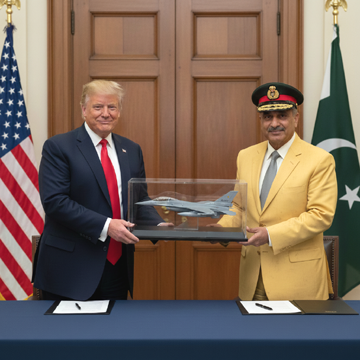
Recently, the United States approved a $686 million support and technology package for Pakistan’s F-16 fleet, framed in the language of “interoperability” and “fleet modernization.” On paper, this sounds impressive. In reality, it highlights a deeper stagnation.
The F-16 is an undeniably brilliant aircraft—for its time. Born out of the 1970s Lightweight Fighter program, it revolutionized fighter design. It emphasized agility over brute force, using a blended wing-body design, forward strakes, relaxed static stability, and fly-by-wire controls. The side-stick controller, bubble canopy, and energy-efficient aerodynamics gave pilots unprecedented situational awareness and dogfighting capability. What began as a pure air-combat fighter later evolved into a capable multirole platform.
Its influence on modern fighter design is undeniable.
But it is still a 50-year-old design.
No number of upgrades can change that fundamental reality. Modern avionics, radar improvements, and software patches may extend its service life, but they cannot turn it into a fifth-generation aircraft. More importantly, maintaining and upgrading the F-16 ecosystem keeps Pakistan dependent on foreign approvals, spare parts, and geopolitical goodwill.
A military that relies primarily on externally controlled legacy platforms cannot evolve into a truly independent military power.
Dependency as a strategic trap
Pakistan’s defence strategy has long been shaped by external patrons. First the United States, then increasingly China, have provided hardware, financing, and diplomatic cover. While this has delivered short-term capability, it has come at the cost of long-term autonomy.
When your fighter jets, tanks, and missiles come from abroad, your strategic decisions are never fully your own. Maintenance schedules depend on foreign suppliers. Upgrades depend on foreign permission. Sanctions or political disagreements can ground entire fleets overnight.
This is not just a military problem—it is a national one. The same pattern appears in Pakistan’s economy, energy sector, and food supply. Dependency becomes a habit, and habits harden into structure.
India’s messy, frustrating alternative
India’s path has been far from smooth. Its defence projects are notorious for delays and cost overruns. Indigenous fighter programs have faced criticism, mockery, and internal resistance. The Light Combat Aircraft (Tejas) took decades to mature. The Advanced Medium Combat Aircraft (AMCA) is still on the drawing board.
Critics often ask: why struggle so much when off-the-shelf options exist?
The answer lies not in the aircraft itself, but in what the process creates.
Every indigenous project—successful or not—builds human capital. Engineers learn systems integration. Supply chains mature. Testing infrastructure improves. Mistakes, though costly, generate institutional knowledge. Over time, this knowledge compounds.
India today designs satellites, launches them reliably, and sells launch services to other countries. It builds nuclear submarines, aircraft carriers, and missiles. Its private sector increasingly participates in defence manufacturing. None of this happened quickly or cheaply.
But it happened.
Self-reliance is not isolation
There is a common misunderstanding that self-reliance means refusing foreign technology. India’s experience shows the opposite. Self-reliance means absorbing, adapting, and eventually surpassing foreign technology—not merely importing it.
India still buys aircraft, engines, and systems from abroad. But increasingly, these purchases are tied to technology transfer, local manufacturing, and long-term capability development. The goal is not purity; it is progression.
Pakistan’s continued dependence on aging platforms like the F-16 suggests stagnation rather than progression. Modern warfare is shifting toward stealth, sensor fusion, unmanned systems, cyber warfare, and integrated command networks. Buying upgraded versions of old platforms does little to prepare a nation for that future.
Economic strength and military power
Military strength ultimately rests on economic strength. A country struggling to feed its population, manage inflation, or stabilize its currency cannot sustain a modern military indefinitely. Defence imports become a burden rather than a multiplier.
India’s economy, despite inequality and inefficiency, generates scale. It funds experimentation. It absorbs failure. It creates options. Pakistan’s economic fragility, by contrast, narrows its choices. When resources are scarce, buying proven but outdated systems feels safer than investing in uncertain indigenous development.
But safety today can mean weakness tomorrow.
The long game
Nation-building is not about quarterly results. It is about decades of cumulative effort. India’s early obsession with building everything made it slow, sometimes laughable, and often frustrating. But it also made India resilient. When global supply chains break, India improvises. When technology regimes tighten, India adapts. When sanctions loom, India negotiates from a position of partial capability rather than total dependence.
Pakistan’s model delivered quicker results in the early decades—but left little behind once the alliances weakened and the money dried up.
Evolution vs maintenance
The contrast between India and Pakistan today is not simply about aircraft, economies, or alliances. It is about evolution versus maintenance.
Buying old designs—even excellent ones like the F-16—maintains capability but does not evolve it. Building new systems—even imperfect ones—forces evolution.
India is still struggling. Its projects are late, its systems incomplete, and its ambitions sometimes exceed its execution. But it is moving forward. Pakistan, by clinging to legacy platforms and external lifelines, risks standing still. In a world where technology, power, and relevance are moving faster than ever, standing still is not neutrality. It is decline.
_____________________________________________________________________
How the F-16 changed — a tour of global modifications through the decades
The General Dynamics / Lockheed Martin F-16 Fighting Falcon began life in the 1970s as a relatively simple, lightweight multirole fighter. Since then it has been one of the most widely exported combat aircraft in history — and one of the most continuously modified. Rather than a single airplane, “the F-16” today is a whole family of airframes, national variants and retrofit packages. This article walks through the most important types of modification — airframe, sensors, engines, weapons, and national customizations — and highlights how different air forces adapted the F-16 to fit their doctrine, industry base and threat environment.
1. From Block 1 to Block 70+ — the official evolution
Lockheed and early U.S. operators produced the F-16 in progressive “Block” batches. Early Block 1/5/10 F-16A/Bs had the original APG-66 radar and basic avionics; later blocks (15, 25, 30/32, 40/42, 50/52, 60, and the modern 70/72) added structural changes, new radars, improved mission computers and increased payload/precision-strike capability. In parallel, USAF programs such as Falcon UP, Service Life Improvement (SLIP) and Service Life Extension Program (SLEP) addressed structural fatigue and restored service life as new systems added weight. These incremental Block and service-life changes created the technical foundation for most national upgrades.
2. Mid-Life Updates (MLU) and national retrofit programs
Many European and other operators held older A/B models together with a Mid-Life Update (MLU) that replaced cockpit instruments, added improved navigation/weapon delivery capability, and often installed improved radars or databus architecture so jets could use modern stores (like AMRAAM, targeting pods and precision bombs). Belgium, Denmark, the Netherlands, Norway and Portugal all ran MLU-like programs in the 1990s–2000s to convert older Falcons into capable 4th-generation multirole fighters without buying new aircraft. These MLUs were cost-effective ways to keep fleets relevant.
3. F-16V / Block 70/72 “Viper” — an AESA and cockpit renaissance
The most important recent Lockheed upgrade is the F-16V (Viper) configuration: modern modular mission computer, new cockpit displays, improved avionics, and—critically—an AESA radar (AN/APG-83 SABR). The Viper retrofit (and the new-build Block 70/72 aircraft) gives legacy F-16s dramatically improved situational awareness, simultaneous air/ground modes, and better electronic protection — closing the gap toward fifth-generation sensor fusion. Several nations have adopted the Viper either by buying new Block 70s or by upgrading existing fleets.
4. Engine swaps and high-power variants (Block 60 / UAE)
Some national variants changed powerplants and cooling/structures to meet unique performance goals. The UAE’s Block 60 (called “Desert Falcon”) stands out: it combined a more powerful GE F110-GE-132 engine with Northrop Grumman’s AN/APG-80 AESA radar, conformal fuel tanks and advanced avionics — a very distinct, high-end export variant tailored to the UAE’s requirements. Block 60 aircraft are among the most capable F-16s ever produced.
5. Israel: the F-16I “Sufa” — weaponization, CFTs and local systems
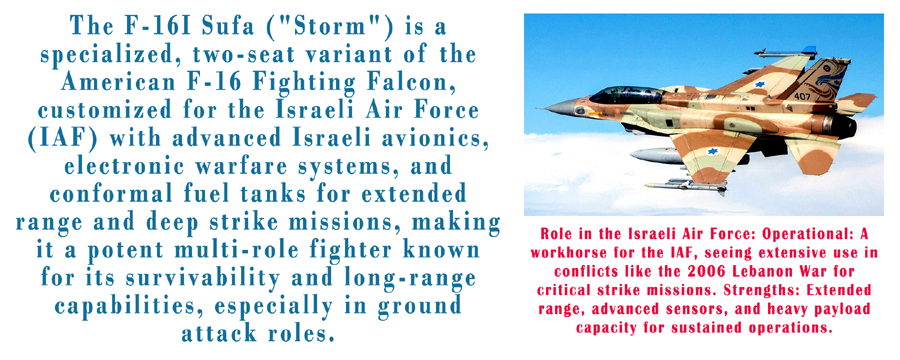
Israel produced one of the most heavily customized F-16s, the F-16I “Sufa” (Storm). Built from Block 50/52 airframes, the Sufa integrates Israeli mission computers, avionics, communications, and electronic warfare systems — plus conformal fuel tanks (CFTs) for extended range and reduced drag compared with external tanks. The IAF also integrated Israeli weapons, datalinks, helmet-mounted cueing and domestically-sourced sensors, making the Sufa a tailored deep-strike platform that reflects Israel’s operational needs and its large domestic defense industry.
6. South Korea’s KF-16 and radar modernisation
South Korea licensed production of the F-16 (KF-16) and later pursued several modernization rounds: new mission computers, radars (including selection of Raytheon’s RACR as a modernization option), avionics, and weapons integration to keep the KF-16 relevant alongside newer fighters. Local industry participation and integration choices reflect Seoul’s desire to maintain an indigenous sustainment and upgrade base.
7. Turkey’s domestic upgrade path
Facing political and export constraints at times, Turkey pursued a mix of foreign upgrade kits and domestic modernization. Recent programs (with Turkish Aerospace and ASELSAN involvement) focus on new mission computers, AESA radars produced or integrated locally, modern cockpits, indigenous IFF and electronic warfare suites — effectively a national F-16 upgrade ecosystem that reduces dependence on imported kits. Turkey has also explored both upgrading existing airframes and buying new Block 70/72s when possible.
8. Weapons, sensors and mission pods — the universal upgrades
Across operators, the following categories have been the most commonly retrofitted:
- Radars: from early APG-66/APG-68 to AESA (APG-80, APG-83) — dramatic improvements in detection, tracking and ground-map modes.
- Electro-optical/targeting pods: LANTIRN/AN/AAQ-13/14, Sniper, LITENING for precision targeting and ISR.
- Electronic warfare and RWRs: upgraded EW suites and radar warning receivers to improve survivability against modern SAMs and fighter radars.
- Datalinks and sensors: Link-16, advanced mission computers and sensor fusion for cooperative engagement.
- Air-to-air and air-to-ground armament: AMRAAM, AIM-9X, JDAM, Paveway, Storm Shadow / Taurus (in some integrations), and various stand-off munitions depending on national policy.
9. Structural life-extension, conformal fuel tanks (CFTs) and range
As weapons and electronics were added, weight increased and service life concerns emerged. Programs like Falcon UP and SLEP addressed structural fatigue. Conformal fuel tanks (additions used by several national variants, notably Israel and UAE) raised range and endurance without the drag penalty of underwing tanks and are often paired with mission-package upgrades to enable longer strike sorties.
10. National doctrine shapes customization
Two patterns recur: countries with strong domestic defense industries (Israel, Turkey, South Korea) push deep local modifications to suit local tactics and to build sovereignty over sustainment; other countries lean on Lockheed’s retrofit packages (MLU, F-16V) to get modern capability fast and with firm supply chains. Wealthy small states (e.g., UAE) sometimes buy bespoke high-spec Blocks (Block 60) that are unique compared with mass-produced US Air Force models.
11. Recent trends: AESA, sensor fusion, and keeping the fleet relevant
The dominant theme of the past decade is sensor and avionics modernization: AESA radars, modern mission computers, improved EW suites, helmet displays, and data linked sensor fusion. These upgrades extend operational relevance and allow older airframes to prosecute modern missions (BVR air combat, precision strike, maritime strike, and complex integrated air defense suppression) at much lower cost than buying a new stealth fighter. Greece, Poland, Taiwan and other operators have pursued or received Viper/Block 70/72 upgrades to achieve these capabilities.
12. What the F-16’s many faces tell us about modern airpower
The F-16’s evolution is a textbook case of how a robust baseline airframe plus modular electronics and open upgrade paths can keep a platform operationally relevant across decades. From cheap, nimble dogfighters to long-reach strike platforms with advanced AESA radars and modern EW, the F-16 class demonstrates the value of upgradeability, national industrial participation, and the market for both off-the-shelf upgrades (MLU, F-16V) and bespoke national variants (F-16I, Block 60).
Quick reference — notable national modifications
- United States (USAF): incremental Blocks, Falcon UP / SLEP, fielding support systems and targeting pods.
- Israel: F-16I Sufa — Israeli avionics, CFTs, local EW/weapons integration.
- UAE: Block 60 (Desert Falcon) — AN/APG-80 AESA, F110-GE-132 engine, advanced avionics, CFTs.
- South Korea: KF-16 — local production, radar and avionics modernizations (RACR, mission computer upgrades).
- Turkey: domestic modernization with ASELSAN and TAI — mission computers, AESA ambitions, local EW/IFF systems.
- Europe (Belgium, Netherlands, Denmark, Norway, Portugal): MLUs and later Viper/Block 70 upgrades to sustain interoperability and modern sensors.
Final thought
The F-16’s story is not a single line but a branching tree: upgrades driven by radar and computer tech (AESA + MCC), national industry ambitions (Israel, Turkey, Korea), and bespoke high-performance builds (UAE Block 60). In a world where sensors and software often matter more than raw speed, the F-16’s modularity has made it a remarkably long-lived and adaptable combat aircraft.