General Naravane reportedly described the instruction as a “hot potato,” suggesting that the political leadership placed the onus entirely on him. Wasn’t it the clearest form of strategic autonomy a professional soldier could receive? Why is the General complaining about freedom to fight?
When senior military leaders publish memoirs, they do more than recount events; they shape public memory. In democracies, that memory influences how citizens evaluate institutions, leadership, and crisis management. The recent controversy surrounding Four Stars of Destiny, the memoir attributed to former Indian Army Chief M. M. Naravane, has reignited debate over civil-military relations, battlefield autonomy, and the nature of command responsibility during the 2020 India–China standoff.
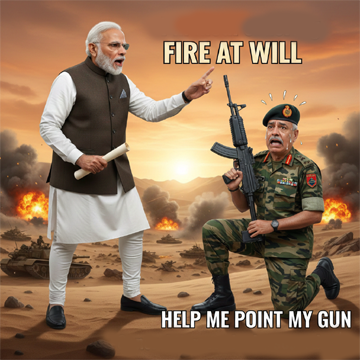
At the heart of the storm is a reported passage describing a moment in August 2020, when Chinese tanks and infantry advanced near Rechin La during the Ladakh crisis. According to excerpts that surfaced prior to formal release, Naravane recounts being told — via Defence Minister Rajnath Singh — that Prime Minister Narendra Modi had said: “Jo uchit samjho, woh karo” — do whatever you deem appropriate.
Naravane reportedly described the instruction as a “hot potato,” suggesting that the political leadership placed the onus entirely on him. That characterization has triggered sharp criticism. Was this an abdication of political guidance? Or was it the clearest form of strategic autonomy a professional soldier could receive? Navarane needs clerical guidance. That is shameful for a soldier who is most likely a clerk or a bureaucrat hidden inside an Army uniform. General Navarane needed written insurance, a form of attorney client priviledge between him and Prime Minister Narendra Modi who has always given the Indian Army carte blanche. If the General needed to protect his backside for future investigations then he ought to have stuck to a desk job. Corporate audits are not part of the Army discipline during war.
The “hot potato” or a carte blanche?
The phrase “Jo uchit samjho, woh karo” can be interpreted in two ways. One interpretation frames it as political distancing — leadership unwilling to assume responsibility. The other frames it as unequivocal trust: the government empowering its Chief of Army Staff to take operational decisions as he deemed fit.
In military doctrine, when a political authority articulates intent but grants operational discretion, it is not ambiguity — it is mission command. The philosophy is simple: political leadership sets objectives; military leadership determines how to achieve them.
To some critics, calling such autonomy a “hot potato” suggests discomfort with decisive responsibility. If a Chief of Army Staff is entrusted to act as he sees fit in a fast-moving battlefield scenario, that trust is not a burden unfairly imposed; it is the essence of the office.
The episode reportedly unfolded when Chinese forces were maneuvering toward Indian positions on the Kailash Heights. The situation was volatile. Escalation could have led to large-scale confrontation between two nuclear-armed neighbors. The decision to fire — or not to fire — would carry immense consequences.
But that is precisely why the position exists.
Command responsibility and the weight of decision
Military leadership is not clerical management. It is not about awaiting detailed written instructions on every maneuver. At the level of Army Chief, operational judgment is expected. When civilian leadership says “do what you think appropriate,” it signals confidence in professional assessment.
If that autonomy is perceived as abandonment, it raises questions about preparedness for the role. A Chief of Army Staff must be capable of independent battlefield calculus — weighing terrain, force ratios, logistics, escalation ladders, and geopolitical ramifications in real time.
To critics of Naravane’s memoir account, describing such authority as a “hot potato” risks implying reluctance to shoulder that responsibility. The phrase suggests something unwanted, risky, better passed on than owned. Leadership, however, is ownership.
The book, the leak, and the political firestorm
Four Stars of Destiny has not yet been formally released. Its publication has reportedly been delayed pending clearances from the Ministry of Defence. Excerpts that surfaced were described by the publisher, Penguin Random House, as originating from an unauthorized leak.
The leak triggered controversy in February 2026. Opposition leaders questioned whether the government had placed undue pressure on the Army Chief. Supporters of the government countered that operational autonomy is standard practice.
Memoirs are inherently selective narratives. They offer perspective, not official records. Yet when they touch on national security crises, even phrasing becomes politically explosive.
Rechin La, Kailash heights, and the 2020 standoff
The broader context is critical. The 2020 standoff along the Line of Actual Control followed months of rising tension. The clash in Galwan Valley shocked the nation. Diplomatic and Corps Commander-level talks were ongoing. On January 12, 2020, General Naravane publicly stated that the situation along the borders with China was under control and that bilateral dialogues were addressing perceived differences. Such statements are part reassurance, part diplomatic signaling. But August saw renewed friction near Rechin La and the Kailash Range. Terrain in this region is unforgiving. High-altitude warfare magnifies logistical strain. Any exchange of fire could escalate rapidly.
In such an environment, clarity of command is essential.
The contrast: Field Marshal Sam Manekshaw
To understand why critics have drawn sharp comparisons, one must revisit the example of Sam Manekshaw, one of India’s most revered military leaders.
In 1971, when Prime Minister Indira Gandhi sought swift military action in East Pakistan, Manekshaw reportedly responded with blunt professional candor. He explained that launching an immediate offensive would likely fail: monsoon marshlands would bog down tanks; logistics were unprepared; and China’s potential involvement remained a factor. He requested time — until winter — when terrain conditions would favor Indian armor and Himalayan passes would be less accessible.
His message was clear: “If you want victory, allow me to decide when and how to fight. If you insist on immediate action, I will obey — but we will likely lose.” Indira Gandhi granted him operational freedom. Months later, India achieved a decisive victory, leading to the creation of Bangladesh. The contrast lies not in whether autonomy was granted. In Manekshaw’s case, he asked for it explicitly. In Naravane’s reported account, autonomy was granted without being requested. The criticism emerging from some quarters is blunt: Manekshaw asserted professional judgment and accepted risk; Naravane, critics argue, appeared uneasy with the very discretion entrusted to him.
Civil-military balance in a democracy
India’s constitutional framework establishes civilian supremacy over the military. Political leaders define strategic objectives; the armed forces execute them. However, operational details are traditionally left to military professionals. When a Prime Minister communicates trust in a Chief’s judgment, that is not abdication. It reflects the principle that battlefield decisions cannot be micromanaged from political offices. To interpret such communication as insufficient direction suggests a misunderstanding of how modern militaries function. The concept of “fire at will” does not require literal phrasing. It can be embedded within the broader instruction: act as you deem appropriate. Critics argue that waiting for explicit phrasing in a rapidly evolving confrontation indicates excessive caution.
Risk, career calculus, and institutional culture
Another line of criticism — sharper and more personal — suggests that excessive risk aversion can shape decision-making at senior levels. Military careers are long. Pension security, post-retirement appointments, and reputation all factor into institutional incentives. If a leader believes that taking decisive action might invite investigation should outcomes sour, the temptation may be to delay, diffuse, or defer. But the highest ranks demand insulation from such considerations. Leadership at that level requires readiness to accept scrutiny in exchange for strategic clarity. The public expects decisiveness when national sovereignty is at stake. To critics, portraying the directive as a burden rather than empowerment exposes a deeper cultural issue: the tension between bureaucratic caution and battlefield boldness.
Statements of assurance and strategic messaging
Naravane’s January 2020 statement assuring that the border situation was under control reflects a delicate balance. Military leaders must reassure domestic audiences while maintaining deterrence credibility. Such public assurances are common. However, hindsight scrutiny often tests them. When subsequent escalations occur, earlier statements are revisited as evidence either of prudent diplomacy or misjudgment. In crisis management, perception matters as much as posture.
Revisiting appointment criteria
The controversy has revived discussion about how India selects its Army Chiefs. Seniority traditionally plays a central role. Yet critics argue that modern security challenges demand broader evaluation metrics: operational audacity, strategic clarity, inter-service coordination capability, and crisis communication strength. Reform proposals include structured psychological profiling for risk tolerance, independent review boards assessing combat command decisions, and expanded joint-service experience prerequisites. Supporters of the current system counter that India’s military has delivered consistent professionalism and that politicizing appointment debates risks undermining morale.
The memoir as historical artifact
Memoirs serve multiple purposes. They preserve memory, settle scores, explain decisions, and sometimes reshape narratives. For historians, they are invaluable but incomplete sources. Four Stars of Destiny reportedly covers Naravane’s four-decade career, including the Galwan clash and the implementation of the Agniveer recruitment scheme. Such breadth ensures the book will influence public understanding of a turbulent period. Yet memoirs also reflect the author’s emotional lens. Describing autonomy as a “hot potato” may reveal internal stress rather than objective misjudgment. Command at that altitude is isolating. Decisions involve lives, geopolitics, and national prestige.
Lessons from 1971 and 2020
The 1971 war demonstrated the synergy of political patience and military planning. Indira Gandhi allowed preparation time; Manekshaw delivered decisive results. The 2020 standoff, by contrast, unfolded in an era of instant media scrutiny, satellite imagery transparency, and social media speculation. Decision-making cycles are compressed; public narratives form in hours. The lesson may not be about personalities but about preparedness for ambiguity. Modern commanders must operate under intense informational pressure.
Strength, perception, and strategic signaling
India’s posture toward China requires calibrated strength. Escalation risks are real. Nuclear deterrence frames every calculation. Yet deterrence credibility also depends on perceived resolve. If public discourse portrays leadership as hesitant, adversaries may test boundaries. Conversely, excessive rhetoric without operational prudence can provoke escalation. Balance is delicate.
Beyond personalities: Institutional evolution
Ultimately, the debate should transcend individual critique. Whether one views Naravane’s memoir remarks as candid vulnerability or misplaced grievance, the larger issue is institutional clarity. How should political leaders communicate operational intent? How should military leaders interpret strategic latitude? What mechanisms ensure that autonomy is exercised confidently and responsibly? These are structural questions.
Autonomy is not ambiguity; stop sobbing General
When civilian leadership tells a Chief of Army Staff to act as he deems appropriate, it is not ambiguity. It is trust. It is mission command in its purest form. Comparisons to Field Marshal Sam Manekshaw underscore the enduring expectation that military leaders combine professional candor with decisive ownership. In 1971, autonomy was requested and granted. In 2020, according to the memoir account, autonomy was granted outright. The controversy surrounding Four Stars of Destiny illustrates how a single phrase can ignite national debate. But beneath the rhetoric lies a fundamental truth: leadership at the highest military level demands comfort with responsibility. History tends to reward clarity and courage. Memoirs may shape narratives, but outcomes shape legacy.