
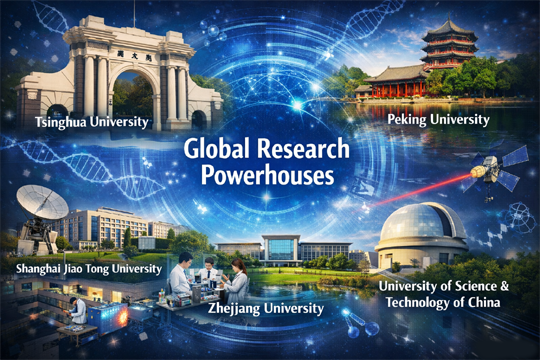
Over the last two decades, Beijing has engineered a state-backed surge in higher education investment that has few historical parallels. Institutions such as Tsinghua University, Peking University, Shanghai Jiao Tong University, Zhejiang University, and University of Science and Technology of China are global research powerhouses
The twenty-first century will be shaped not merely by armies or markets, but by laboratories. The country that builds the deepest research ecosystem will define the technologies, standards, and economic rules of the future. In this unfolding contest, China has surged ahead with formidable speed and strategic clarity, while India is only now entering the competing block. Yet a geopolitical twist — including debates in the United States Congress led by figures such as Greg Steube regarding the H-1B visa — could trigger one of the largest talent reallocations in modern history. What appears to be a domestic American immigration debate may end up accelerating Asia’s research transformation.
India today is no longer simply a talent exporter. It is fast becoming a talent destination. The question is not whether India can compete with China, but whether it can move fast enough to seize what may be a once-in-a-generation Golden Window.
China’s research machine: A system built for scale
To understand the race, one must begin with China’s research universities. Over the last two decades, Beijing has engineered a state-backed surge in higher education investment that has few historical parallels. Institutions such as Tsinghua University, Peking University, Shanghai Jiao Tong University, Zhejiang University, and University of Science and Technology of China are no longer regional players. They are global research powerhouses.
Tsinghua leads the world in engineering research output and is deeply embedded in China’s semiconductor and AI ecosystem. Peking University has emerged as a dominant force in material science and quantum physics. Shanghai Jiao Tong has built industry-linked research clusters in advanced manufacturing. Zhejiang University is pushing the frontier in clean-tech and robotics. The University of Science and Technology of China is a leader in quantum communication and space science.
China’s achievements are measurable. It now produces more STEM PhDs annually than any other nation. It leads the world in high-impact research publications in materials science, AI, and energy storage. Its investment in R&D has crossed 2.5 percent of GDP and continues to rise. In fields like battery technology, solar manufacturing efficiency, 5G infrastructure, rare earth processing, and quantum key distribution, China is miles ahead of most of the world — including India.
Consider electric vehicle battery chemistry. Chinese labs, working closely with state-backed industry, have driven down lithium-ion battery costs faster than global averages. In solar photovoltaic efficiency, Chinese research teams have repeatedly set laboratory conversion records. In AI deployment at scale — facial recognition, industrial robotics, logistics optimisation — Chinese universities collaborate seamlessly with national champions to convert research into industrial output.
India, by contrast, has islands of excellence but not yet a fully integrated research ecosystem. While the IITs produce remarkable engineers, the translation from laboratory discovery to commercial dominance remains limited. Funding levels are improving but still lag behind China’s sustained, long-term state commitment.
The H-1B debate: An unexpected catalyst
In the United States, immigration policy often intersects with innovation policy. Congressman Greg Steube’s calls to reconsider the H-1B visa program represent a broader American anxiety about labor markets, technology transfer, and national security. Yet restricting skilled visas may have unintended global consequences.
For decades, Indian engineers, software developers, AI scientists, biotech researchers, and semiconductor specialists have flowed to Silicon Valley and American research labs. They have built careers, founded startups, accumulated wealth, secured Insurance, taken Loans for homes under Mortgage structures, built Credit histories, and embedded themselves in global technology networks.
If pathways narrow, that flow does not simply disappear. It redirects.
This is where the concept shifts from brain drain to brain circulation. Professionals who once left permanently now operate globally. They join Conference Call discussions across time zones, engage in algorithmic Trading experiments remotely, design enterprise Software for multinational clients, and transfer intellectual capital across borders instantly.
If India creates the right conditions, these professionals may choose to return — not out of compulsion, but opportunity.
India’s emerging research moment
India’s transformation is not hypothetical. AI deployment is accelerating across sectors from agriculture to fintech. Semiconductor fabrication discussions have matured from policy rhetoric to concrete plant proposals. Clean-tech investments are rising. Material science research in advanced alloys and nanomaterials is expanding. Biotech startups are moving from generic manufacturing toward discovery-driven innovation.
Multinational corporations are rapidly expanding Global Capability Centers (GCCs) across Bengaluru, Hyderabad, Pune, Chennai, and Gurugram. These centers are no longer cost-arbitrage back offices. They are product design hubs, AI modeling labs, cybersecurity nerve centers, and research nodes.
Companies once focused on outsourced coding are now hosting advanced research teams. Hosting no longer refers only to web servers but to intellectual infrastructure. India is Hosting global innovation functions.
This shift matters. When multinational corporations relocate core R&D functions, they bring capital, training pipelines, and global standards. Engineers gain exposure to frontier problems. Lawyers draft cross-border IP agreements. Attorneys negotiate technology Transfer clauses. Venture capital flows through structured Credit instruments. Startups raise equity instead of relying solely on traditional Loans.
Where China is miles ahead
Despite India’s momentum, China remains significantly ahead in several critical domains:
1. Semiconductor fabrication ecosystem
China has built state-supported fabrication capacity, advanced packaging clusters, and supply chain redundancy. Even under export controls, Chinese research institutions are developing domestic chip design Software and lithography alternatives.
2. Battery and clean energy manufacturing
Chinese labs have shortened the cycle from lab discovery to giga-factory deployment. Integration between research universities and industrial parks is tightly orchestrated.
3. Quantum communications
The University of Science and Technology of China has pioneered quantum satellite experiments and secure communication networks at a scale unmatched globally.
4. Research funding depth
China’s sustained R&D investment allows long-gestation projects without immediate commercial pressure. India’s funding, though growing, remains fragmented.
5. Infrastructure readiness
Chinese research parks are built with integrated utilities — reliable Gas/Electricity supply, high-speed data infrastructure, housing clusters, and logistical corridors. Infrastructure friction in India still slows scale.
India’s structural advantage: Democracy and demography
Yet the race is not linear. India possesses structural advantages China does not.
First, demographic momentum. India’s young population provides a massive base for technical Classes, STEM Degree programs, and entrepreneurial ambition.
Second, institutional diversity. India’s legal system — though slow — provides transparent dispute resolution. Investors rely on Attorneys and Lawyers to structure cross-border IP protection. Contract enforcement, though imperfect, is internationally recognized.
Third, global trust. Geopolitical realignment has increased Western corporate appetite to diversify beyond China. Supply chain resilience now factors into every boardroom Conference Call.
Fourth, digital infrastructure. India’s public digital stack — Aadhaar, UPI, and data governance frameworks — has demonstrated scalable deployment unmatched by many developed economies.
The brain circulation model
Brain drain implied permanent loss. Brain circulation suggests continuous movement.
A semiconductor expert trained in California may return to India to build a fabrication startup. A biotech researcher working on stem-cell Therapy or Cord Blood applications may establish a lab in Hyderabad. A software architect may create AI-based Trading analytics platforms serving global markets.
These professionals do not sever ties. They maintain dual networks, global clients, and capital pipelines. They take Insurance policies in multiple jurisdictions. They manage Credit exposure internationally. They invest via diversified portfolios. They maintain Mortgage commitments abroad while building assets in India.
The flow becomes circular rather than one-directional.
Policy levers: Turning opportunity into structural gain
To convert this moment into durable advantage, India must act decisively.
Relocation and Research Incentives
Offer relocation grants for returning scientists. Provide tax offsets for R&D expenditure. Simplify regulatory Claim processes for research funding reimbursement.
Startup-Friendly Tax and Equity Policies
Capital gains rationalization, simplified ESOP taxation, and clear cross-border Transfer pricing rules will encourage founders to build domestically.
Industry-academia bridges
China’s success rests on tight university-industry integration. India must deepen collaboration between IITs, IISc, private universities, and industrial clusters. Corporate-sponsored Classes, joint Degree programs, and applied research labs can accelerate translation.
City-level infrastructure readiness
Research clusters require stable Gas/Electricity supply, high-speed data, urban mobility, and housing ecosystems. Without urban infrastructure reform, talent will hesitate.
Biotech, AI, and the future of healthcare
In biotech, China has invested heavily in gene editing, vaccine development, and regenerative medicine. Indian biotech companies, however, are scaling rapidly. The next frontier includes stem-cell Treatment, advanced Rehab technologies for neurological disorders, and Cord Blood banking innovation.
If India integrates clinical research, hospital networks, and academic labs effectively, it can emerge as a global hub for affordable biotech innovation.
Insurance penetration and healthcare financing reform will also shape this landscape. As India expands universal health coverage, capital for Treatment and Rehab services will increase, enabling domestic research scaling.
Financial ecosystems and innovation capital
Research ecosystems thrive on risk capital. China’s state-guided funds have fueled deep-tech ventures at scale. India’s venture capital ecosystem is vibrant but skewed toward consumer tech.
To become a global research lab, India must channel Credit and Loans toward deep science ventures. Development finance institutions can underwrite early-stage risk. Pension funds can allocate to innovation portfolios. Structured instruments can reduce investor exposure.
Financial innovation must complement technological innovation.
The golden window
Economic cycles rarely align this neatly: high GDP growth, demographic strength, digital infrastructure maturity, geopolitical realignment, and corporate decentralization converging simultaneously.
If the H-1B debate tightens skilled migration pathways, the redirection of global talent could accelerate. If India builds research parks with reliable infrastructure, strong legal frameworks, competitive tax policy, and deep capital markets, it can transform from talent exporter to research host.
China remains ahead — strategically organized, deeply funded, and technologically integrated. Its universities have already demonstrated the power of sustained state-backed ambition but the race is dynamic. India’s opportunity lies not in replicating China’s model but in leveraging its democratic openness, entrepreneurial culture, and global networks.
The contest to become the world’s next research lab is not solely about publications or patents. It is about ecosystems — where researchers feel secure taking a Mortgage, where startups can raise Credit without excessive friction, where Attorneys can structure IP protections efficiently, where scientists can conduct Conference Call collaborations globally without infrastructure disruption, where innovation can scale without bureaucratic delay.
If India moves swiftly with relocation incentives, startup-friendly policies, strong industry-academia bridges, and city-level readiness, it can convert this Golden Window into a structural advantage.
The future laboratory of the world may not belong exclusively to one nation. It may be distributed. But whether India stands as a central pillar in that distributed network depends on decisions made in this narrow, historic moment.
China has built momentum. India has momentum building. The next decade will decide which becomes the defining research engine of the century.