
If the Indian Parliament’s Lok Sabha were expanded to 850 seats and Pakistan-occupied Kashmir (PoK), including Azad Kashmir and Gilgit-Baltistan, were integrated into India, a new delimitation commission would determine the exact number of seats for democratic representation
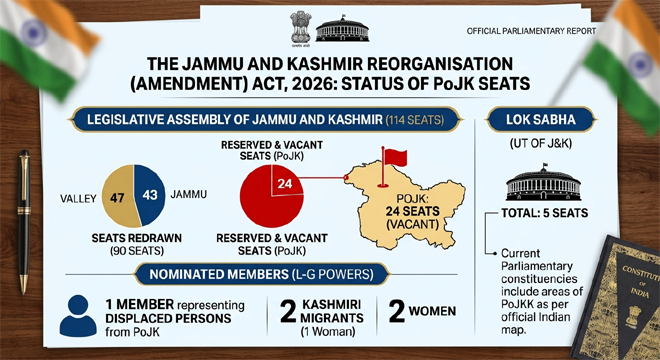
Based on current political positions and assembly seat reservations: 24 Seats Minimum: The Jammu and Kashmir Legislative Assembly has reserved 24 seats for the areas of PoK. These seats remain vacant in the UT assembly and are considered part of India’s territory. Expansion Mechanism: Recent proposals for a new delimitation (around 2026) in India indicate an intent to increase the total number of Lok Sabha seats, with the Election Commission of India empowered to act as the Delimitation Commission for areas under Pakistan’s occupation. 5-6 Seats Proposal: Previous parliamentary discussions (private member bills) have suggested adding five or six Lok Sabha seats reserved for the PoK and Gilgit-Baltistan region.
Therefore, if PoK were to be added to India under the scenario where the Lok Sabha is increased to 850 seats, approximately 5–6 additional Lok Sabha seats would likely be created for the region, bringing the total number of seats to 850 including those designated for the new territory. The actual number would be determined by a Delimitation Commission based on the population figures, which are currently unavailable for that region.
India’s parliamentary arithmetic has always been deeply tied to representation, federal balance, and the evolving idea of India itself. With discussions around a future delimitation exercise and the possibility of expanding the House to 850 seats, a new layer of complexity is added when one considers territories currently outside India’s administrative control, such as Pakistan-occupied Kashmir (PoK), including Azad Kashmir and Gilgit-Baltistan.
We explore the implications of such a scenario, combining constitutional provisions, historical claims, demographic logic, and political realities to understand how representation might evolve if these territories were formally integrated into India.
Understanding delimitation and its historical context
Delimitation in India refers to the process of redrawing the boundaries of electoral constituencies to reflect changes in population. This task is carried out by the Delimitation Commission of India, whose decisions are legally binding and cannot be challenged in court. The aim is simple in theory: ensure that each elected representative in the Lok Sabha represents roughly an equal number of citizens.
India has undergone several delimitation exercises since independence, but the process was frozen in 1976 through a constitutional amendment to encourage population control measures. This freeze was extended until 2026, meaning that for decades, parliamentary representation has not kept pace with demographic changes.
As India approaches this deadline, discussions about a fresh delimitation exercise have intensified. One proposal often discussed is expanding the Lok Sabha to around 850 seats to better reflect India’s massive and unevenly distributed population. Such an expansion would significantly alter political representation across states, particularly benefiting those with higher population growth.
Now, when one introduces the question of Pakistan-occupied territories into this framework, the issue becomes not just one of arithmetic but also of sovereignty and constitutional intent.
The constitutional position on Pakistan-occupied Kashmir
India has consistently maintained that the entire region of Jammu and Kashmir, including areas currently under Pakistani control, is an integral part of its territory. This claim is reflected in the structure of the Jammu and Kashmir Legislative Assembly, which historically reserved 24 seats for constituencies in Pakistan-occupied Kashmir. These seats remain vacant, symbolizing India’s claim over the region.
This reservation is not merely symbolic—it provides a constitutional basis for future integration. If these territories were to come under Indian administration, the existing framework would allow for their political incorporation without requiring a fundamental reimagining of the constitutional structure.
However, translating this into Lok Sabha representation is not straightforward. Parliamentary seats are allocated based on population, and reliable demographic data for PoK, Azad Kashmir, and Gilgit-Baltistan is limited or contested. This uncertainty makes precise calculations difficult, forcing policymakers to rely on estimates and precedents.
Estimating representation: the 5–6 seat framework
One commonly cited estimate in policy discussions is that the inclusion of PoK and adjacent regions could result in approximately 5 to 6 Lok Sabha seats. This figure has appeared in various parliamentary debates and private member proposals, reflecting a rough consensus based on population approximations.
To understand this estimate, it is useful to consider how Lok Sabha constituencies are typically structured. On average, each constituency represents between 1.5 to 2 million people, although this varies significantly across states. If one assumes a combined population of roughly 8 to 12 million across PoK, Azad Kashmir, and Gilgit-Baltistan, the allocation of 5–6 seats appears consistent with existing norms.
However, this is only a starting point. A future delimitation exercise conducted by the Election Commission of India, acting in the capacity of a delimitation authority, would likely refine these numbers based on more accurate data.
The mechanics of expanding the Lok Sabha to 850 seats
The idea of expanding the Lok Sabha to 850 seats is rooted in the need to improve representation in a country of over 1.4 billion people. The current strength of 543 elected members means that each MP represents, on average, more than 2.5 million citizens—far higher than in most democracies.
An expansion to 850 seats would reduce this ratio significantly, making MPs more accessible and constituencies more manageable. It would also allow for better representation of rapidly growing states such as Uttar Pradesh, Bihar, and Madhya Pradesh.
In this expanded framework, the inclusion of PoK would not necessarily increase the total beyond 850. Instead, the 5–6 seats allocated to these territories would likely be included within the overall cap. In other words, the total number of seats would remain 850, but a small portion would be designated for the newly integrated regions.
This approach aligns with how India has historically managed territorial changes, ensuring that the overall structure of Parliament remains stable while accommodating new realities.
Population data challenges and their implications
One of the biggest challenges in determining representation for PoK and related regions is the lack of reliable population data. Unlike Indian states, which conduct regular censuses through the Office of the Registrar General and Census Commissioner of India, these territories do not have data that is easily verifiable or compatible with Indian statistical standards.
This creates a dilemma for policymakers. On one hand, representation must be based on population to maintain democratic fairness. On the other hand, waiting for perfect data could delay political integration.
A likely solution would be to use provisional estimates during the initial phase, followed by adjustments in subsequent delimitation exercises. This approach would allow for immediate representation while preserving the flexibility to refine seat allocations over time.
Political and strategic considerations
Beyond the technical aspects, the inclusion of PoK in India’s parliamentary framework carries significant political and strategic implications. It would signal a major shift in regional dynamics and could influence India’s internal political landscape.
For instance, the addition of 5–6 seats might seem minor in numerical terms, but in a closely contested Parliament, even a handful of seats can be decisive. These seats could also bring new voices and perspectives into national politics, reflecting the unique cultural and geographic characteristics of the region.
Moreover, the process of integration would likely involve not just parliamentary representation but also administrative restructuring, infrastructure development, and social integration. Each of these factors would influence how effectively the new constituencies are represented in Parliament.
Lessons from past territorial integrations
India’s history offers several examples of how new territories have been integrated into its political system. From the accession of princely states to the reorganization of states along linguistic lines, the country has repeatedly demonstrated its ability to adapt its institutional framework.
In each case, representation in the Lok Sabha was adjusted to reflect the new realities. This suggests that the inclusion of PoK, while complex, would not be unprecedented. The key challenge would be ensuring that the process is transparent, equitable, and consistent with constitutional principles.
The role of future delimitation commissions
Ultimately, the exact number of seats allocated to PoK would be determined by a future delimitation exercise. This process would likely involve extensive data collection, public consultations, and legal scrutiny.
The role of the delimitation authority—whether it is a standalone commission or the Election Commission acting in that capacity—would be crucial in ensuring that the final outcome is both fair and credible. Given the political sensitivity of the issue, the process would need to be insulated from partisan pressures.
A numerical conclusion with broader implications
If one were to answer the original question directly: in a Lok Sabha expanded to 850 seats, the inclusion of Pakistan-occupied Kashmir, including Azad Kashmir and Gilgit-Baltistan, would likely result in the allocation of approximately 5–6 seats to the region. These seats would be part of the total 850, not in addition to it.
However, this numerical answer only scratches the surface. The real significance lies in what such a change would represent—a redefinition of India’s political geography, a test of its democratic institutions, and a reaffirmation of its constitutional claims.
In the end, delimitation is not just about drawing lines on a map. It is about shaping the voice of a nation. And in a country as vast and diverse as India, every seat in the Lok Sabha carries with it the weight of millions of aspirations, making the question of representation both deeply technical and profoundly human.