
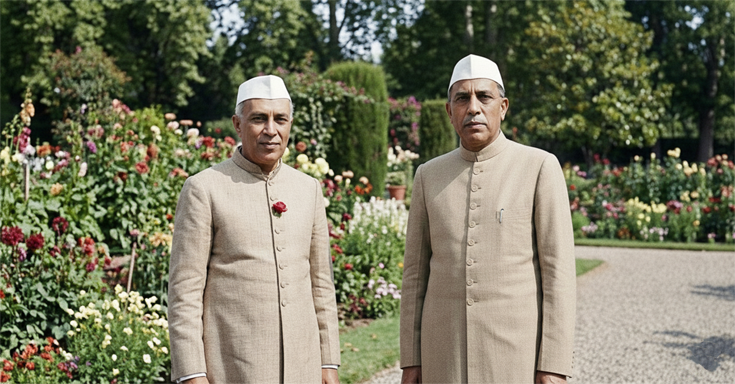
Kashmir was rendered a mess by five people. Talk about too many cooks or some ill-intentioned – bad cooks. Jawaharlal Nehru (first Prime Minister of Republic of India), Sheikh Abdullah (first Prime Minister of Jammu and Kashmir acceded to Republic of India), Raja Hari Singh (last ruling Maharaja of the independent princely state of Jammu and Kashmir), Muhammad Ali Jinnah (founder and first Governor-General of Pakistan) and Liaquat Ali Khan (first Prime Minister of Pakistan)
The Valley of Kashmir—once the serene Kingdom of Kashmir ruled by Maharajas, celebrated in poetry and legend—became, over the course of seven decades, a geopolitical labyrinth. The region’s tumultuous transformation from an independent princely state to the most militarized zone in the world was not accidental. It was the cumulative result of decisions—some botched, some self-serving, and some simply naïve—by five pivotal characters:
Jawaharlal Nehru, Sheikh Abdullah, Maharaja Hari Singh, Muhammad Ali Jinnah, and Liaquat Ali Khan.
Their actions, inactions, hesitations, ambitions, and rivalries created a patchwork of political complexity that kept Kashmir trapped in conflict long after 1947. The mess that began with the tribal invasion of 1947 evolved into wars, constitutional ambiguities, insurgency, and deep-rooted separatism—all of which persisted until 2019, when Prime Minister Narendra Modi and Home Minister Amit Shah undertook a radical restructuring of Jammu & Kashmir’s political status.
This article explores how the five original players shaped the Kashmir problem, how the conflicts unfolded through key military operations, and how, decades later, India began clearing the 72-year-old tangle through the abrogation of Article 370 and the region’s administrative reorganization.
I. How five men created the Kashmir imbroglio
Kashmir’s post-Partition chaos was not a natural outcome of history—it was the product of errors and conflicting ambitions of five central figures.
1. Maharaja Hari Singh: The reluctant decision maker
Hari Singh, the last ruling Maharaja of the princely state of Jammu and Kashmir, hoped to remain independent. He neither wanted to join India nor Pakistan. His indecision proved disastrous.
- He delayed signing the Instrument of Accession.
- He underestimated Pakistan’s intentions.
- He failed to anticipate the tribal invasion that overwhelmed his forces.
His belated signing of the accession on October 26, 1947, came only after Pakistan-backed Lashkars swept into Kashmir, committing atrocities and marching toward Srinagar.
2. Muhammad Ali Jinnah: The architect of the first invasion
Jinnah, determined to bring Kashmir into Pakistan, signed off on Operation Gulmarg—a covert plan that sent tribal militias and disguised Pakistani soldiers into the Valley.
- Jinnah personally endorsed the invasion plan.
- The covert attack violated the Standstill Agreement the Maharaja had signed with Pakistan.
- The invasion was intended to force Kashmir’s accession to Pakistan before India could intervene.
This decision triggered the first Indo–Pak war.
3. Liaquat Ali Khan: The strategic executor
As Pakistan’s first Prime Minister, Liaquat Ali Khan supported the invasion politically and logistically:
- He green-lighted troop support under the disguise of tribal Lashkars.
- He ensured Pakistan’s military leadership had the political cover to intervene.
Thus, Jinnah conceptualized the Kashmir push; Liaquat helped operationalize it.
4. Jawaharlal Nehru: The idealist who looked away
Nehru’s emotional connection to Kashmir influenced his political decisions—sometimes detrimentally.
- He delayed troop deployment until the Maharaja signed accession, even as the invasion intensified.
- He sidelined the more pragmatic Sardar Vallabhbhai Patel, who wanted quicker, firmer action.
- His trust in Sheikh Abdullah’s leadership shaped the internal politics of Kashmir for decades.
Nehru’s decisions did secure Kashmir’s legal accession to India—but also sowed long-term complications.
5. Sheikh Abdullah: The Lion of Kashmir with a complicated legacy
Sheikh Abdullah, the popular leader of Kashmiris, became the first Prime Minister of Jammu & Kashmir after accession.
But his political journey was turbulent:
- Nehru supported him, often at the expense of other voices.
- He sought autonomy and advocated special privileges for Kashmir.
- His rhetoric and fluctuating positions contributed to the creation of Article 370.
- Later, India dismissed and imprisoned him, accusing him of separatist leanings.
Together, these five men shaped the early decades of Kashmir’s political structure—one that remained frozen until the 21st century.
II. The military story: How wars and operations shaped Kashmir’s map
Kashmir’s political mess was compounded by military conflicts that shaped borders, identities, and narratives on both sides.
1. The 1947–48 tribal invasion: Operation Gulmarg
Pakistan’s first offensive was executed by:
- Brigadier Akbar Khan, under the code name Tariq
- Tribal Lashkars trained or aided by the Pakistan Army
- Political endorsement from Jinnah and Liaquat Ali Khan
Key Pakistani figures included:
- Sardar Shaukat Hayat Khan
- Major Khurshid Anwar
The raiders advanced rapidly until they met heroic resistance from:
- Brigadier Rajinder Singh, the Commander-in-Chief of J&K State Forces, who held them off long enough for the Indian Army to arrive, sacrificing his life in the process.
India airlifted troops into Srinagar only after the Instrument of Accession was signed, marking the official beginning of the first Indo–Pak war.
2. The 1965 War: Operation Gibraltar and Grand Slam
Pakistan tried again nearly two decades later.
Political leadership:
President Ayub Khan of Pakistan, who approved the strategy mistakenly believing that Kashmiris would rise in revolt against India.
Military commanders:
- General Musa Khan (Pakistan Army Chief)
- Major General Akhtar Hussain Malik (Pakistan Army for Operation Gibraltar)
- General Yahya Khan (Pakistan Army – later political head of Pakistan)
Pakistan infiltrated thousands of guerrillas into Kashmir to incite an uprising. The plan backfired. Locals did not join the rebellion. India retaliated strongly, capturing strategic positions including Barki near Lahore under commanders like Maj Gen Har Kishan Sibal.
3. 1971 and Sam Manekshaw’s Legacy
Field Marshal Sam Manekshaw is often incorrectly linked to the “gaining of Kashmir.” In reality:
- His legendary success was in 1971, leading India to a decisive victory against Pakistan and facilitating the creation of Bangladesh.
- The borders of Kashmir were not significantly altered in this war.
Thus, Kashmir was not “won” by a single Indian Army Chief. It was acceded through a legal document and subsequently defended through multiple military operations by different leaders.
Who Secured Kashmir for India?
The real answer is a sequence, not an individual:
- Hari Singh signed the accession.
- Brigadier Rajinder Singh (Jammu and Kashmir Army) delayed the invasion.
- Indian Army commanders from 1947 to 1971 fought off Pakistani operations.
- Political and military decisions over decades preserved India’s control.
III. A Mess That Lasted 72 Years
From 1947 to 2019, Kashmir operated under a semi-autonomous structure, shaped by Articles 370 and 35A:
- It had its own Constitution and flag.
- Indian laws applied selectively.
- Non-residents were barred from land ownership and government jobs.
- A web of special privileges kept the region insulated from national integration.
This framework, born of the political dealings among Nehru, Abdullah, and Hari Singh, and reinforced by decades of insurgency and separatism, kept Kashmir in constitutional and psychological limbo.
IV. August 5, 2019: The Day the Knot Was Untied
On August 5, 2019, the Modi–Shah leadership fundamentally changed the trajectory of Jammu & Kashmir.
1. Abrogation of Article 370
Article 370—which granted special status to J&K—was effectively revoked.
This meant:
- No separate Constitution
- No separate flag
- Full applicability of the Indian Constitution
In December 2023, the Supreme Court upheld this decision.
2. Reorganization of the State
The state was bifurcated into:
- Union Territory of Jammu & Kashmir (with legislature)
- Union Territory of Ladakh (without legislature)
This restored direct central administration while laying groundwork for stable local governance.
V. Post-2019: Integrating Jammu & Kashmir into the national mainstream
The revocation of Article 370 was not merely symbolic—it triggered a series of structural, legal, and developmental transformations.
A. Legislative and administrative integration
1. Application of central laws
Nearly 890 Indian laws—previously excluded—now apply in J&K.
This includes laws protecting:
- Dalits
- Adivasis
- Women’s rights
- Children’s rights
- Labor rights
For the first time, these groups receive the same protections as other Indian citizens.
2. End of permanent residency privileges
With Article 35A abolished:
- Non-residents can buy land.
- All Indians can apply for government jobs.
- Private investment is now viable.
3. Grassroots democracy
The three-tier Panchayati Raj structure—non-existent for decades—is now fully operational:
- Panchayats
- Block Development Councils
- District Development Councils
This shift represents genuine decentralization.
4. Reservation benefits
SC, ST, and OBC reservations now apply in:
- Employment
- Local body elections
- Educational institutions
The political system of J&K now mirrors that of the rest of the country.
b. Development and economic revitalization
1. Industrial development
A new industrial policy pushed investment proposals worth ₹80,000 crore, a first in J&K’s history where private investment previously stagnated due to legal restrictions.
2. Infrastructure push
Major projects underway or completed include:
- The world’s tallest railway bridge over the Chenab
- The completion of the Udhampur–Srinagar–Baramulla Railway Link (USBRL)
- Enhanced road and tunnel infrastructure ensuring all-weather connectivity
3. Agriculture and horticulture transformation
The ₹5,000-crore Holistic Agriculture Development Programme (HADP) aims to modernize:
- Apple and saffron cultivation
- Dairy and livestock management
- Marketing and export channels
4. Tourism revival
Tourism has surged, aided by:
- ₹1,400 crore in tourism-specific projects
- Development around the Hazratbal Shrine
- Opening new destinations in Kupwara, Poonch, and Gurez
Kashmir recently recorded its highest-ever tourist footfall.
5. Education and healthcare expansion
New institutions include:
- AIIMS Jammu and AIIMS Kashmir
- IITs and IIMs
- New medical colleges
- Nursing and paramedical institutes
These investments aim to reverse decades of neglect.
C. Security stabilization and social integration
1. Improved Security Situation
Government data indicates:
- Sharp decline in stone-pelting
- Fewer militant recruitments
- Decline in Pakistan-backed networks
- Reduction in street violence and shutdowns
Daily life has normalized compared to the years of unrest between 1990 and 2016.
2. Government outreach
Union Ministers regularly tour the region to gather citizen feedback and monitor implementation.
3. National symbolism and identity
- The national flag now flies at all government buildings.
- National holidays are celebrated publicly with growing participation.
These symbolic integrations reinforce the Valley’s connection with the rest of India.
VI. A valley reclaiming stability after seven decades
The story of Kashmir is one of political missteps followed by the weight of decades of conflict. The early decisions of Nehru, Sheikh Abdullah, Hari Singh, Jinnah, and Liaquat Ali Khan thrust the region into a vortex that neither diplomacy nor armed conflict could fully resolve.
But the developments after 2019 mark a decisive shift. With the removal of Article 370, the integration of central laws, an unprecedented development push, strengthened security, and revived democratic institutions, Jammu & Kashmir is experiencing structural change unseen since 1947.
It is not the end of the journey—social, psychological, and economic transitions take time. But for the first time in 72 years, the foundations of a stable, integrated, and prosperous Kashmir are firmly in place.