
A less than five hours drive is Western Uttar Pradesh, where particularly districts such as Muzaffarnagar, Shamli, Meerut, Baghpat, and Saharanpur, form the historic heartland of North India’s gur production. The region benefits from fertile alluvial soil, abundant canal irrigation from the Ganga-Yamuna Doab system, and generations of sugarcane farming expertise
The search for authentic jaggery, the kind that tastes like childhood winters, smoky kolhus, and freshly crushed cane, has become surprisingly difficult in and around Delhi. Much of the jaggery sold in urban markets today is adulterated with refined sugar, chemical clarifiers, artificial colors, or glucose syrup to improve appearance, hardness, and shelf life. Consumers who grew up eating traditional gur often notice that modern versions are unnaturally brittle, excessively sweet, or lacking the deep molasses aroma that once defined the product. The good news is that within a five-hour driving radius from Delhi lies one of the world’s largest traditional jaggery belts, stretching across western Uttar Pradesh, parts of Haryana, and the upper Doab region. With a little knowledge and careful sourcing, residents of Delhi can still obtain genuinely unadulterated sugarcane jaggery directly from farmers, kolhus, and mandi networks. This article explores where to find it, how to identify it, and why geography matters when authenticity is the goal.
The geography of India’s traditional jaggery belt near Delhi
Western Uttar Pradesh, particularly districts such as Muzaffarnagar, Shamli, Meerut, Baghpat, and Saharanpur, forms the historic heartland of North India’s gur production. The region benefits from fertile alluvial soil, abundant canal irrigation from the Ganga-Yamuna Doab system, and generations of sugarcane farming expertise. Before industrial sugar mills expanded, farmers commonly processed cane juice themselves using wood-fired evaporators, producing jaggery for both local consumption and trade. Even today, thousands of small seasonal units operate during the cane crushing season (roughly November to March), making it one of the best times to source fresh gur.
For Delhi residents, these areas are easily accessible by road within two to five hours, making direct purchase feasible without intermediaries. The closer you get to the production zone, especially villages rather than city markets, the higher the probability of finding jaggery that has not been mixed with refined sugar.
Muzaffarnagar: the jaggery capital within reach
Among all nearby destinations, Muzaffarnagar is widely considered the epicenter of North India’s jaggery trade. The district produces massive quantities of gur annually, supplying wholesalers across the country. Its large agricultural mandis handle everything from freshly molded blocks to powdered jaggery and specialty varieties.
One option for visitors is the Muzaffarnagar mandi network, including trading hubs such as Molhar Mal Mahender Kumar and the broader Muzaffarnagar Mandi complex, where farmers and traders converge. Buyers willing to speak directly with producers can often request “desi kolhu gur”, jaggery made without additives. Another specialized retailer is RAW JAGGERY, which markets minimally processed jaggery products and can be a starting point for urban consumers seeking quality.
Driving time from Delhi typically ranges between 3 and 4 hours via NH-334, making it one of the most practical sourcing locations. The advantage of Muzaffarnagar lies in scale: multiple suppliers, competition among producers, and access to freshly produced batches during the season.
Shamli and the surrounding villages
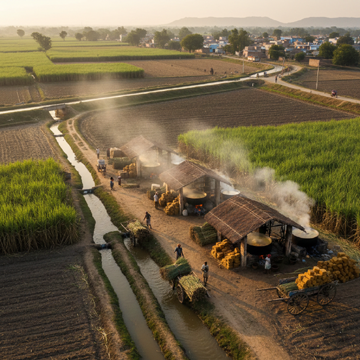
Just south of Muzaffarnagar lies Shamli district, another stronghold of small-scale jaggery production. Unlike larger mandis, Shamli offers easier access to village-level kolhus where jaggery is produced in traditional open pans using bagasse (sugarcane fiber) as fuel. Buyers who want the purest form, often softer, darker, and more aromatic, may prefer purchasing directly from such units.
Local agricultural markets like R.P. Traders Shamli serve as aggregation points for farm produce, including gur. However, the best strategy is often to drive into nearby villages during the crushing season and request to buy directly from farmers. Many producers sell surplus batches informally to visitors.
The Delhi-to-Shamli drive is about 2.5 to 3 hours, making it one of the closest authentic sourcing zones.
Meerut and Baghpat: closer alternatives to Delhi
For those unwilling to drive deep into Uttar Pradesh, districts like Meerut and Baghpat provide nearer options. Both regions grow significant sugarcane and host seasonal jaggery production units.
Baghpat district, located barely 1.5 to 2 hours from Delhi, has numerous cane farms and small processing setups around rural belts near the Yamuna. Facilities such as Baghpat Sugar Mill coexist with traditional units, though buyers should note that mill-adjacent products may be more commercialized. The best quality typically comes from independent village producers rather than large industrial facilities.
Meerut district also offers opportunities to find kolhu-made jaggery, especially in rural areas outside the main city. Visiting weekly rural haats (markets) can yield surprisingly authentic products if one knows how to evaluate them.
Haryana’s jaggery clusters within driving distance
Although western Uttar Pradesh dominates production, parts of Haryana, including districts like Karnal, Panipat, and Yamunanagar, also produce traditional jaggery. These regions are reachable within 2 to 4 hours from Delhi and may offer slightly different flavor profiles depending on cane variety and processing methods. Haryana jaggery sometimes has a lighter color and milder molasses taste compared with the darker gur from Uttar Pradesh.
Farm visits, local mandis, and roadside kolhus are often the most reliable sources. Winter highway drives frequently reveal temporary jaggery stalls selling freshly molded blocks.
Delhi’s own wholesale hubs for jaggery
For those unable to travel, Delhi itself has wholesale distribution points where jaggery from production regions arrives. One such hub is Gur Mandi in the northern part of the city. While not all products there are guaranteed to be pure, knowledgeable buyers who ask about origin and production methods can sometimes locate high-quality batches sourced directly from villages.
However, urban wholesale markets carry a higher risk of adulteration compared with direct farm purchases because traders may mix or reprocess jaggery for appearance and uniformity.
Why adulteration happens and how to avoid it
Refined sugar adulteration is primarily driven by economics and aesthetics. Adding sugar crystals increases hardness, improves shelf stability, and produces a lighter, more visually appealing product that urban consumers often prefer. Chemical clarifiers may also be used to remove impurities quickly, resulting in unnaturally bright yellow or golden blocks.
To avoid adulterated jaggery, buyers should rely on sensory evaluation. Pure jaggery often has a slightly uneven color, sometimes darker brown patches, and a soft or chewy interior. It should smell strongly of cane juice and caramelized molasses rather than plain sweetness. When broken, it may crumble irregularly rather than snapping cleanly like candy.
Seasonal freshness is another clue. Fresh winter jaggery tends to retain moisture and softness, whereas heavily adulterated versions remain rock-hard for months.
The kolhu experience: buying directly from producers
One of the most rewarding ways to obtain authentic jaggery is visiting a working kolhu, the traditional crushing and boiling unit. During the season, cane stalks are fed into crushers powered by diesel engines or electric motors. The juice flows into large iron pans where it is boiled and concentrated over wood or bagasse fires. Workers skim impurities manually, and the thick syrup is poured into molds to cool.
Buying directly from such units offers several advantages: transparency in production, freshness, and often lower prices than urban markets. Many farmers welcome visitors, especially if purchases are made in bulk.
Seasonal timing and travel planning
The jaggery season typically runs from November to March, with peak production between December and February. Visiting during this period dramatically increases the chance of finding fresh, additive-free gur. Outside the season, most available jaggery has been stored for months, increasing the likelihood of processing or mixing.
Travel planning should also consider rural road conditions, which can vary. Early morning departures from Delhi help avoid traffic and allow buyers to reach villages during active production hours.
Health and cultural reasons for choosing pure jaggery
Beyond taste, many consumers seek pure jaggery for perceived health benefits. Traditional gur contains trace minerals such as iron, potassium, and magnesium, along with small amounts of antioxidants derived from cane juice. While it remains a sugar and should be consumed in moderation, it is often considered nutritionally superior to refined white sugar.
Culturally, jaggery holds deep significance in Indian cuisine, festivals, and seasonal diets. Winter foods like til-gur sweets, chikkis, and laddoos rely heavily on its distinctive flavor. Using adulterated jaggery can noticeably alter traditional recipes.
Price expectations and bargaining
Prices vary depending on quality, season, and source. Direct farm purchases are usually cheaper than urban retail, but premium artisanal jaggery may cost more due to labor-intensive production. Buyers should expect to pay extra for chemical-free, traditionally processed gur, especially if certified organic.
Bulk buying with friends or family can reduce costs and justify the travel effort.
Emerging trends: organic and specialty jaggery
In recent years, demand for chemical-free and organic jaggery has grown among urban consumers. Some producers now market specialty varieties such as turmeric jaggery, ginger jaggery, and liquid jaggery (kakvi). While these products can be authentic, buyers should verify production methods carefully because labeling standards are inconsistent.
Direct relationships with farmers remain the most reliable assurance of purity.
Practical recommendations for Delhi residents
For maximum authenticity, a Delhi resident should consider the following strategy. First, plan a winter road trip to western Uttar Pradesh, targeting Muzaffarnagar or Shamli districts. Second, visit village kolhus rather than relying solely on city markets. Third, sample before purchasing and observe texture, smell, and color carefully. Fourth, buy enough quantity to last several months, storing it in airtight containers in a cool, dry place.
Those unable to travel can explore Delhi’s wholesale hubs and ask specifically for “kolhu ka desi gur from Muzaffarnagar or Shamli,” though results may vary.
The enduring appeal of real jaggery
The search for unadulterated jaggery is ultimately about more than food. It reflects nostalgia, trust in traditional methods, and a desire to reconnect with agricultural roots that urban life often obscures. Within a few hours of Delhi lies a living heritage of sugarcane cultivation and artisanal processing that continues despite industrial pressures.
For anyone willing to drive beyond the city limits, the reward can be profound: warm, fragrant blocks of freshly made gur that taste exactly like the winters of childhood, before refined sugar changed everything.
One-day road trip from Delhi to buy pure jaggery
Route option 1: Delhi → Shamli → Muzaffarnagar (best overall choice)
This is the most recommended route because it combines village-level production and large mandis.
Total driving time (round trip): 7–9 hours
Best season: December to February
Departure time: 6:00–6:30 AM
Stop 1: Baghpat belt (optional warm-up stop)
Drive via:
Delhi → Loni → Baraut → Baghpat
Travel time: 1.5–2 hours
The Baghpat region has many small roadside kolhus during winter. You may find fresh jaggery blocks sold directly near farms.
You can also explore around:
- Baghpat
This stop is optional but useful if you want to compare quality before going deeper into the jaggery belt.
Stop 2: Shamli villages — direct from farmers
Continue toward Shamli (about 1 hour from Baghpat).
This is where you start finding truly traditional jaggery.
One notable producer cluster:
- HANS HERITAGE JAGGERY AND FARM PRODUCE
Around Jhinjhana, Unn Road, and nearby villages you’ll see multiple working kolhus in winter.
What to do:
- Ask locals: “Kolhu ka desi gur kahan milta hai?”
- Visit 2–3 units before buying.
- Taste before purchase.
You will often get softer, aromatic gur here — usually the most authentic.
Stop 3: Muzaffarnagar mandi — bulk purchase hub
Drive another 45–60 minutes to Muzaffarnagar.
Major trading hub:
- Jaggery Enterprise in Muzaffarnagar mandi
Muzaffarnagar has one of India’s largest jaggery markets. Here you can buy:
- Solid blocks
- Powdered jaggery
- Liquid jaggery
- Specialty varieties
Advantage: Multiple suppliers → easier to compare quality.
Tip: Ask for “kolhu wala desi gur — bina cheeni milawat.”
Suggested timeline for the day
6:00 AM — Leave Delhi
8:00 AM — Reach Baghpat area (optional stop)
9:30 AM — Reach Shamli villages, visit kolhus
12:30 PM — Lunch break (local dhaba)
1:30 PM — Reach Muzaffarnagar mandi
3:30 PM — Start return
7:30–8:30 PM — Reach Delhi
Route option 2: Delhi → Meerut rural belt (shorter trip)
If you want a shorter journey:
Delhi → Ghaziabad → Meerut villages
Travel time: 2–2.5 hours one way.
Look for:
- Village kolhus outside the city
- Weekly rural haats
- Farm gate sellers
Quality can be good, but selection is smaller than Muzaffarnagar/Shamli.
How to identify pure jaggery on the spot
When you visit farms or mandis, use these tests:
Texture test
- Pure: slightly soft or chewy center
- Adulterated: very hard, brittle, glass-like snap
Smell test
- Pure: strong sugarcane/molasses aroma
- Adulterated: mostly sweet, little aroma
Color test
- Pure: uneven brown to dark golden
- Chemical: bright yellow or uniform
Dissolving test (quick)
Break a piece into warm water:
- Pure: cloudy sediment, slow dissolve
- Adulterated sugar mix: clear dissolve quickly
How much to buy
Typical household storage:
- 5–10 kg lasts several months
- Store airtight in cool place
- Avoid moisture exposure
Fresh winter jaggery stays good 6–8 months easily.
Expected price range (seasonal)
Prices vary yearly, but typically:
- Farm purchase: ₹45–70 per kg
- Mandi retail: ₹55–90 per kg
- Organic branded: ₹120–250 per kg
Higher price does not always mean better purity — farm sourcing matters more.
Food stops during the trip (recommended experience)
Part of the charm is the rural food culture.
Look for:
- Sarson ka saag & makki roti
- Fresh sugarcane juice
- Gur chai (tea sweetened with jaggery)
Highway dhabas around Shamli and Muzaffarnagar are famous for winter meals.
Why this belt gives the best jaggery near Delhi
Western UP has advantages:
- Fertile alluvial soil
- High-sucrose cane varieties
- Generations of processing skill
- Thousands of small seasonal kolhus
- Massive mandi ecosystem
This combination is difficult to replicate elsewhere near Delhi.
Pro tips from experienced buyers
- Always taste before buying bulk.
- Buy from at least two different producers.
- Avoid overly shiny or perfectly uniform blocks.
- Softer gur is usually less adulterated.
- Morning purchases are freshest.
- Farmers are friendlier if you show genuine interest.
If you cannot travel
Delhi wholesale option:
- Gur Mandi (North Delhi area)
But purity varies — travel is still best.
The real reward
Many people who make this trip say the same thing: the moment you smell freshly boiling cane juice in a village kolhu, you realise how different real jaggery is from supermarket versions.
It’s not just food — it’s an agricultural heritage experience.

