
For Israel, which views military autonomy as existential, dependence on the United States is proving to be uncomfortable. Recent conflicts have underscored how supply chains can be delayed, approvals slowed, and political pressure exerted at precisely the moment speed and discretion matter most. India looks like a more like-minded ally at this juncture
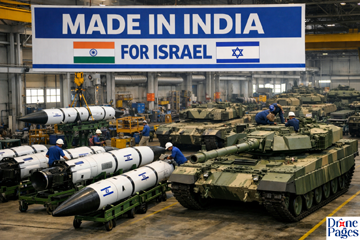
For decades, Israel’s military strength rested on a paradox. It possessed one of the world’s most advanced defence innovation ecosystems yet remained structurally dependent on the United States for critical military ordnance, platforms, and diplomatic cover. That arrangement, forged during the Cold War and reinforced through successive conflicts, delivered undeniable advantages—but it also imposed limits.
Those limits are now being tested.
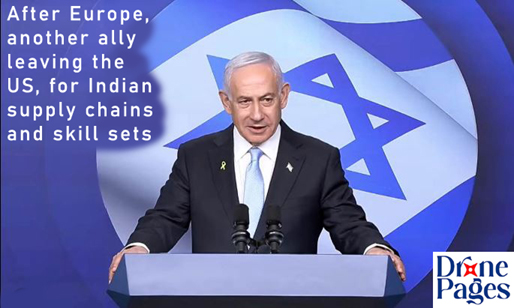
Prime Minister Benjamin Netanyahu’s recent push to make Israel independent in military ordnance manufacturing marks a profound strategic shift. At its core lies a simple but uncomfortable truth: dependence invites leverage. And leverage, in moments of political divergence, becomes constraint. Israel no longer wants the United States—or any external power—dictating terms in areas central to its national security.
This recalibration is not about abandoning alliances. It is about hedging them. And in that hedge, India has emerged not merely as a supplier, but as a foundational partner.
Israel wants out of the U.S. umbilical cord
The United States remains Israel’s largest defence partner, but the relationship has grown more conditional over time. Congressional oversight, end-use monitoring, export controls, and shifting political sentiments in Washington increasingly shape what Israel can deploy, where, and how.
For a country that views military autonomy as existential, this is uncomfortable. Recent conflicts have underscored how supply chains can be delayed, approvals slowed, and political pressure exerted at precisely the moment speed and discretion matter most. India looks like a more like-minded ally at this juncture.
Israel’s response is not rhetorical defiance but industrial restructuring. By diversifying manufacturing bases and embedding production outside U.S. jurisdiction, Israel reduces exposure to political bottlenecks. This is where India enters the picture—not as a stopgap, but as a strategic pillar.
India’s transformation from buyer to co-producer
India and Israel have long shared a buyer–seller defence relationship. India purchased Israeli drones, missiles, sensors, and surveillance systems; Israel gained a reliable market. That phase is ending.
Under India’s “Make in India” and defence indigenisation policies, foreign suppliers are encouraged—sometimes compelled—to manufacture locally, partner with Indian firms, and transfer know-how. Israel, unlike many Western suppliers, has embraced this model enthusiastically.
The reason is pragmatic. India offers what few countries can simultaneously provide: scale, skilled manpower, cost efficiency, engineering depth, and political reliability without intrusive conditionalities. For Israel, moving manufacturing to India is not a concession—it is an advantage.
The shift to “Make in India” is not cosmetic
Israel’s defence engagement with India today is not about assembling kits with imported components. It is about building end-to-end manufacturing ecosystems on Indian soil.
Israeli firms are relocating production lines, sourcing subsystems from Indian MSMEs, and integrating Indian engineers into core design and testing processes. Facilities in India are being designed not only to meet Indian Armed Forces requirements but also to serve global export markets.
This shift fundamentally alters India’s position in global defence supply chains. India is no longer just the final customer—it is becoming the workshop.
Unmanned systems: Drones as the first frontier
Unmanned systems are at the heart of Israel’s defence-industrial pivot. Drones, loitering munitions, and autonomous surveillance platforms have moved from niche capabilities to central pillars of modern warfare.
Israel Aerospace Industries (IAI), Elbit Systems, and Rafael are expanding Indian partnerships to manufacture unmanned aerial systems and their subsystems locally. Indian MSMEs are supplying airframes, avionics housings, power systems, and ground control components.
Crucially, Indian engineers are being trained not merely to assemble but to modify, upgrade, and adapt these systems for diverse operational environments—from deserts to high-altitude terrain. This deepens India’s technical competence while giving Israel a scalable production base beyond its limited domestic geography.
Small arms and ammunition: Quiet but strategic
While drones grab headlines, small arms and ammunition are where autonomy matters most. These are consumables—used in large volumes and needed continuously during conflict.
Israeli Weapon Industries (IWI) has partnered with Indian firms to manufacture rifles, carbines, and light weapons domestically. Ammunition production, historically neglected in India, is now being revitalised through joint ventures that combine Israeli design with Indian manufacturing scale.
For Israel, this reduces dependence on U.S. ammunition supply chains. For India, it builds long-overdue depth in a critical but unglamorous sector of defence readiness.
Advanced platforms, cybersecurity, and AI
Israel’s comparative advantage lies not only in hardware but in software-defined warfare. Cybersecurity, electronic warfare, battlefield AI, and sensor fusion are areas where Israeli firms lead globally.
India’s IT and engineering ecosystem makes it uniquely suited for this domain. Joint teams are now working on embedded software, data analytics, AI-driven targeting systems, and cyber defence tools. These are not peripheral functions; they are central to modern combat effectiveness.
Indian professionals working on these systems are not mere coders. They are being integrated into classified, mission-critical programmes that shape future warfare doctrines.
Hiring Indian talent: Beyond factory floors
Israel’s engagement with India extends beyond joint ventures and factories. Through formal agreements, Israel has been recruiting thousands of Indian workers across construction, manufacturing, and technical fields.
This hiring serves multiple purposes. It addresses Israel’s labour shortages, familiarises Indian workers with Israeli industrial standards, and builds human bridges that reinforce long-term collaboration.
However, the larger story is not migration—it is localisation. The priority is to embed Israeli defence manufacturing within India, using Indian talent at scale rather than relocating production to Israel.
MSMEs: The silent backbone of co-operation
One of the most consequential aspects of this partnership is the integration of Indian MSMEs into Israeli supply chains. Unlike traditional defence offsets that concentrate benefits among large firms, Israeli companies are sourcing from hundreds of smaller Indian manufacturers.
These MSMEs are producing precision components, electronics, composites, and mechanical systems. Exposure to Israeli quality standards, timelines, and documentation practices is raising their global competitiveness.
Over time, this ecosystem effect may outlast any single contract. Once an MSME qualifies for Israeli defence supply chains, it becomes attractive to other global defence primes as well.
Israel trusts India
Strategic partnerships are built as much on trust as on capability. Israel views India as politically stable, strategically autonomous, and unlikely to weaponise trade dependencies.
India does not attach ideological conditions to defence cooperation. It does not threaten sanctions over operational choices. And it has demonstrated consistency across governments in maintaining ties with Israel.
For Israel, this predictability matters. Diversifying away from U.S. dependence only works if the alternative partner does not introduce new uncertainties.
India’s gains: Jobs, skills, and strategic depth
For India, the benefits are multi-layered. Defence manufacturing creates high-skill jobs that cannot be easily automated or offshored. It deepens engineering expertise in materials, electronics, and systems integration.
More subtly, it embeds India within strategic supply chains that matter during conflict. A country that manufactures for others also learns how to sustain itself.
This cooperation accelerates India’s transition from the world’s largest arms importer to a credible defence producer and exporter.
Export markets: India as Israel’s production hub
One of the least discussed but most important aspects of this shift is exports. Manufacturing in India allows Israeli firms to serve markets that might be politically or logistically complex to supply directly from Israel.
India’s neutral positioning, cost advantages, and manufacturing scale make it an ideal export hub. Systems produced in India can be customised for Asian, African, and Latin American markets more easily than those made in Israel or the U.S.
This transforms India from a defence consumer into a defence platform.
Risks and frictions
This partnership is not without risks. Intellectual property protection, export control compliance, and bureaucratic delays remain challenges. India’s defence procurement processes can be slow, and regulatory clarity is still evolving.
There is also the geopolitical sensitivity of balancing relations with multiple defence partners simultaneously. India must ensure that cooperation with Israel complements—not complicates—its broader strategic autonomy.
A quiet rewriting of defence globalisation
What is unfolding between Israel and India represents a broader trend: the decentralisation of defence manufacturing away from traditional Western hubs. As geopolitics fragments global supply chains, countries are seeking trusted, capable partners rather than single patrons.
Israel’s pivot toward India reflects this reality. It is not a rejection of the United States, but a recognition that sovereignty in the 21st century requires diversified industrial foundations.
Tel Aviv to New Delhi: From supplier to strategic partner
Israel’s decision to reduce dependence on U.S. military ordnance is a watershed moment in its strategic thinking. That this transition runs through India is no accident. India offers what Israel needs: scale without strings, capability without coercion, partnership without patronage.
For India, this is more than an economic opportunity. It is a strategic elevation—from buyer to co-producer, from customer to collaborator. If sustained with policy coherence and industrial discipline, this partnership could redefine not just bilateral ties, but the architecture of global defence manufacturing itself.

