
One of the defining strengths of Indian tour operators lies in their ability to personalize travel experiences at a granular level. Unlike standardized, one-size-fits-all packages commonly offered by many global firms, Indian companies often design itineraries that reflect the specific cultural, culinary, and logistical needs of their clients
Indian tour operators have steadily carved out a distinct and respected position in the global travel industry by combining deep cultural understanding with modern service expectations. Their success is not accidental; it is the result of decades of adaptation to one of the most complex domestic travel markets in the world. India itself is a mosaic of languages, religions, dietary preferences, climates, and travel expectations. Operators that can navigate this diversity at home naturally develop the skillset required to serve international travelers with similar complexity. This has enabled Indian travel companies to emerge as highly competitive players globally, especially in customized, experiential, and value-driven tourism.
One of the defining strengths of Indian tour operators lies in their ability to personalize travel experiences at a granular level. Unlike standardized, one-size-fits-all packages commonly offered by many global firms, Indian companies often design itineraries that reflect the specific cultural, culinary, and logistical needs of their clients. Whether it is arranging Jain meals in Europe, ensuring vegetarian food availability in remote destinations, or accommodating religious observances during travel, these operators demonstrate a level of sensitivity that resonates strongly with customers. This capability is not merely an add-on feature but a core competency rooted in India’s own diverse social fabric.
Companies such as Kesari Tours and Erco Travels have built their reputation on precisely this kind of customization. They understand that for many Indian travelers, food is not just a preference but a necessity shaped by faith and tradition. By ensuring access to appropriate meals even in distant countries, they remove a major barrier to international travel. This level of attention extends beyond food to include language support, cultural familiarity, and even travel pacing, which often differs from Western norms.
Another significant advantage is cost competitiveness. India consistently ranks highly in global tourism price competitiveness indices, enabling operators to offer packages that deliver substantial value for money. Lower operational costs, strong supplier networks, and efficient planning allow Indian companies to create itineraries that are both affordable and comprehensive. This does not necessarily mean compromising on quality; rather, it reflects an ability to optimize resources and negotiate effectively with global partners.
This cost advantage becomes particularly important in a global travel environment where rising expenses often limit accessibility. Indian tour operators bridge this gap by making international travel feasible for a broader segment of the population. At the same time, they also cater to premium travelers by offering luxury experiences that are still competitively priced compared to similar offerings from Western operators.
The evolution of personalized travel services
Over the past decade, the global tourism industry has witnessed a shift from mass tourism to experiential travel. Travelers increasingly seek authentic, immersive experiences rather than superficial sightseeing. Indian tour operators have adapted quickly to this trend, moving away from large, rigid group tours toward smaller, more flexible, and experience-driven itineraries. This transition has allowed them to compete effectively with boutique international travel firms that specialize in curated experiences.
Personalization now extends to every aspect of the journey. Operators design itineraries based on individual interests, whether it is culinary exploration, historical immersion, adventure travel, or spiritual journeys. For instance, a traveler interested in European art can receive a tailored itinerary focusing on museums, galleries, and local art scenes, complete with expert guides and insider access. Similarly, those seeking wellness experiences can be directed toward retreats that align with their preferences.
A key element in this evolution is the use of local expertise. Indian tour operators often collaborate with local guides and service providers in destination countries, ensuring that travelers receive authentic insights rather than generic information. This approach not only enhances the travel experience but also builds strong global networks that further strengthen the operators’ capabilities.
Technology has also played a crucial role in enabling personalization. Digital platforms allow operators to gather detailed information about customer preferences and use data analytics to design more relevant itineraries. However, what sets Indian companies apart is their ability to combine technology with human touch. Personalized service is not limited to algorithms; it involves dedicated travel consultants who understand the nuances of each client’s requirements.
The emphasis on smaller group sizes is another important development. Large tour groups, once a hallmark of organized travel, are gradually being replaced by intimate groups that allow for more meaningful interactions and flexibility. This shift aligns with global trends and enhances the overall quality of the travel experience.
Comprehensive logistics and seamless travel management
One of the most compelling advantages offered by Indian tour operators is their ability to manage end-to-end travel logistics. For many travelers, especially those venturing abroad for the first time, the complexity of planning a trip can be overwhelming. Visa applications, flight bookings, accommodation arrangements, local transportation, and travel insurance are just a few of the many components that need to be coordinated. Indian operators simplify this process by offering comprehensive solutions that cover every aspect of the journey.
Visa assistance is a particularly valuable service. Navigating the requirements of different countries can be challenging, with varying documentation standards and processing times. Indian tour operators have developed expertise in handling these procedures efficiently, often maintaining dedicated teams to manage visa applications. This reduces uncertainty and ensures a smoother travel experience for clients.
Flight and accommodation arrangements are also handled with precision. Operators leverage their relationships with airlines and hotels to secure competitive rates and reliable services. This not only enhances cost efficiency but also ensures consistency in quality. Travelers can rely on their tour operator to provide accommodations that meet their expectations in terms of comfort, location, and amenities.
Another critical aspect is on-ground support. Indian tour operators typically provide local representatives or guides who assist travelers throughout their journey. This presence offers reassurance and immediate problem-solving capabilities in case of unforeseen issues. Whether it is a missed flight connection, a medical emergency, or a change in itinerary, having a support system in place significantly enhances the travel experience.
The concept of a “zero-stress” journey is central to the value proposition of Indian tour operators. By taking responsibility for all logistical aspects, they allow travelers to focus entirely on enjoying their trip. This approach is particularly appealing in today’s fast-paced world, where time and convenience are highly valued.
Global reach combined with local understanding
Indian tour operators have successfully expanded their presence beyond domestic markets, establishing themselves as key players in outbound tourism. Companies such as Thomas Cook India and SOTC Travel exemplify this global reach. They operate across multiple countries while maintaining a strong understanding of Indian travelers’ preferences.
This dual capability—global reach and local insight—is a powerful differentiator. International travel often involves navigating unfamiliar environments, cultural differences, and logistical challenges. Indian operators bridge this gap by providing services that are tailored to the specific needs of their clients while adhering to international standards of quality and safety.
For example, Indian travelers often prefer itineraries that include a mix of sightseeing, shopping, and leisure time. They may also have specific expectations regarding food, language, and group dynamics. Indian tour operators design their packages with these preferences in mind, ensuring a more comfortable and enjoyable experience.
At the same time, these operators are adept at catering to international travelers visiting India. The country’s vast diversity can be daunting for first-time visitors, with its complex transportation networks, varied climates, and cultural differences. Indian operators use their local knowledge to create well-structured itineraries that showcase the best of the country while minimizing potential challenges.
This inbound expertise is particularly valuable in high-end tourism. Luxury travelers often seek curated experiences that combine comfort with authenticity. Indian tour operators excel in this segment by offering bespoke itineraries that include premium accommodations, private transportation, and exclusive access to cultural and historical sites.
Infrastructure and industry support driving growth
The success of Indian tour operators is also supported by the broader development of the country’s tourism infrastructure. Improvements in air connectivity, road networks, and hospitality services have made travel more accessible and efficient. India’s growing network of international airports and increased flight connectivity have facilitated outbound travel, while also attracting inbound tourists.
The country’s strong ranking in cultural resources further enhances its appeal as a travel destination. India’s rich heritage, diverse landscapes, and vibrant traditions provide a wealth of opportunities for tourism development. Tour operators leverage these resources to create unique experiences that differentiate them from competitors.
Business travel is another area where Indian operators have demonstrated significant growth. The country’s expanding economy and increasing global integration have led to a rise in corporate travel. Tour operators cater to this segment by offering specialized services such as conference planning, corporate retreats, and incentive travel programs.
The role of government policies and initiatives should also be acknowledged. Efforts to promote tourism, simplify visa processes, and improve infrastructure have created a conducive environment for the industry. Public-private partnerships have further strengthened the sector, enabling collaboration between government agencies and private operators.
Technology continues to play a transformative role in the industry. Online booking platforms, mobile applications, and digital payment systems have streamlined the travel planning process. Indian tour operators have embraced these innovations while maintaining their focus on personalized service, creating a hybrid model that combines efficiency with human interaction.
Competing on the global stage with confidence
Indian tour operators have reached a stage where they are not merely participants in the global tourism industry but active competitors shaping its evolution. Their strengths in customization, cost efficiency, and comprehensive service delivery position them well against international counterparts.
In outbound tourism, Indian operators have demonstrated their ability to handle complex, long-haul travel with ease. Destinations such as Europe, Southeast Asia, and North America require meticulous planning and coordination. Indian companies manage these challenges effectively, offering seamless experiences that rival those provided by established global firms.
Inbound tourism presents a different set of opportunities and challenges. India’s vast and diverse landscape requires specialized knowledge and careful planning. Indian tour operators excel in this area by offering curated itineraries that highlight the country’s unique attractions while ensuring comfort and safety for travelers.
The emphasis on niche and experiential travel further strengthens their competitive position. Whether it is wildlife safaris, spiritual journeys, culinary tours, or adventure travel, Indian operators have developed expertise in creating specialized experiences that cater to specific interests. This focus on niche segments allows them to differentiate themselves in a crowded market.
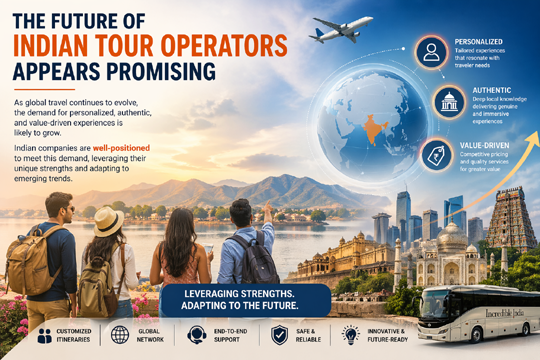
Looking ahead, the future of Indian tour operators appears promising. As global travel continues to evolve, the demand for personalized, authentic, and value-driven experiences is likely to grow. Indian companies are well-positioned to meet this demand, leveraging their unique strengths and adapting to emerging trends.
In conclusion, the success of Indian tour operators is a testament to their ability to combine tradition with innovation. By understanding the needs of diverse travelers and delivering tailored solutions, they have established themselves as leaders in the global tourism industry. Their journey reflects not only the growth of a sector but also the broader transformation of India as a global player in travel and hospitality.