
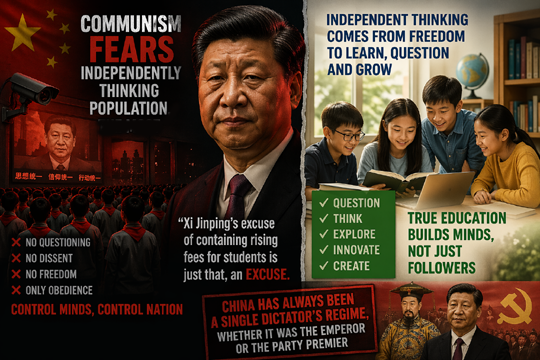
Communism fears an independently thinking population, the most. That is what comes out of private sector educational institutions. Xi Jinping’s excuse of containing rising fees for students is just that, an excuse. China has always been a single dictator’s regime, whether it was the emperor or the party premier
The debate around education systems often reveals deeper truths about the priorities of a nation. When China decided to clamp down on privately run education businesses, especially those catering to primary school students, it sent a strong and deliberate signal. The move was framed as a regulatory intervention aimed at reducing academic pressure, controlling rising costs, and ensuring equitable access. Yet beneath the official narrative lies a more complex reality. Governments rarely act on a single motive, and in this case, the decision appears to blend concerns about affordability with a deeper unease about the influence of independent institutions on young minds.
Private education enterprises, particularly those operating at scale, often introduce diversity in thought, pedagogy, and exposure. While this can be beneficial, it also creates spaces that are less directly controlled by the state. For a system that prioritizes ideological consistency, such independence can be perceived as a risk. By tightening regulations, limiting profit-making, and restructuring the tutoring industry, China has effectively reduced the influence of private actors in shaping early education. Whether one views this as protective or restrictive depends largely on perspective.
However, what is undeniable is the clarity of intent. The message is simple: education, especially at the foundational level, should not be treated as a marketplace commodity. The Chinese state has drawn a line, arguably a harsh one, against the commercialization of learning. It is a move that has sparked global debate, not only about governance and control but also about the ethics of profit in education.
This raises an uncomfortable contrast when one turns to India, where the trajectory has been markedly different. Over the past two decades, the Indian education system, particularly in urban areas, has witnessed a steady and often unchecked expansion of private schooling. What was once a supplementary option has, in many cases, become the default aspiration. The definition of a “good school” has shifted, from one rooted in teaching quality and values to one associated with infrastructure, branding, and, most visibly, cost.
The quiet rise of expensive schooling
In Indian cities today, the cost of schooling has reached levels that would have seemed extraordinary a generation ago. Annual tuition fees of ₹1 lakh are increasingly seen as an entry-level benchmark in many private institutions. Schools charging ₹2–3 lakh per year are no longer considered elite outliers; they are part of a growing mainstream category often marketed as “premium” or “international” education providers.
In metropolitan areas, the numbers climb even higher. Fees exceeding ₹5 lakh annually are not unusual, particularly in schools that emphasize global curricula, advanced facilities, and extracurricular breadth. Importantly, these figures often represent only the base tuition. Once additional expenses, transportation, uniforms, books, digital resources, and activity charges, are included, the total financial burden can easily double.
There is also a less transparent layer of costs. Parents frequently encounter demands labeled as donations, capitation fees, or facilitation charges. These payments, often unofficial yet widely understood, further inflate the cost of access. While regulations exist to curb such practices, enforcement remains inconsistent, allowing these mechanisms to persist in various forms.
The result is a system where affordability increasingly determines opportunity. Education, which ideally should function as a leveling force in society, begins to mirror and reinforce existing inequalities. For many families, securing admission to a reputed school becomes not just an educational decision but a significant financial commitment, sometimes involving sacrifices that extend beyond reasonable limits.
This shift has not occurred overnight. It is the outcome of policy choices, market dynamics, and societal perceptions converging over time. As public education systems struggle with issues of quality and infrastructure, private institutions have stepped in to fill the gap. However, in doing so, they have also introduced a pricing model that aligns more closely with business logic than with the principles of universal access.
When schools become business models
At some point in this evolution, schools began to transform from institutions of learning into structured business entities. This transformation is not inherently negative, efficiency, innovation, and investment can improve educational outcomes. However, the balance between educational purpose and commercial interest has become increasingly skewed.
Many private schools operate under corporate frameworks, with defined revenue targets, expansion plans, and brand positioning strategies. Campuses are designed to impress, marketing campaigns emphasize lifestyle and prestige, and fee structures are calibrated to reflect perceived value rather than actual cost. In such an environment, education risks becoming a product, and students, along with their families, become customers.
This commercialization also influences decision-making within institutions. Investments may prioritize visible infrastructure over teacher development, as the former is easier to market. Curriculum choices may lean toward globally recognized programs, not solely for their educational merit but for their appeal to aspirational parents. The language of education begins to overlap with the language of luxury, premium, exclusive, world-class.
To be fair, it would be inaccurate to paint all private schools with the same brush. Across India, there are educators and institutions committed to genuine learning, ethical practices, and social responsibility. These schools often operate quietly, without aggressive branding, focusing instead on pedagogy and student development. However, the broader system tends to reward scale, visibility, and profitability. As a result, institutions that align with market dynamics often gain prominence, shaping public perception of what constitutes quality education.
This creates a feedback loop. As expensive schools gain prestige, demand for them increases, allowing fees to rise further. Parents, driven by the desire to secure the best possible future for their children, participate in this cycle, even when it strains their resources. Over time, the normalization of high costs shifts expectations across the board, making affordability an exception rather than the norm.
The question of equity and access
The most significant consequence of this transformation is its impact on equity. Education has long been regarded as a public good, a foundational element of social mobility and economic development. When access to quality education becomes contingent on financial capacity, this principle is undermined.
In theory, India’s policy framework recognizes the importance of equitable access. Initiatives aimed at universal education, such as the Right to Education Act, seek to ensure that every child has the opportunity to learn. However, the coexistence of a high-cost private sector with a struggling public system creates a dual structure. On one side are well-resourced schools offering extensive opportunities; on the other are institutions grappling with limitations in infrastructure, staffing, and funding.
This duality reinforces social divisions. Students from affluent backgrounds benefit from exposure, networks, and resources that extend beyond the classroom. Meanwhile, those from less privileged backgrounds may face constraints that limit their potential. Over time, these disparities translate into unequal outcomes, affecting higher education, employment, and overall life prospects.
The comparison with China becomes relevant here. By restricting profit-driven education at the primary level, China has attempted, whether successfully or not, to prevent such disparities from widening. The approach is not without criticism. Limiting private participation can reduce innovation and choice, and excessive control may stifle diversity in education. However, the underlying question it raises is difficult to ignore: who is education ultimately for?
In India, this question often remains implicit rather than explicit. The system continues to evolve without a clear consensus on the role of private enterprise in education. Should schools operate as businesses, subject to market forces? Or should they function primarily as social institutions, with profit playing a limited role? The absence of a definitive answer allows the current trajectory to persist.
Rethinking priorities in education
Addressing these challenges requires more than regulatory adjustments; it demands a re-evaluation of priorities. Education policy must balance multiple objectives, quality, accessibility, innovation, and sustainability. Achieving this balance is inherently complex, but certain principles can guide the process.
First, transparency in fee structures is essential. Parents should have a clear understanding of what they are paying for, and regulatory mechanisms must ensure that charges are justified and consistent with actual costs. Second, investment in public education needs to be strengthened. A robust public system can serve as a benchmark, reducing excessive reliance on private institutions and providing a viable alternative for families across income levels.
Third, the role of private schools should be clearly defined. Encouraging private participation does not necessarily require allowing unrestricted commercialization. Models that combine private efficiency with public accountability, such as not-for-profit frameworks or regulated fee caps, can offer a middle path.
Finally, societal perceptions must evolve. The idea that higher cost automatically equates to better education needs to be questioned. Quality learning depends on multiple factors, including teacher competence, curriculum design, and student engagement. These elements are not inherently linked to price.
Are we building minds or monetizing dreams?
At its core, the debate is not about China versus India, or public versus private systems. It is about the fundamental purpose of education. When learning becomes closely tied to affordability, the promise of equality begins to fade. Education shifts from being a right to becoming a privilege, accessible primarily to those who can pay for it.
The developments in China serve as a reminder that governments can, when they choose, intervene decisively in this space. Whether one agrees with the methods or not, the intent to redefine education as a public good is evident. In contrast, India finds itself at a crossroads, where the momentum of market-driven growth continues to shape the system.
The challenge lies in finding a path that preserves the benefits of private participation, innovation, diversity, and investment, while ensuring that education remains accessible and equitable. This is not an easy task, and it requires collaboration between policymakers, educators, and society at large.
Ultimately, the question is both simple and profound. Are we building minds, nurturing curiosity, and preparing individuals to contribute meaningfully to society? Or are we, consciously or otherwise, monetizing aspirations, turning education into a transaction rather than a transformation?
The answer will define not only the future of education but also the character of the society it serves.