
In USA, the top echelons of investment banks, venture capital firms, and biotech labs accents will often tilt Indian. For other communities with jobs, this will spell admiration. Without jobs, other communities feel resentment. Despite commercial success, Indians in USA have no political capital, which is a segment reserved for white Americans, owing to USA’s Christian two-party public policy structure
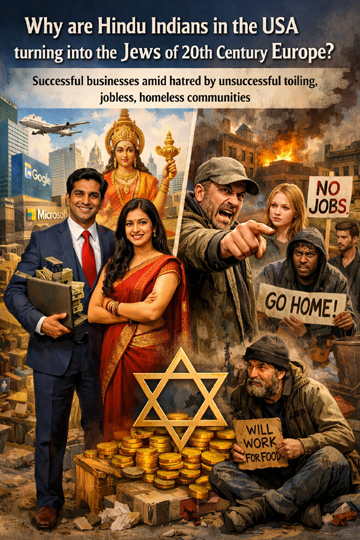
The Indian American story is the kind that makes consulting firms salivate, politicians boast during Conference Call briefings, and investment banks scramble to update their diversity slides. Less than one percent of the United States population, yet routinely topping income charts, academic achievement tables, and professional rosters from Insurance underwriting to Software engineering, from Mortgage broking to high-stakes Trading floors. According to data from the U.S. Census Bureau and the Pew Research Center, Indian Americans have the highest median household income of any major ethnic group in the United States, often nearly double the national median. Over 75 percent hold at least a bachelor’s Degree. In a country obsessed with upward mobility, this is statistical stardom.
But here is where the plot thickens. Prosperity, history teaches us, has a dangerous twin: resentment. And as hate crimes rise in pockets of American cities, whispers circulate in community halls and WhatsApp groups: Are Indians in the U.S. becoming what Jews were in 1930s Europe, visible symbols of economic success amid simmering frustration from struggling majorities?
It is a provocative comparison, but one worth examining soberly, with global context and hard data, not hysteria.
The numbers that sparkle and sting
The Indian diaspora in the United States numbers roughly 4.5 million, according to the Migration Policy Institute. That’s under 1.5 percent of the total population. Yet median Indian American household income crosses $150,000 in several surveys, well above the U.S. national median hovering around $75,000, as reported by the U.S. Census Bureau.
Consulting firms like McKinsey & Company and Boston Consulting Group routinely highlight South Asians in their leadership diversity reports as overrepresented in high-skill, high-wage sectors: technology, healthcare, finance, and academia. The National Science Foundation notes that Indian immigrants form one of the largest groups of foreign-born STEM workers in the U.S., dominating H-1B visa approvals year after year.
Walk into Silicon Valley and the accents in Software design labs will often tilt Indian. The CEOs of giants like Google and Microsoft, Sundar Pichai and Satya Nadella, are Indian-born. The top echelons of investment banks, venture capital firms, and biotech labs have a similar hue.
This is not accidental. It is the outcome of migration filters that prioritized high-skilled workers. The 1965 Immigration and Nationality Act opened the gates to professional talent. Indians arrived with engineering Degrees, medical certifications, and a laser focus on upward mobility. The result? High rates of home ownership, robust participation in Mortgage markets, excellent Credit scores, and substantial participation in entrepreneurial ventures.
According to data from the Kauffman Foundation, immigrants are disproportionately likely to start businesses, and Indians rank among the top contributors to tech startups valued at over $1 billion.
Economic niches and cultural stereotypes
In economic sociology, success clusters create stereotypes. Jewish communities in early 20th century Europe were overrepresented in finance, retail, law, and academia. That visibility, coupled with economic crises, made them scapegoats during downturns.
Today, Indian Americans are heavily concentrated in IT, medicine, finance, and academia. You are more likely to meet an Indian cardiologist than an Indian construction worker. While African Americans and Caribbean communities, present for centuries, span the entire socioeconomic ladder, from Lawyer to cop to small business owner to struggling job seeker, Indians are perceived as uniformly affluent.
This perception is not entirely accurate. There are Indian motel workers, taxi drivers, and small shop owners operating on thin margins. Yet the dominant image is that of the coder earning six figures, the Attorney arguing corporate cases, the specialist doctor billing Insurance firms, the executive on a Conference Call discussing global strategy.
The Brookings Institution has noted that economic polarization in America fuels identity-based resentment. When white working-class wages stagnate, documented extensively by the Economic Policy Institute, and jobs in manufacturing decline, highly skilled immigrants become easy targets. The narrative simplifies brutally: “They took our jobs.”
Chinese Americans are seen as less of a threat than Indians
In the United States, both Indian Americans and Chinese Americans have achieved remarkable success in corporate and professional sectors, particularly in technology, medicine, finance, and academia. Yet, despite similar socioeconomic profiles and similarly limited representation in high-level electoral politics, perceptions among economically distressed white Americans—especially those experiencing unemployment or homelessness—often diverge between the two groups. One subtle but culturally significant factor sometimes discussed by sociologists and community observers is the adoption of Western or Christian first names by many Chinese immigrants alongside their Chinese names.
Name familiarity plays a psychological role in how groups are perceived. For many Americans, especially those with limited exposure to immigrant communities, names serve as quick cultural signals. A Chinese American professional named “Michael Chen” or “David Wong” may subconsciously appear more culturally accessible to a struggling white American than an Indian American named “Siddharth” or “Raghunandan,” simply because the first name is already embedded in mainstream American linguistic culture. This familiarity does not eliminate prejudice, but it can soften perceptions of cultural distance. The phenomenon is similar to how immigrants historically adopted Anglicized names to reduce discrimination in employment or housing markets.
Religion and perceived religious proximity also matter. A significant proportion of Chinese Americans identify as Christian, Buddhist, or non-religious, but the presence of Christian names can create an assumed religious overlap with America’s historically Christian majority. Indian Americans, by contrast, are more publicly associated with Hinduism, Sikhism, Islam, or other minority faiths unfamiliar to many Americans. For individuals already experiencing economic insecurity, unfamiliar religious symbols or names can amplify a sense of “otherness,” even when there is no direct competition or conflict.
Another layer involves historical narratives. Chinese immigrants have long been part of American history, from railroad construction in the 19th century to modern entrepreneurship, despite facing severe discrimination such as the Chinese Exclusion Act. Over generations, the community developed adaptive strategies, including bilingual naming practices, that helped integration into mainstream institutions. Indian immigration, by comparison, surged more prominently after changes in U.S. immigration law in 1965, meaning widespread cultural familiarity developed later. Recency can affect perception: communities seen as “newer” sometimes attract more suspicion during periods of economic anxiety.
Importantly, both Chinese and Indian Americans are often politically underrepresented relative to their population size and economic influence. High corporate participation does not automatically translate into electoral power, partly because many immigrants focus first on economic mobility, education, and family stability rather than politics. This shared pattern means neither group is typically viewed as a dominant political force threatening white working-class interests.
However, perception gaps should not be overstated. Anti-Asian sentiment has affected Chinese Americans significantly, particularly during geopolitical tensions involving China. Similarly, Indian Americans have also faced discrimination and stereotyping. Economic frustration among marginalized populations can be directed toward any visible minority group depending on local context, media narratives, and political rhetoric.
Ultimately, the relative comfort some struggling white Americans may feel toward Chinese Americans compared with Indian Americans is less about objective competition and more about perceived cultural familiarity. Names—especially those that sound recognizably Western or Christian—act as social bridges, reducing immediate psychological distance. But deeper issues of economic inequality, identity, and belonging shape attitudes far more than naming practices alone.
A tale of degrees, visas, and the American meritocracy myth
The Indian American ascent is deeply tied to educational capital. More than three-quarters hold at least a bachelor’s Degree, and a significant proportion have master’s or doctoral qualifications. This is not representative of India’s population at large; it is a hyper-selected slice.
Reports by OECD on migration show that highly educated migrants often outperform native populations in earnings precisely because immigration systems are designed to attract top-tier talent.
Contrast this with earlier waves of African or Hispanic migration, which were driven by labor demand in agriculture, railroads, and service sectors. The U.S. Chamber of Commerce, U.S. Chamber of Commerce, has repeatedly argued in policy briefs that high-skilled immigration fuels GDP growth, innovation, and tax revenues.
But economics does not erase emotion. When a laid-off factory worker in Ohio sees a new tech park staffed largely by Indians on H-1B visas, nuance evaporates. Meritocracy is celebrated, until it feels exclusionary.
The Hispanic paradox and occupational segmentation
The Hispanic population, now over 60 million, according to the U.S. Census Bureau, is deeply embedded in manual labor, construction, hospitality, agriculture, and food services. Hispanic food, Mexican, Cuban, Puerto Rican, is wildly popular as cuisine. Yet the capital ownership in restaurants, franchising, and large-scale food Hosting businesses often lies elsewhere.
Sociologists point to occupational segmentation: different migrant waves slot into different economic layers. Indians went into STEM and healthcare. Hispanics filled labor shortages in agriculture and construction. African Americans, shaped by centuries of systemic discrimination, navigate a far more complex legacy involving redlining, discriminatory Mortgage policies, and unequal access to Credit, well documented in Federal Reserve studies.
Hate crimes and economic anxiety
The Federal Bureau of Investigation reports periodic spikes in hate crimes targeting Asian Americans, particularly during economic or geopolitical stress. During the COVID-19 pandemic, attacks on people perceived as Asian surged dramatically.
While Indian Americans are not targeted at the same scale as East Asians in pandemic-related incidents, anecdotal evidence and community organization data show increasing harassment, especially in smaller towns where demographic change is rapid.
The analogy to 1930s Germany is emotionally charged. Jews in Weimar and Nazi Germany were scapegoated during hyperinflation, unemployment, and national humiliation. They were portrayed as controlling finance, media, and professional jobs. It culminated in unspeakable horror.
It is crucial to say this plainly: The United States today is not 1930s Germany. Democratic institutions, civil rights protections, and pluralistic norms remain strong. Yet economic anxiety combined with cultural polarization is combustible. The Southern Poverty Law Center tracks extremist rhetoric, and there is evidence that immigrants, particularly visible, successful minorities, are frequent targets.
Success breeds suspicion
Why does success provoke hostility? Behavioral economists might say envy is a rational response to inequality. Political scientists at the Council on Foreign Relations have argued that globalization produces winners and losers. Indian Americans are visible winners of globalization. They benefit from cross-border talent Transfer, global education pipelines, and multinational corporate networks.
They are often dual navigators, sending remittances to India, investing in U.S. startups, trading stocks, buying real estate. They understand Loans, optimize Credit, and build wealth through disciplined savings. Consulting reports from Deloitte highlight the diaspora’s role in cross-border investment and innovation ecosystems.
But optics matter. When communities struggling with Gas/Electricity bills see neighbors driving Teslas funded by tech salaries, resentment simmers. When a local job seeker without a college Degree competes against a highly credentialed immigrant with a master’s in Computer Science, the frustration is personal.
The myth of uniform prosperity
There is danger in flattening Indian Americans into a monolith of affluence. The Urban Institute notes that income inequality within Asian American communities is among the highest of any racial group. There are undocumented Indians, struggling small business owners, and families burdened with Loans for education and housing.
Even high earners face pressure: elder care costs, private school Classes, medical Insurance premiums, and hefty Mortgage payments in expensive cities like San Jose or New York. A tech worker’s salary may look glamorous, but the cost of living often devours it.
Global parallels beyond Europe
Globally, economically successful minorities have faced backlash: the Chinese diaspora in Southeast Asia, the Lebanese in West Africa, Indians in East Africa. The pattern repeats: small minority, high commercial visibility, local resentment during downturns.
The World Bank has studied how diaspora networks enhance trade and capital flows. These networks accelerate Recovery after crises by channeling investment and knowledge. But they can also trigger nationalist backlash if locals feel excluded.
The role of narrative and media
Media framing matters. When coverage emphasizes “Indians taking over tech” or “foreigners dominating medicine,” it can morph into caricature. At the same time, ignoring legitimate concerns about wage stagnation or job displacement fuels populism.
The challenge is to hold two truths simultaneously: Indian Americans have achieved extraordinary economic success, and broader segments of American society feel economically insecure. Addressing one without acknowledging the other is a recipe for polarization.
From scapegoat to stakeholder
The lesson from history is not paranoia but participation. Jewish communities in America thrived because of integration, civic engagement, philanthropy, and alliance-building. Indian Americans are increasingly visible in politics, academia, and civil society. They Donate generously, fund universities, and sponsor community Treatment centers and Rehab facilities.
Building bridges, through community Hosting of cultural festivals, open dialogues, and business partnerships, reduces otherness. When neighbors see each other not as competitors for jobs but as collaborators in local Recovery and growth, the temperature drops.
Economic reform as antidote
Ultimately, resentment rooted in economic insecurity requires structural solutions. Workforce retraining Classes, accessible higher education, fair lending practices, and investment in distressed regions are essential. The International Monetary Fund has warned that inequality undermines social cohesion in advanced economies.
Policies that expand opportunity for all, rather than restrict immigration or vilify minorities, are more likely to sustain prosperity.
A warning without hysteria
Comparisons to 1930s Europe must be made cautiously. The horrors inflicted upon Jews were the result of state-sponsored genocide. America’s institutions, while imperfect, are fundamentally different.
Yet complacency is unwise. Economic stress plus identity politics can corrode democratic norms. If Indian Americans are perceived solely as economic elites detached from broader society, isolation may grow.
The answer is not retreat into gated communities or exclusive Conference Calls. It is deeper civic engagement, transparent dialogue about immigration policy, and investment in shared prosperity.
The American experiment continues
The United States has long been a nation where immigrants, from Irish to Italians to Jews to Asians, arrived, prospered, and eventually integrated into the mainstream. Initial suspicion often gave way to acceptance.
Indian Americans today stand at a fascinating intersection: admired for their Degrees and professional achievements, envied for their incomes, occasionally targeted by frustration.
The path forward lies not in fear but in partnership. The American economy thrives on talent, innovation, and diversity. Insurance agents, Lawyers, Software architects, Mortgage brokers, doctors, and entrepreneurs of Indian origin are part of that mosaic.
History warns against scapegoating minorities during downturns. Data from think tanks, consulting firms, and government repositories confirms that high-skilled immigration contributes significantly to growth. The task for policymakers is to ensure that growth is inclusive.
If that balance is struck, the narrative will not be one of repetition of Europe’s darkest chapter, but of a pluralistic society learning, sometimes messily, often noisily, to accommodate ambition without breeding hatred.
The Indian American story is not about becoming the Jews of 20th century Europe. It is about navigating visibility in an age of inequality. It is about turning success into shared opportunity, and resentment into reform. In a world of Trading algorithms and cross-border capital Transfer, the true test is not who earns the most, but who builds the most resilient, inclusive future.
And that, perhaps, is a Conference Call worth Hosting.
CITATIONS
Crimes against Hindu Indian Americans in the U.S. include incidents of verbal abuse, physical assaults, and vandalism of homes and temples. These incidents have been on the rise in recent years, driven by a complex mix of factors including broader anti-immigrant sentiment, geopolitical tensions, and online hate.
Nature and Frequency of Crimes
Temple Vandalism: There have been a number of high-profile incidents involving the defacement of Hindu temples across the U.S., particularly in California, Texas, and Indiana. The acts often involve anti-India or pro-Khalistan graffiti, or sometimes Christian supremacist messages. In 2023, a record eight anti-Hindu hate crimes were reported in California alone, many of which were temple desecrations.
Physical and Verbal Assaults: Indian Americans have faced individual attacks and harassment.
In August 2022, a woman in Plano, Texas, was charged with a hate crime for verbally abusing four Indian American women.
The same month, an Indian American man was captured on video using racist slurs, calling another Indian American a “dirty Hindu”.
In 2023, an Indian national was pushed to his death at a New York subway station.
Online and Public Intimidation: Anti-Indian and anti-Hindu narratives have exploded on social media platforms, which some experts link to real-world hostility. Public protests with anti-immigrant and anti-Hindu messaging have also occurred, such as masked men in Irving, Texas, carrying signs that read “Don’t India My Texas”.
Contributing Factors and Complications
Conflation of Identity: Experts note a “racialization of religion,” where Americans’ perceptions of race become intertwined with their views on religion, leading to prejudice. Indian Americans, regardless of their specific faith, have sometimes been targeted due to their “perceived foreignness”.
Political Tensions: Geopolitical issues, such as those related to the H-1B visa program and the Khalistan separatist movement, have contributed to a rise in targeted hate. Disagreements within the South Asian community over these issues have also deepened divides.
Data Collection Issues: Advocacy groups like the Hindu American Foundation (HAF) and the Coalition of Hindus of North America (COHNA) argue that a lack of specific data tracking makes it difficult to fully understand the scope of anti-Hindu hate crimes. Often, these incidents are categorized under broader “anti-Asian” or general anti-immigrant hate crimes.
In response to the rising tide of hate, various Indian-American advocacy groups and lawmakers have called for stronger anti-hate crime legislation, increased security for places of worship, and more robust tracking and investigation by law enforcement agencies like the FBI.