
This single story from Buxar thus opens a larger inquiry: if caste discrimination is prohibited by law, why does caste continue to shape marriages, social interactions, educational institutions, and economic opportunities? And why do institutions with caste-linked names—such as Jat colleges or Brahman colleges—continue to exist in a constitutional democracy that promises equality?
In the dusty lanes of Buxar district in Bihar, the story of Golu Yadav has traveled faster than any political speech or social media post. Golu, a young man from the region, became the subject of intense discussion after he married a young orphan girl who had been begging on passenger trains. According to his account, he first noticed her while traveling; she was being stared at inappropriately by fellow passengers. Disturbed by what he witnessed, he intervened, spoke to her, and eventually decided—after securing his family’s consent—to take her home for her safety. In time, the relationship deepened and culminated in marriage.
In many ways, this could have been a simple human-interest story about compassion and courage. Yet in India, even such acts often acquire another layer: caste. Questions quickly arose in the locality about the caste backgrounds of the bride and groom. Would the marriage cross caste lines? Would it invite social backlash? Would it bring ostracism? The very fact that these questions surfaced in 21st-century India reveals the persistent hold of the caste system, even though the Constitution and numerous laws declare caste-based discrimination illegal.
This single story from Buxar thus opens a larger inquiry: if caste discrimination is prohibited by law, why does caste continue to shape marriages, social interactions, educational institutions, and economic opportunities? And why do institutions with caste-linked names—such as Jat colleges or Brahman colleges—continue to exist in a constitutional democracy that promises equality?
The constitutional promise against caste discrimination
India’s constitutional framework is unambiguous in its formal rejection of caste-based discrimination. When the Constitution came into effect on January 26, 1950, it embedded a series of provisions aimed at dismantling centuries-old hierarchies.
Article 14 guarantees equality before the law and equal protection of the laws. Article 15 explicitly prohibits discrimination on grounds of religion, race, caste, sex, or place of birth. Article 16 extends this principle to public employment, forbidding discrimination in matters of state employment based on caste, among other grounds. Most significantly, Article 17 abolishes “untouchability” and forbids its practice in any form. This is not merely symbolic language; it represents a constitutional revolution against one of the most entrenched social systems in the world.
To operationalize Article 17, Parliament enacted the Protection of Civil Rights Act, 1955. This law criminalizes the practice of untouchability and penalizes denial of access to public spaces, services, and facilities on caste grounds. Later, recognizing the persistence and brutality of caste-based violence, Parliament enacted the Scheduled Castes and Scheduled Tribes (Prevention of Atrocities) Act, 1989. This Act provides stringent penalties for offenses committed against members of Scheduled Castes and Scheduled Tribes, including social boycotts, physical violence, sexual assault, and dispossession from land.
Additionally, the Prohibition of Employment as Manual Scavengers and their Rehabilitation Act, 2013, seeks to eliminate the caste-linked occupation of manual scavenging and to provide rehabilitation and dignified livelihoods to affected families. Together, these laws and constitutional guarantees create a comprehensive legal architecture against caste discrimination.
Yet law on paper and practice on the ground often diverge.
The lived reality of caste in contemporary India
Despite constitutional safeguards, caste remains deeply woven into India’s social fabric. It manifests in marriages, housing patterns, political mobilization, employment networks, and even access to basic services.
Marriage remains the strongest site of caste reproduction. The overwhelming majority of marriages in India are endogamous—within the same caste or sub-caste. Families often use matrimonial advertisements that explicitly specify caste preferences. Inter-caste marriages, though increasing, are still a minority and sometimes face violent backlash, including so-called “honour killings.” In this context, Golu Yadav’s marriage, depending on caste alignments, may be viewed not merely as a personal choice but as a social defiance.
In rural India, caste-based segregation of settlements persists. Separate hamlets or colonies for Scheduled Castes are common. Access to temples, water sources, and cremation grounds can still be contested. In some regions, reports continue of Dalits being denied entry into barber shops, forced to sit separately in schools, or facing violence for asserting their rights.
In urban areas, caste may operate more subtly but remains influential. Housing societies sometimes screen tenants informally based on surname and perceived caste. Employment networks often run along caste lines, particularly in small and medium enterprises. Political parties mobilize voters through caste arithmetic, reinforcing identities that the Constitution sought to transcend.
Educational access has improved significantly, partly due to reservation policies for Scheduled Castes, Scheduled Tribes, and Other Backward Classes. Yet discrimination within educational institutions has been documented, ranging from social exclusion to biased grading and campus segregation. The persistence of caste in elite institutions underscores that social reform lags behind legal reform.
Caste and the paradox of caste-named colleges
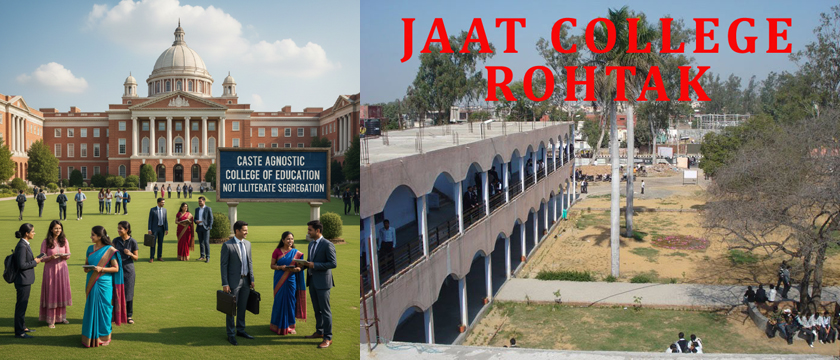
Against this backdrop, the existence of institutions such as All India Jat Heroes Memorial College in Rohtak or Gaur Brahman Degree and Ayurvedic Colleges in Rohtak raises a natural question: if caste-based discrimination is illegal, why do caste-based colleges exist?
The answer lies partly in history and partly in legal nuance. Many such institutions were founded in the early or mid-20th century, often before independence or in the immediate post-independence era. Their founders were community organizations seeking to promote education among their own social groups, which at the time often lacked access to formal education.
For example, institutions associated with the Jat community—such as Jat College Baraut (established in 1917) or All India Jat Heroes Memorial College (established in 1944)—emerged in a historical context where rural and agrarian communities sought to uplift themselves through collective action. These colleges were not necessarily designed to exclude others, but to mobilize resources within the community for educational advancement.
Similarly, organizations like the Gaur Brahman Vidya Pracharini Sabha established colleges to preserve cultural heritage, promote traditional learning such as Ayurveda, and create opportunities for their community members. Over time, these institutions became affiliated with public universities—such as Maharshi Dayanand University (MDU), Rohtak—and operate under state regulations.
Legally, the mere name of an institution reflecting a community origin does not violate the Constitution, provided the institution does not discriminate in admissions or employment on caste grounds. Article 15(1) prohibits discrimination by the state, and Article 29 and 30 provide certain rights to minorities to establish and administer educational institutions. However, caste-based exclusion in admissions would be unconstitutional unless specifically permitted under affirmative action policies.
Today, most such colleges are open to students of all communities. They offer degrees in arts, science, commerce, education, and specialized fields like Ayurveda. Their names reflect historical origins rather than legally sanctioned caste exclusivity. Yet the symbolism of caste in their titles reflects the continuing salience of caste identity in public life.
The historical roots of caste stratification
To understand why caste persists, one must examine its historical roots. The caste system evolved over centuries, combining religious, occupational, and social hierarchies. The classical varna framework—Brahmin, Kshatriya, Vaishya, and Shudra—intersected with thousands of jatis (birth-based groups), creating a complex web of status and occupation.
British colonial rule further codified caste through censuses and administrative classification. Colonial ethnography hardened fluid identities into fixed categories. Post-independence policies, particularly reservations for historically disadvantaged communities, sought to correct past injustices but also reinforced caste categories as administrative units.
Thus, caste in modern India operates as both a source of discrimination and a basis for affirmative action. The same constitutional framework that abolishes untouchability also mandates reservations in education and public employment for Scheduled Castes and Scheduled Tribes. This dual approach reflects a recognition that formal equality is insufficient without substantive measures to address historical disadvantage.
The gap between law and social reform
Why has caste endured despite legal prohibitions? Several factors contribute to the gap between law and lived reality.
First, social norms change more slowly than statutes. Deeply ingrained beliefs about purity, status, and hierarchy cannot be erased by legislation alone. Second, economic inequality often overlaps with caste identity, reinforcing structural disadvantage. Land ownership patterns, occupational segregation, and educational disparities continue to reflect caste lines.
Third, enforcement challenges persist. While the Scheduled Castes and Scheduled Tribes (Prevention of Atrocities) Act provides strong penalties, implementation depends on local police and administrative machinery, which may themselves be influenced by caste dynamics. Delays in investigation, witness intimidation, and low conviction rates undermine deterrence.
Fourth, caste has been politically mobilized. Electoral politics frequently relies on caste coalitions. Political representation has empowered marginalized communities in many ways, but it has also entrenched caste as a primary axis of identity.
Inter-caste marriage as social transformation
In this context, inter-caste marriages represent a powerful mechanism for social change. The Special Marriage Act, 1954 provides a civil route for marriage irrespective of caste or religion. Several state governments offer incentives to encourage inter-caste marriages, particularly when one spouse belongs to a Scheduled Caste.
However, social acceptance remains uneven. Couples may face family opposition, social boycott, or violence. The Supreme Court of India has repeatedly condemned honour killings and directed states to protect inter-caste couples. In cases such as Shakti Vahini v. Union of India (2018), the Court issued guidelines to curb khap panchayat interference in marriages.
The story from Buxar, though framed around compassion and protection, underscores how marriage can disrupt caste boundaries. When individuals choose partners across caste lines, they challenge not only family expectations but the structural logic of caste endogamy.
Educational empowerment and community initiatives
Returning to caste-linked colleges, it is important to distinguish between exclusion and empowerment. Many community-founded institutions emerged from a desire to uplift marginalized or regionally disadvantaged groups. In pre-independence India, access to higher education was limited and often dominated by urban elites. Community mobilization created pathways for rural youth to pursue degrees.
Such institutions often emphasized holistic development—sports, cultural activities, and community service—alongside academics. Brahman-affiliated colleges sometimes focused on traditional knowledge systems like Ayurveda, preserving intellectual traditions that might otherwise have declined.
Over time, these colleges integrated into mainstream university systems. They follow standardized curricula, regulatory oversight, and inclusive admission policies. While their names retain historical identity markers, their operational frameworks align with constitutional principles.
Caste in urban modernity
Even as India urbanizes and digitizes, caste adapts rather than disappears. Online matrimonial platforms allow filtering by caste. Social media groups reinforce caste networks. In some corporate sectors, informal hiring through referrals may reflect caste homophily.
At the same time, urban anonymity and economic mobility create spaces for cross-caste interaction. Mixed workplaces, universities, and residential complexes foster new social bonds. The expansion of higher education and internal migration dilute rigid village hierarchies.
The tension between continuity and change defines contemporary India. Caste is neither static nor uniformly declining; it is transforming.
The moral and legal imperative ahead
India’s constitutional vision is clear: a society free from caste-based discrimination. The legal framework—Articles 14, 15, 16, and 17; the Protection of Civil Rights Act; the SC/ST (Prevention of Atrocities) Act; the Manual Scavenging Act—provides tools for enforcement. Judicial pronouncements reinforce equality and dignity.
Yet achieving substantive equality requires more than punitive laws. It demands social reform, educational transformation, economic redistribution, and sustained civic engagement. Schools must teach constitutional values. Local administrations must enforce anti-discrimination laws impartially. Civil society must challenge prejudice in everyday life.
Community-founded colleges, if inclusive and progressive, can play a constructive role by expanding access and promoting social integration. They must ensure that their historical identities do not translate into subtle exclusion.
Beyond legality to lived equality
The marriage in Buxar is a reminder that individual acts can illuminate structural issues. A young man’s decision to protect and marry a vulnerable woman invites admiration. But the questions it triggered about caste reveal how deeply social hierarchies endure.
India has legally abolished untouchability and prohibited caste discrimination. It has enacted stringent laws against atrocities and mandated affirmative action to address historical wrongs. Yet caste persists in marriage, housing, politics, and social interaction.
The existence of caste-named colleges reflects historical efforts at community upliftment rather than formalized discrimination. Most operate within constitutional norms and are open to all. Nevertheless, their names symbolize the continuing relevance of caste identity.
The path forward lies not in denying caste’s existence, nor in resigning to its permanence, but in aligning social practice with constitutional principle. Inter-caste marriages, inclusive education, economic opportunity, and rigorous enforcement of anti-discrimination laws are essential steps.
India’s Constitution envisioned a republic where birth does not determine destiny. Realizing that vision requires vigilance, courage, and empathy—qualities embodied, in their own modest way, by acts that cross social boundaries and affirm shared humanity.