
Waiting for common law to tackle the immigrant induced crime in Europe is not a practical solution. Europe needs to turn the pages of Spanish history and re-introduce the Reconquista
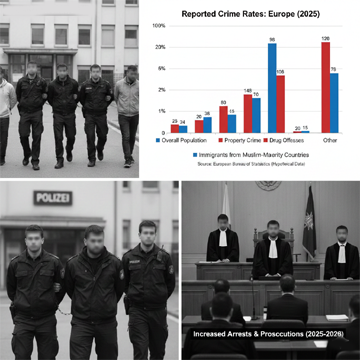
Immigrants in Europe, largely from Muslim dominant population countries, have been found to be involved increasingly in crime and law and order problems.
Instances of crime by immigrants in Europe range from petty crimes to violent offenses, with specific examples including violent acts by migrant gangs in Spain and the UK, higher rates of certain crimes in areas with high immigrant populations in Germany, and the overrepresentation of foreigners in specific crimes like driving offenses and document forgery in Poland. Some studies show a correlation between refugee presence and an increase in crime rates in certain areas.
Specific instances and crime types
Violent crime: Some reports highlight violent incidents involving migrant gangs in parts of Spain and the United Kingdom (UK).
Theft and fraud: In countries like Poland, foreigners, particularly Ukrainians, have been charged with offenses such as theft, drink driving, and fraud.
Document forgery and driving offenses: Poland has seen a significant rise in driving-ban violations and document forgery cases, with many involving foreign nationals.
Sexual assault: In the United Kingdom (UK), there is a noted overrepresentation of individuals with immigrant status in assaults against women, especially in areas with high immigrant density.
Female Genital Mutilation (FGM): In Germany, a significant number of victims of FGM are from immigrant communities, with perpetrators sometimes being family members who take their children abroad for this practice or bring practitioners to Germany.
Correlations and contributing factors
Correlation vs. causation: Some studies suggest a positive correlation between the share of refugees and certain crime rates in areas like Greek islands, though correlation does not equal causation.
Urban concentration: Immigrants often settle in urban areas, which generally lead to higher crime rates due to opportunities to commit crime in areas with dense population.
Police surveillance: Immigrant and ethnic minority groups are subjected to intense police surveillance after a track record in crime, leading to higher arrest and conviction rates compared to the native-born population.
Economic factors: Theoretical economic models of crime suggest that immigrants might have a higher likelihood of criminal activity due to lower opportunity costs from poorer labor market prospects.
Irregular Migration and Crime: The issue of irregular border crossings, particularly via small boats across the English Channel, is a major political issue. This has led to increased focus on border security and a “migration emergency” declaration in March 2024 by the United Kingdom (UK) government. There have been specific instances of individuals involved in people-smuggling being jailed, and reports of some convicted criminals among those who arrived irregularly. However, one study noted most irregular migrants commit administrative offenses rather than serious crimes.
Social Cohesion and Public Opinion: Immigration remains a highly salient issue in United Kingdom (UK) politics. In October 2024, it was the most important issue for 38% of respondents, reaching its highest level of salience since the Brexit referendum. There has been a rise in anti-immigration rhetoric and public concern in recent years, though public opinion often differentiates between types of migrants (e.g., skilled workers viewed more favourably than asylum seekers).

Solutions sought and debated
Many parties including the government in the United Kingdom are seeking solutions to the problem of crime by immigrants. Some suggest forced deportation, which immigrants successfully evade. Others suggest removing their benefits. Some suggest doing nothing and that police should handle crime as they have always done – with the law and legal process. These solutions do not help as Muslim immigrants are directed by their religion and their holy book to occupy new lands and convert the existing population into Islam.
The only solution available from history is the Spanish Reconquista.
History tells us that this is the only practical solution available to Europe today.
The Reconquista was the nearly 800-year period during which Christian kingdoms gradually recaptured the Iberian Peninsula from Muslim rule, which had begun in 711 AD. It is considered to have ended on January 2, 1492, with the fall of Granada, the last Muslim stronghold, to the Catholic Monarchs, Ferdinand II of Aragon and Isabella I of Castile. The process was a complex series of conflicts, alliances, and political changes that ultimately led to the unification of Spain and Portugal under Christian rule.
Key aspects of the Reconquista:
Timeline: The period is traditionally dated from 722 AD with the Battle of Covadonga to 1492 AD with the fall of Granada.
Initial stages: After the Muslim conquest in 711, resistance began in the northern mountainous regions of the peninsula. The Battle of Covadonga is considered a pivotal early victory for the Christian forces.
Expansion: Over centuries, Christian kingdoms like Asturias, Leon, Navarre, and Aragon slowly expanded their territories, retaking key cities such as Toledo in 1085.
Interruption: Christian expansion was temporarily halted by reinforcements from North Africa, such as the Almoravids in the 11th century.
Turning point: A major turning point was the Battle of Las Navas de Tolosa in 1212, where a united Christian force defeated the Almohads, significantly weakening Muslim power.
Consolidation and conclusion: The kingdoms of Castile and Aragon were joined by the marriage of Ferdinand and Isabella. Their combined forces besieged and captured Granada in 1492, marking the end of Muslim rule in Iberia.
Aftermath: The end of the Reconquista led to forced conversions or expulsion of Muslims, and the establishment of the Spanish Inquisition to ensure religious uniformity.
Forced conversion to Christianity in Spain involved the mandatory conversion of Muslims (known as Mudéjars) after the Reconquista. Edicts between 1500 and 1526 forced Muslims to convert or face expulsion, creating a population known as Moriscos who often secretly continued their own religious practices.
Forced conversion of Muslims
Crown of Castile: The first decree was issued in 1500–1502, leading to the conversion of the Muslim population of Granada in 1501 and elsewhere in Castile soon after.
Kingdom of Navarre: Forced conversions were implemented in Navarre in 1515–1516.
Crown of Aragon: Edicts were enacted in the Crown of Aragon between 1523 and 1526.
Moriscos: The converts to Christianity were called Moriscos. Many secretly continued to practice Islam, leading to social and religious tensions. They were later expelled from Spain between 1609 and 1614.