
British police asks Harman Kapoor, the decent citizen to behave like a sacrificial offering. Do not resist too strongly. Do not escalate. Do not chase. Do not strike back. Do not use tools at hand. Do not injure the attacker. This kind of ridiculous situation makes you wish for the fun gun culture that is in the USA
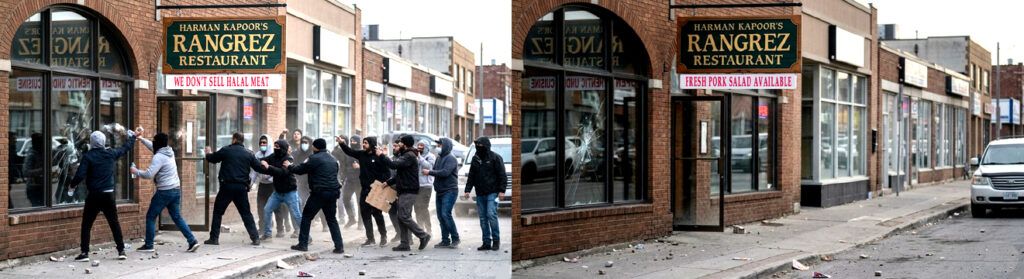
Harman Kapoor can’t run a restaurant on his own terms. Looting, arsonist Muslim immigrants and neighbours of Harman Kapoor have a free hand in wrecking this restaurant. However, Harman gets arrested if he defends his life and territory. How London has fallen. Once Scotland exits from the United Kingdom, England will become a sorry cesspool. Families living in England have no security and future. The United Kingdom’s Royal Navy and Royal Air Force are a shadow of their imperial self. The Royal Navy cannot maintain its aircraft carriers. Theft and larceny are common in London and neighbouring cities.
There is a particular kind of public anger that emerges when ordinary people begin to feel that the state no longer protects them. It is not merely frustration with taxes, or annoyance with bureaucracy, or even irritation with incompetent politicians. It is something deeper and more corrosive: the conviction that the rules are no longer applied fairly, that law-abiding people are expected to remain passive while aggressors act with impunity, and that the social contract has started to break down. The complaint at the heart of this argument is simple and emotionally powerful. A person builds a livelihood, works within the law, pays the bills, and tries to keep a family safe. Yet when faced with intimidation, vandalism, theft, violence, or mob behaviour, that same person feels abandoned. If he resists, he risks punishment. If he submits, he is ruined. In that gap between responsibility and protection, rage flourishes.
The story of a restaurateur such as Harman Kapoor, whether taken as an individual example or as a symbolic figure, speaks to a wider anxiety in modern Britain. It is the fear that the respectable citizen has become the least protected person in the system. The shopkeeper, the small business owner, the parent, the commuter, the pensioner, the neighbour who follows the rules—these are the people who increasingly believe they are told to tolerate disorder in the name of procedure, sensitivity, or political caution. If that perception spreads, the consequences are grave. A society can survive hardship. It can survive austerity. It can survive political turnover. What it struggles to survive is the loss of confidence that order exists at all.
The small business as the front line of social decay
Small businesses often become the first visible victims of a broader civic decline. Grand political speeches about diversity, inclusion, regeneration, and opportunity mean very little when a family-run restaurant, corner shop, takeaway, or café cannot operate in peace. The small entrepreneur is uniquely exposed. Unlike a giant corporation, he cannot absorb repeated losses, hire private security at scale, relocate branches at will, or shield himself behind layers of management. His business is personal. It is tied to his savings, his labour, his family name, and often his home. When a business is looted, vandalised, extorted, repeatedly robbed, or harassed by local troublemakers, the damage is not only economic. It is moral and psychological.
A restaurant in particular stands at the intersection of commerce and community. It is visible, public, and vulnerable. It must remain open late. It depends on reputation. It depends on customers feeling safe. It cannot thrive if the neighbourhood around it turns threatening. When anti-social elements begin to dominate the street, when theft becomes routine, when intimidation grows common, when neighbours either look away or become hostile, a business owner quickly learns that survival depends less on enterprise than on endurance. The issue is no longer entrepreneurship in the optimistic sense. It becomes a grim contest of attrition.
That is why cases involving shopkeepers and restaurateurs resonate so widely. People see in them a mirror of national weakness. If a man cannot protect his own doorway, what exactly is the state for? If his premises can be attacked while the law hesitates, moralises, or arrives too late, then the public begins to conclude that legality has been severed from justice. Such conclusions are dangerous, but they are not irrational. They arise when institutions appear to defend process more vigorously than peace.
The crisis of self-defence in modern liberal societies
One of the most explosive questions in any declining society is the question of self-defence. Every state claims a monopoly on legitimate force. In theory this is a civilisational achievement. It prevents private vengeance, clan feuds, and vigilante rule. Citizens accept limits on personal retaliation because they trust that the police, courts, and prisons will act on their behalf. But what happens when that trust weakens? What happens when response times are slow, prosecutions inconsistent, and victims feel that their own actions are scrutinised more harshly than those of aggressors?
The result is a moral inversion that deeply offends common sense. People begin to believe that the law asks the decent citizen to behave like a sacrificial offering. Do not resist too strongly. Do not escalate. Do not chase. Do not strike back. Do not use tools at hand. Do not injure the attacker. Wait, report, document, comply. For middle-class commentators insulated from street disorder, these instructions may sound reasonable. For those facing real violence, they can sound absurd. A man being cornered by a gang, a woman threatened in her own shop, a householder facing intruders, or a businessman trying to stop arson will not experience the situation as a seminar on proportionality. He will experience it as terror.
The danger here is not only that people may lose faith in law. It is that they may come to see law as an active obstacle to justice. Once that happens, every arrest of a victim who resisted force becomes politically radioactive. Every prosecution of a citizen who fought back confirms the suspicion that official Britain is more comfortable disciplining the respectable than confronting the dangerous. That may not always be fair as a literal description of the legal system. But politically and emotionally, it is devastating.
London as symbol, not merely city
London occupies a special place in the imagination of decline because it is not just another urban centre. It is the old imperial capital, the administrative heart of the United Kingdom, the showcase city presented to the world as a model of cosmopolitan success. For generations, London represented authority, continuity, and prestige. Even when Britain lost empire, London retained an aura of command. It was meant to embody competence. If disorder, theft, random violence, open drug use, retail insecurity, failing transport discipline, and civic unease become associated with London, then the symbolism is severe. People do not say merely that one city has problems. They say the centre no longer holds.
Narratives of decline gain force when everyday experiences seem to confirm them. A stolen phone on a street corner, a smash-and-grab robbery, an open display of shoplifting, police stretched thin, knife-crime headlines, shuttered storefronts, rising private security barriers, and families instructing their children where not to walk after dark—these are the building blocks of a civilisational mood. They are mundane in isolation but ominous in accumulation. When citizens feel that theft is common, that criminals are emboldened, and that consequences are uncertain, they start adjusting their behaviour accordingly. They avoid certain areas. They move away if they can. They spend less time in public spaces. They become wary, guarded, and less trusting.
That is how cities fray. Not through one dramatic collapse but through thousands of private withdrawals from public confidence. A city remains technically functional while becoming spiritually exhausted. Visitors may still admire the landmarks. Tourism may continue. Financial services may hum. But the ordinary resident begins to feel that the city no longer belongs to those who live honestly within it.
Immigration, integration, and the politics of accusation
Any serious discussion of urban disorder in Britain quickly runs into the question of immigration. This is where debate becomes most heated and most intellectually careless. On one side are those who insist that any link between migration and social strain is bigotry. On the other side are those who blame entire communities for criminality, disorder, or cultural incompatibility. Neither approach is adequate. A functioning society must be able to discuss immigration with precision rather than hysteria.
Large-scale migration changes neighbourhoods, schools, labour markets, housing demand, and public culture. That is simply true. The effects can be enriching, disruptive, or both, depending on scale, pace, governance, and integration. Problems arise when political elites demand social transformation while refusing frank discussion of its consequences. If communities feel overwhelmed by rapid change, if policing fails, if parallel social norms emerge, if trust erodes between long-settled residents and newcomers, then resentment will grow. Denouncing that resentment does not dissolve it. It merely drives it into sharper and sometimes uglier forms.
At the same time, it is both unjust and reckless to treat millions of people as a hostile bloc because of the actions of criminals, extremists, or disorderly groups. Crime is committed by offenders, not by abstract categories. Public safety requires law enforcement, functioning courts, border control, and integration policies—not blanket vilification. The moment criticism slips from policy failure into collective religious or ethnic denunciation, the argument loses seriousness and becomes tribal propaganda. That may feel satisfying to the angry, but it does not solve the underlying disorder. It only deepens mistrust and fuels a cycle in which every social conflict is interpreted through the crudest possible lens.
The real failure, then, lies not in the existence of diversity but in the collapse of confident integration under a weak political class. Britain’s establishment spent years celebrating a version of multiculturalism that too often avoided the harder work of creating shared norms, mutual obligations, and a clear expectation of lawful conduct. A country cannot be held together by slogans. It requires a civic culture strong enough to absorb difference without surrendering order.
The neighbour question and the death of solidarity
The complaint is not always only about strangers. Often it is about neighbours. This matters. Social decline becomes truly painful when hostility is felt not merely from distant institutions or anonymous criminals but from the people living next door. In older visions of English life, the neighbourhood was imagined as a buffer against chaos. People knew one another. Even when they disagreed, there was a minimum ethic of coexistence. Today, in many places, that sense of local solidarity has weakened. High turnover, anonymity, transient populations, mutual suspicion, and fragmented identities have hollowed it out.
For a business owner, neighbourly indifference can be almost as destructive as criminal predation. The feeling that those nearby will not intervene, will not testify, will not speak up, or will join in hostility produces a particular kind of despair. One no longer feels unlucky; one feels surrounded. Public order depends not only on police and courts but also on informal norms: shame, reputation, neighbourly pressure, the quiet expectation that people will not tolerate mayhem on their street. When those informal mechanisms vanish, the burden on formal institutions becomes overwhelming.
The tragedy is that rebuilding such solidarity is far harder than destroying it. Once trust evaporates, every group retreats into defensive narratives. Long-settled residents feel abandoned. Newer residents feel blamed. Businesses feel exposed. Police feel resented. Politicians issue slogans. The media amplifies extremes. Everyone talks about cohesion while acting from suspicion. In that atmosphere, even isolated incidents are absorbed into a general story of national decay.
The illusion of post-imperial comfort
Part of the bitterness in British decline narratives comes from memory. Britain was once not merely functional but formidable. The gap between past grandeur and present fragility can be emotionally destabilising, especially in a country whose public institutions long rested on prestige and habit as much as force. The Royal Navy once underwrote global trade routes and projected confidence across oceans. The Royal Air Force once stood as a symbol of national defiance and technical excellence. The armed forces carried not only military weight but psychological meaning. They reassured citizens that Britain remained serious.
When people say today that the Royal Navy and Royal Air Force are shadows of their former selves, they are expressing more than a military judgment. They are lamenting a civilisational thinning-out. Equipment problems, budget constraints, recruitment issues, overextension, procurement failures, and diminished capacity become symbols of a larger loss of state competence. The inability to maintain flagship assets, or the impression of such inability, is read by the public as proof that the governing class cannot sustain even the institutions most central to national prestige.
This matters domestically as well as strategically. Citizens draw connections between external weakness and internal disorder. If the state cannot secure its borders, maintain credible armed forces, control the streets, process offenders swiftly, or inspire confidence in its institutions, then it begins to look like a state living on inherited reputation. That is a dangerous place for any country to be. Respect abroad and obedience at home both depend, to some degree, on the perception of capability.
The Scottish question and the English future
The anxiety surrounding Scotland’s possible exit from the United Kingdom belongs to this same wider mood of fragmentation. For many observers, Scottish independence would not be a discrete constitutional event but another chapter in a long story of disintegration. The union would shrink. The symbolic coherence of Britain would weaken. England would be forced into a new and uncertain self-understanding. People who already fear social disorder, demographic upheaval, economic strain, and institutional decay would interpret secession as proof that even the historic architecture of the state is no longer secure.
It is easy to dismiss such fears as melodrama. Yet nations are sustained partly by imagination. Political unions endure not only because they are efficient but because they feel legitimate and emotionally real. If one part peels away, the rest must renegotiate identity under stress. For England, that could intensify long-suppressed questions. What is the English state for? Who is it protecting? What cultural core, if any, does it expect newcomers to join? What obligations bind regions, classes, and communities together? These questions have been blurred for years by the language of managerial governance. A constitutional rupture would sharpen them.
Still, to suggest that England would automatically become a cesspool is to replace analysis with fatalism. Decline is not destiny. But renewal requires clarity. It requires admitting that social peace, national identity, and public order cannot be indefinitely taken for granted. A country that avoids hard questions about itself eventually answers them through crisis.
Crime, punishment, and the vanishing fear of consequences
One reason theft and larceny provoke such public fury is that they strike at the minimum promise of daily civilisation. Not everyone follows geopolitics. Not everyone cares about constitutional reform. But almost everyone understands the basic wrongness of having property stolen, premises damaged, or a livelihood threatened. When these offences become commonplace, and when offenders appear unafraid, the public senses a collapse in deterrence.
Deterrence is not an abstract doctrine. It is a social feeling. It exists when the potential criminal believes that getting caught is plausible, punishment is unpleasant, and society is not neutral between victim and offender. That feeling appears weaker in many Western cities than it once did. Endless paperwork, under-resourced policing, cautious prosecution, crowded prisons, lenient sentencing habits, and ideological discomfort with punishment have all contributed to the impression that consequences are negotiable. The result is a form of low-level anarchy in which the honest adapt downward while the dishonest push outward.
This does not mean every offender is a hardened predator or that every social problem can be solved through harsher force. But it does mean that a society which loses the ability to impose consequences invites contempt. Law without teeth becomes theatre. Public order depends not just on compassion, rehabilitation, or explanation. It depends on the visible certainty that predation will be met by response.
Families and the retreat from public confidence
Perhaps the most damaging consequence of disorder is not commercial loss but familial pessimism. Once parents begin to feel that there is no security and no future, a nation’s problems deepen beyond statistics. Families measure a country differently from governments. They ask whether children can move safely through neighbourhoods, whether schools reinforce rather than undermine social norms, whether streets feel navigable, whether effort will be rewarded, whether institutions can be trusted, and whether tomorrow looks sturdier than today.
When the answer to too many of those questions becomes no, family life itself becomes defensive. People withdraw into private spaces. They avoid risk. They lower expectations. Those who can leave, leave. Those who cannot remain but stop believing. This is how national morale decays. Not through one ideological conversion, but through millions of small decisions made in kitchens, school runs, and late-night conversations between exhausted adults.
A country can tolerate disagreement. It cannot thrive when its families conclude that prudence lies in disengagement. The deepest cost of urban insecurity is therefore not material but generational. Children raised amid visible disorder learn one of two corrosive lessons: either that law is weak and must be circumvented, or that decent people are fools. Neither lesson supports a healthy republic or monarchy.
Elite denial and the language gap
One of the reasons anger becomes so harsh is that many citizens feel they are being lied to in polite language. They see crime and are told perception is the problem. They see neighbourhood tensions and are told diversity is unquestionably enriching. They see institutions struggling and are told systems are resilient. They see visible decline and are told the data are complicated. Often the data are indeed complicated. But politics is not only a matter of spreadsheets. It is also a matter of whether public language bears any resemblance to lived experience.
The gap between elite vocabulary and popular experience has widened dangerously in Britain and elsewhere. Managers, commentators, consultants, and senior officials speak in euphemism because euphemism preserves reputations. Citizens speak in anger because anger expresses what euphemism conceals. The trouble is that anger, once unleashed, tends to simplify and scapegoat. Yet the fault does not lie only with the angry. It also lies with leaders who made frank speech socially costly until only the reckless were willing to attempt it.
A healthy political culture would do the opposite. It would allow sober discussion of crime, migration, assimilation, failing deterrence, institutional weakness, and urban fear without instantly collapsing into either denial or demonisation. Britain badly needs such a language. Without it, debate will remain trapped between official piety and populist fury.
What recovery would actually require
If Britain wishes to reverse decline, rhetoric will not be enough. Public order has to be restored at street level, not merely invoked in manifestos. That means visible policing where disorder is routine, faster and more credible consequences for repeat offenders, legal clarity around self-defence, better protection for small businesses, and an end to the complacent tolerance of chronic anti-social behaviour. It also means border control and immigration policy that are honest about scale, assimilation, and capacity rather than governed by taboo or sentimentality.
Recovery would further require rebuilding a shared civic culture. That does not mean forcing sameness on a complex society. It means making clear that the country has norms which apply to everyone and are not optional. Law must be enforced without fear or favour. Communities must be expected to integrate into a common public order. Political leaders must stop performing moral superiority and start demonstrating administrative seriousness. Military capacity, too, matters—not only for defence but as a sign that the state still believes in competence, continuity, and obligation.
None of this is glamorous. It is harder than slogans about toughness or compassion. But nations are not saved by posture. They are saved by institutions that work.
A country at the edge of self-doubt
The bleakest claims about England’s future may be exaggerated, but exaggeration itself tells us something important. People exaggerate when they feel unheard, cornered, or mocked. Beneath the apocalyptic language lies a simpler and more respectable fear: that the ordinary, law-abiding person is no longer central to the state’s moral concern. If Britain allows that belief to harden, it will damage itself more profoundly than any one crime wave or constitutional quarrel could.
A country falls when too many citizens stop expecting fairness. It falls further when they stop expecting protection. It falls furthest when they stop expecting recovery. Britain is not condemned to that fate. But neither can it drift past the warning signs forever. A restaurant owner fighting to keep his premises safe, a family wondering whether their children have a future, a commuter guarding a phone on a city street, a neighbourhood choosing whether to intervene or look away—these are not marginal scenes. They are the real measure of national health.
The question is not whether Britain can still deliver speeches about tolerance, resilience, and diversity. It can. The question is whether it can again become a place where ordinary people feel that the law stands behind them, that institutions retain strength, that public space belongs to the decent, and that tomorrow will not be more lawless than today. Until that question is answered convincingly, the rhetoric of decline will continue to spread, because it feeds on something more durable than ideology: the lived fear that order itself is slipping.