
Rupert Lowe’s speech, centred on a proposed “Sovereignty and Allegiance Act,” framed political participation as contingent upon an unquestioned hierarchy of loyalty to the nation-state
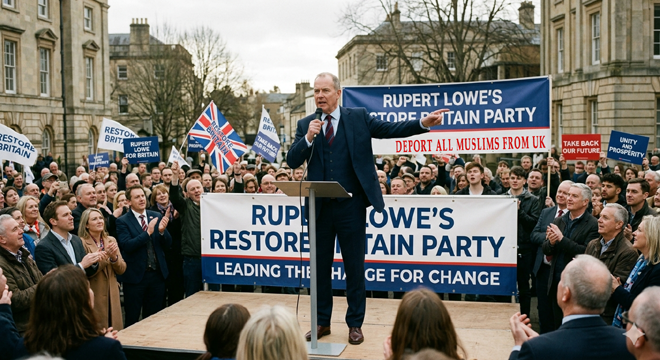
The United Kingdom has once again found itself in the throes of a deeply polarised national debate, as incendiary slogans and confrontational political rhetoric collide in the heart of Palace of Westminster. What began as a wave of protests has rapidly escalated into a broader crisis of identity, governance, and social cohesion. Chants calling for the deportation of all Muslims, once confined to the fringes, have now entered mainstream political discourse, igniting outrage, fear, and urgent questions about the limits of free speech in a liberal democracy.
At the same time, a dramatic parliamentary confrontation involving Rupert Lowe and Zarah Sultana has further inflamed tensions, symbolising a deeper fracture within British politics. The episode is not merely a clash of personalities; it reflects a broader struggle over national identity, loyalty, and the meaning of citizenship in an increasingly diverse society.
The events unfolding today are not isolated. They are the culmination of years of political, economic, and cultural pressures, Brexit, immigration debates, terrorism fears, and the rise of populist movements, all converging at a volatile moment in British history.
The Westminster confrontation and the language of loyalty
The dramatic exchange inside the House of Commons marked a turning point in the current controversy. Rupert Lowe’s speech, centred on a proposed “Sovereignty and Allegiance Act,” framed political participation as contingent upon an unquestioned hierarchy of loyalty to the nation-state. His direct challenge to Zarah Sultana, questioning whether internationalist or ideological commitments undermine national duty, resonated far beyond the chamber.
Such rhetoric taps into a long-standing tension within democratic systems: the balance between pluralism and unity. In a multicultural society like the UK, citizens often hold layered identities, religious, ethnic, ideological, and national. To suggest that these identities are inherently incompatible with loyalty to the state is to challenge the very foundations of liberal democracy.
The immediate reaction within Westminster was one of chaos and division. Some lawmakers condemned the remarks as inflammatory and dangerous, arguing they risk legitimising discrimination. Others, however, saw them as a necessary articulation of concerns that many voters feel are ignored by the political establishment.
Protest slogans and the boundaries of free speech
Outside Parliament, the situation took on a more volatile character. Protesters gathered in large numbers, some carrying placards and chanting slogans that called for the deportation of all Muslims. Such demands represent a stark escalation in public discourse, raising serious legal and ethical questions.
The United Kingdom has long grappled with the tension between freedom of expression and the prohibition of hate speech. Laws such as the Public Order Act and the Equality Act are designed to prevent incitement to hatred while preserving the right to protest. The current controversy tests these frameworks in unprecedented ways.
Advocates of free speech argue that even offensive or extreme views must be allowed in order to preserve democratic openness. Critics counter that calls for the removal of an entire religious group cross a clear moral and legal line, amounting to collective punishment and discrimination.
This debate is not merely theoretical. It has real-world consequences, shaping how communities perceive their safety and belonging within British society.
Historical context: immigration, empire, and identity
To understand the present crisis, one must consider the historical context of immigration and identity in the UK. Britain’s modern multicultural landscape is deeply rooted in its imperial past. Migration from South Asia, the Caribbean, and Africa, particularly in the decades following World War II, helped rebuild the nation and transformed its demographic composition.
Over time, however, immigration has become a politically charged issue. Concerns about economic competition, cultural integration, and national identity have periodically surfaced, often intensifying during periods of economic uncertainty or geopolitical tension.
The Brexit referendum in 2016 marked a watershed moment. While driven by a complex mix of factors, concerns about immigration and sovereignty played a central role. The current controversy can be seen, in part, as an extension of the unresolved debates that Brexit exposed but did not settle.
Terrorism, security, and public perception
Security concerns have also played a significant role in shaping public attitudes. High-profile terrorist incidents, such as the 7 July 2005 London bombings and the 2007 Glasgow Airport attack, have left a lasting imprint on the national psyche. These events, carried out by individuals identifying as Islamist extremists, have contributed to a perception, often amplified by media coverage, that links Islam with security threats.
It is important, however, to distinguish between extremist violence and the broader Muslim population. The vast majority of Muslims in the UK are law-abiding citizens who contribute positively to society. Conflating an entire religious community with the actions of a few not only distorts reality but also risks deepening divisions and fostering resentment.
Crime, data, and the politics of interpretation
One of the most contentious aspects of the debate involves crime statistics and their interpretation. Official data in the UK does not categorise crime by religion, focusing instead on ethnicity and nationality. This makes it difficult to draw definitive conclusions about crime patterns among specific religious groups.
Nevertheless, certain high-profile cases have had an outsized impact on public perception. Incidents involving organised child sexual exploitation in parts of northern England, for example, have been widely reported and often framed in terms of the perpetrators’ ethnic or religious background. Similarly, statistics about the proportion of Muslim inmates in certain categories of crime have been cited in political debates.
However, such data must be interpreted with caution. Selective use of statistics can create misleading narratives, especially when broader context is ignored. For instance, the overall composition of the prison population reflects a complex interplay of socio-economic factors, policing practices, and demographic trends.
Equally important is the recognition that crime is not confined to any single group. Reports have highlighted that different types of crime may be associated with different demographics, underscoring the need for nuanced analysis rather than sweeping generalisations.
Media, amplification, and the shaping of narratives
The role of media, both traditional and social, cannot be overstated in the current crisis. The rapid spread of video clips from the Westminster confrontation has amplified its impact, reaching millions within hours. Social media platforms, in particular, have enabled the dissemination of unfiltered content, often stripped of context.
This environment creates fertile ground for misinformation and polarisation. Sensational headlines and viral clips can reinforce existing biases, making it more difficult for nuanced perspectives to gain traction. At the same time, alternative media ecosystems have emerged, catering to audiences who distrust mainstream outlets.
The result is a fragmented information landscape in which different segments of the population operate with entirely different sets of “facts.”
The rise of populism and political realignment
The controversy also reflects broader trends in European and global politics. Populist movements have gained traction by positioning themselves as defenders of national identity against perceived threats from globalisation, immigration, and supranational institutions.
In the UK, this dynamic has been particularly pronounced in the post-Brexit era. Parties and politicians seeking to capitalise on public discontent have increasingly adopted more confrontational rhetoric. The language used by figures like Rupert Lowe is emblematic of this shift, framing political debates in terms of existential struggle rather than policy formulation.
This approach can be politically effective, mobilising support among voters who feel marginalised or ignored. However, it also carries risks, including the normalisation of extreme views and the erosion of democratic norms.
Social cohesion under strain
Perhaps the most immediate concern arising from the current situation is its impact on social cohesion. The UK’s strength has long been its ability to accommodate diversity while maintaining a shared sense of belonging. The rhetoric and protests now dominating the headlines threaten to undermine this delicate balance.
For Muslim communities, the situation is particularly fraught. Reports of rising anti-Muslim hate crimes suggest that inflammatory rhetoric can translate into real-world harm. Feelings of alienation and insecurity may, in turn, hinder integration and exacerbate tensions.
At the same time, many non-Muslim citizens express genuine concerns about issues such as integration, security, and cultural change. Dismissing these concerns outright risks further alienating segments of the population and fuelling resentment.
Legal and institutional responses
The government and legal institutions face a difficult challenge in responding to the crisis. On one hand, they must uphold the rule of law and protect vulnerable communities from hate speech and violence. On the other, they must avoid overreach that could be perceived as suppressing legitimate political expression.
Potential responses include increased policing of protests, stricter enforcement of hate speech laws, and public statements aimed at calming tensions. Parliamentary debates may also be considered in response to the Westminster confrontation, depending on whether it is deemed to have violated standards of conduct.
Ultimately, the effectiveness of these measures depends on their ability to strike a balance between competing principles.
The international dimension
The controversy has not gone unnoticed beyond the UK’s borders. Debates over immigration, public safety, and national identity are playing out across Europe and the wider spectrum. Events in the UK may influence, and be influenced by, similar developments elsewhere.
International observers often view Britain as a test case for multicultural democracy. How it navigates the current crisis could have implications for other nations grappling with similar challenges.
What next?
Predicting the outcome of the current crisis is difficult. Several scenarios are possible. The controversy may gradually subside, as news cycles shift and political attention moves elsewhere. Alternatively, it could mark the beginning of a more sustained period of polarisation and conflict.
Much will depend on the actions of political leaders, the media, and civil society. Responsible leadership, characterised by restraint, clarity, and a commitment to shared values, could help de-escalate tensions. Conversely, continued reliance on inflammatory rhetoric may deepen divisions.
The broader question facing the UK is not merely how to respond to a single controversy, but how to reconcile competing visions of its future. Is it to be a pluralistic society that embraces diversity, or one that prioritises a more narrowly defined conception of national identity? The answer will shape the nation for years to come.
A defining moment for British democracy
The drama unfolding in and around the Palace of Westminster represent more than a transient political storm. They are a reflection of deeper currents within British society, currents that have been building for years and are now breaking to the surface.
The confrontation between Rupert Lowe and Zarah Sultana, the crowds calling for mass deportations, and the broader debate over speech and identity all point to a nation at a crossroads.
How the UK responds will determine not only the immediate trajectory of its politics, but also the long-term health of its democracy. In navigating this hurdle, the challenge will be to uphold the principles of justice, equality, and freedom while addressing the legitimate concerns of its citizens.
The stakes could hardly be higher.