
To prevent agricultural overproduction and establish a new market, agri-businesses heavily marketed corn derivatives (like corn syrup, corn oil, and corn-based cereals) to Americans through paid doctor testimonials. Doctors started poor mouthing, eggs, grits and bacon as unhealthy breakfasts and start praising cornflakes as the healthy alternative. It was a lie but it worked
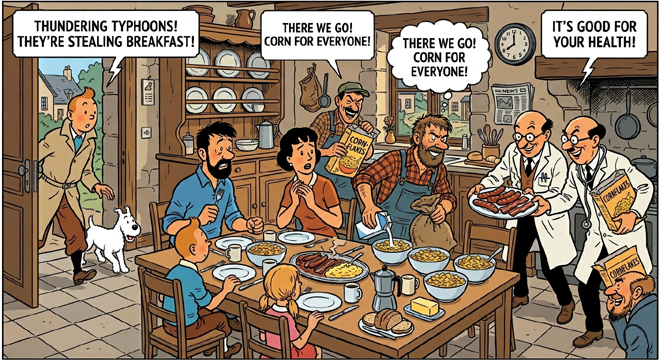
The overnight shift from a horse-driven to a diesel and petrol economy in the early-to-mid 20th century in USA rendered millions of draft animals obsolete overnight. Consequently, vast farmlands previously used to grow corn, hay and oats to feed these millions of horses could not pivot suddenly to other cash crops. True America style they even had a mountain of warehouse stored corn and oats. To prevent agricultural overproduction and establish a new market, agri-businesses heavily marketed corn derivatives (like corn syrup, corn oil, and corn-based cereals) to Americans through paid doctor testimonials. Doctors started poor mouthing, eggs, grits and bacon as unhealthy breakfasts and start praising cornflakes as the healthy alternative. It was a lie but it worked. Americans started poisoning themselves with more and more carbohydrates in cornflakes.
Cornflakes were originally created by Dr. John Harvey Kellogg, director of the Battle Creek Sanitarium in Michigan, in the late 1890s as a bland health food. A devout Seventh-day Adventist, Dr. Kellogg believed that rich, flavorful, and spicy foods overstimulated the body and incited “impure” thoughts (like masturbation). To keep his patients on a path of moral purity and good digestion, he invented toasted flakes from boiled grains.
Actually, it had nothing to do with Calvinism and religion but everything to do with lying to the customer to save the corn farmers from ruin. Dr. Kellogg’s brother, Will Keith Kellogg (W.K. Kellogg), realized the commercial potential of these bland flakes. He bought the rights, added sugar to make them palatable, and launched the Battle Creek Toasted Corn Flake Company in 1906. During the 1940s, as the corn lobby sought broader markets and Americans sedentary lifestyles increased due to the industrial revolution, W.K. Kellogg and other food companies initiated aggressive marketing campaigns. They positioned heavily processed, sugary breakfast cereals as a “healthy,” quick, and scientific way to start the day. This lobby paid individual doctors to endorse cornflakes. The broader processed-food industry relied heavily on institutional backing from nutritionists and medical associations. These organizations published studies and provided “medical endorsements” arguing that a quick-digesting carb breakfast was essential for energy. The industry often collaborated with public health boards and aligned with lobbyists (like the United Fruit Company, to promote the famous “cereal and banana” breakfast) to create the modern cultural consensus that breakfast is the most important meal of the day. From then on the move to poison your breakfast had begun.
John Harvey Kellogg supposedly invented cornflakes in the early 1900s with one simple idea, to get kids to drink more milk by making it fun. The original serving was straightforward: a big bowl of milk (200ml), a small amount of cereal (30 grams), and an egg on the side. Those days breakfast in the USA looked like this: 300 calories. 15 grams of protein. Moderate carbs. One egg for good fats. Grits with protein related fats. 100 years later cornflake companies have flipped the entire ratio with extensive pricing and advertising. Americans now take a large bowl of cereal, 80 to 90 grams, and add a splash of milk, maybe 100ml. The nutrition of that breakfast: 400 calories, 75 grams of carbs, debatable 6 grams of protein, no healthy fats for the skin and the synovial fluid. Nearly triple the carbs. Less than half the protein. No egg. No fruit. Cereal that has been factory prepared without oil and stored in a warehouse for three years in flashy packaging is definitely unhealthy, whatever the ratio to milk and fruits. The real story is different.
Cornflakes are convenience to the agri-business; bad for the customer
The history of breakfast in the United States is often presented as a story of convenience, innovation, and modernity. It is told as the triumph of science over tradition, of efficiency over labor-intensive cooking, and of industrial progress over the slower rhythms of nineteenth-century life. Few products symbolize this transformation more than the humble cornflake. Marketed for generations as a healthy and wholesome breakfast choice, cornflakes became one of the most successful food products in modern history. Yet behind the cheerful advertising, colorful packaging, and promises of health lies a far more complicated story about industrial agriculture, food marketing, changing lifestyles, and the enormous influence of corporations on public eating habits.
At the beginning of the twentieth century, breakfast in many American households looked very different from what it would become a hundred years later. Eggs, bacon, porridge, grits, milk, fruit, bread, and other relatively simple foods dominated the morning meal. Protein and fat played a central role in sustaining people through long days of physical labor. America was still a largely agricultural and industrial society where millions of people worked on farms, in factories, in construction, and in transportation. Daily calorie expenditure was significantly higher than it is today.
Into this environment entered Dr. John Harvey Kellogg, one of the most influential and controversial figures in American nutritional history. Kellogg was not merely a physician. He was also a health reformer, a religious thinker, and the director of the famous Battle Creek Sanitarium in Michigan. His beliefs about food reflected both medical theories of his era and his personal moral convictions. He advocated a diet that was intentionally bland, simple, and free from excessive stimulation. He believed rich foods, spices, alcohol, and heavy meat consumption contributed to both physical and moral decline.
The development of flaked cereal emerged from this worldview. Kellogg and his associates experimented with grains that could be cooked, flattened, and toasted into flakes. The resulting product was easy to digest, inexpensive, and aligned with his vision of healthy living. Contrary to later advertising campaigns, the original cereal was not designed as a sweet treat or a highly processed breakfast product. It was conceived as a relatively plain health food.
In its earliest form, cereal occupied a supporting role rather than the dominant position it would later assume. Milk remained a major component of the meal. Eggs often provided additional protein and fat. Breakfast was still built around a balance of nutrients rather than around a single packaged product. The cereal itself was only one element of a broader dietary pattern.
What happened over the following century was not simply the success of one invention. It was the transformation of an entire food culture. Industrialization, mass advertising, changing work patterns, agricultural economics, and corporate marketing combined to reshape how Americans thought about breakfast. By the late twentieth century, millions of people had come to view a bowl of processed cereal as the default morning meal.
The nutritional consequences of this shift remain a subject of debate. Critics argue that modern breakfast cereals contain excessive amounts of refined carbohydrates and added sugars while providing relatively little protein or healthy fat. Supporters point out that many cereals are fortified with vitamins and minerals and can form part of a balanced diet. Regardless of which position one adopts, there is little doubt that the rise of cereal transformed both consumer behavior and the economics of food production.
The story of cornflakes therefore provides a window into a broader question: how do industrial societies change eating habits? More importantly, who benefits when traditional foods are replaced by highly processed alternatives? To answer these questions, one must examine not only nutrition but also the economic forces that shaped twentieth-century America.
From horses to industrial agriculture
One of the least discussed aspects of food history is the dramatic transformation of agriculture during the early twentieth century. Before the widespread adoption of automobiles, trucks, and tractors, the American economy depended heavily on horses. Millions of animals were used for transportation, farming, freight movement, and military purposes. Feeding these animals required enormous quantities of corn, oats, hay, and other crops.
The mechanization of transportation and agriculture fundamentally altered this equation. As tractors replaced draft horses and motor vehicles replaced horse-drawn transport, demand for animal feed changed dramatically. Land that had been devoted to feeding horses became available for other agricultural uses. Farmers, agribusinesses, and commodity producers faced new challenges as production capacity increasingly exceeded demand in certain sectors.
Agricultural surpluses have long been a recurring feature of modern economies. When farmers produce more than consumers can absorb, prices fall and political pressure grows for new markets. Governments, corporations, and industry groups frequently search for ways to increase consumption of existing commodities.
Corn occupied a particularly important place in this process. It was abundant, versatile, and adaptable to industrial processing. Over time, corn found its way into countless products, including sweeteners, oils, animal feeds, starches, and breakfast cereals. The economic incentives for expanding corn consumption were significant.
The growth of food-processing technology further accelerated this trend. Advances in milling, packaging, preservation, and transportation made it possible to manufacture food on an unprecedented scale. Companies could process enormous quantities of grain, package it attractively, and distribute it across the country.
At the same time, urbanization was changing consumer behavior. Families had less time for elaborate breakfasts. More people worked fixed schedules outside the home. Convenience became a powerful selling point. Packaged foods promised speed, consistency, and ease of preparation.
Food manufacturers recognized an opportunity. Rather than simply selling grains as agricultural commodities, they could transform them into branded products with much higher profit margins. The value was no longer in the corn itself but in the processing, packaging, marketing, and consumer perception attached to it.
Advertising became essential. Companies needed consumers to believe that processed cereals were not merely convenient but also scientifically superior. The emerging fields of nutrition and public health provided useful language for these campaigns. Scientific terminology carried authority, and marketers quickly learned how to incorporate it into promotional materials.
As a result, breakfast ceased to be merely a meal. It became a commercial battlefield where corporations competed to shape public understanding of health, nutrition, and modern living. The cereal box evolved into one of the most successful marketing platforms in consumer history.
The power of advertising and nutritional messaging
The twentieth century witnessed the rise of advertising as one of the most influential forces in American culture. Food companies became pioneers in using mass media to shape consumer behavior. Newspapers, magazines, radio broadcasts, television programs, and later digital platforms carried carefully crafted messages about what people should eat.
Breakfast cereal companies were particularly effective at this strategy. They understood that food choices are rarely based solely on nutritional science. Consumers are influenced by habit, emotion, convenience, social status, and cultural expectations. Advertising campaigns therefore sold not just products but entire lifestyles.
The concept of a “healthy breakfast” became one of the industry’s most valuable marketing tools. Scientific language was used extensively in promotional materials. References to vitamins, energy, digestion, and nutrition appeared alongside images of happy families and successful children. The message was simple: eating cereal was modern, intelligent, and responsible.
Critics argue that these campaigns often exaggerated the health benefits of processed foods while downplaying their limitations. A bowl of cereal can certainly provide energy, but it may also contain large quantities of refined carbohydrates and added sugars. Depending on the product and serving size, the nutritional profile can differ substantially from traditional breakfasts centered on eggs, dairy, fruit, and minimally processed foods.
Another important development was the gradual shift in serving proportions. Earlier breakfast patterns often emphasized milk, eggs, and other protein-rich foods. Over time, larger portions of cereal became common while protein sources were reduced or eliminated. This change reflected both economic and cultural forces. Cereal was inexpensive, easy to store, and highly profitable for manufacturers.
The emergence of food endorsements further strengthened consumer confidence. Nutrition experts, medical professionals, and public health advocates frequently participated in discussions about dietary recommendations. While many acted in good faith based on the best available evidence, critics contend that industry influence sometimes shaped research priorities and public messaging.
The relationship between corporations and scientific institutions remains controversial today. Food companies fund research, sponsor conferences, and support educational programs. Such relationships do not automatically invalidate scientific findings, but they raise legitimate questions about conflicts of interest and the influence of commercial incentives on nutritional advice.
Meanwhile, processed breakfast foods became deeply embedded in American culture. Children grew up associating cereal with cartoons, prizes, and colorful mascots. Adults came to view cereal as a quick solution for busy mornings. Convenience increasingly outweighed considerations about food processing or ingredient quality.
The result was the normalization of a breakfast model that would have seemed unusual to many earlier generations: a large serving of processed grain accompanied by relatively small amounts of protein and fat. Whether this change represented progress or decline remains a matter of debate, but its impact on eating habits is undeniable.
Rethinking breakfast in the twenty-first century
Today, interest in nutrition has entered a new phase. Consumers are increasingly skeptical of highly processed foods and more willing to question decades of conventional dietary advice. The popularity of high-protein diets, whole-food approaches, and minimally processed ingredients reflects a broader reevaluation of modern eating habits.
This shift does not necessarily mean that cereal is inherently harmful. Nutritional outcomes depend on overall dietary patterns rather than on any single food. However, many health experts agree that protein, fiber, healthy fats, and nutrient density deserve greater attention than they received during certain periods of twentieth-century food marketing.
The debate surrounding breakfast illustrates a larger lesson about food culture. Dietary recommendations are influenced not only by science but also by economics, technology, politics, and marketing. Consumers often assume that popular eating habits emerge naturally from objective evidence. In reality, food systems are shaped by powerful commercial interests and historical circumstances.
Understanding the history of cornflakes helps reveal how these forces operate. What began as a relatively simple grain product eventually became the centerpiece of a vast industry. Along the way, changing agricultural realities, industrial production methods, and sophisticated advertising campaigns transformed public perceptions of health and nutrition.
The challenge for modern consumers is to navigate this landscape critically. Rather than accepting marketing claims at face value, individuals can examine ingredient lists, nutritional content, processing methods, and scientific evidence. They can evaluate foods according to their own health goals rather than relying solely on advertising narratives.
Perhaps the most important lesson is that convenience and health are not always identical. The industrial food system excels at producing foods that are cheap, portable, shelf-stable, and profitable. Those characteristics may or may not align with optimal nutrition. Consumers must therefore decide where to draw the line between convenience and quality.
The history of breakfast is ultimately a story about choice. Every generation inherits dietary habits shaped by the decisions of previous generations. Some traditions survive because they are beneficial. Others persist because they are heavily marketed. Distinguishing between the two requires curiosity, skepticism, and a willingness to question assumptions.
Cornflakes remain one of the most recognizable foods in the world. Their success reflects remarkable achievements in manufacturing, branding, and distribution. Yet their story also serves as a reminder that food is never just food. It is culture, economics, politics, science, and commerce combined. Understanding that complexity may be the first step toward making more informed decisions about what appears on the breakfast table each morning.