
When religious identity becomes the primary lens through which individuals understand society, it can also limit critical thinking and reinforce divisions between communities. Political leaders build voting coalitions, craft targeted messages, and appeal to community loyalties but any politician cannot mobilize caste sentiment if caste consciousness is absent from society. Religious polarization becomes politically useful only when strong religious identities already exist among the population
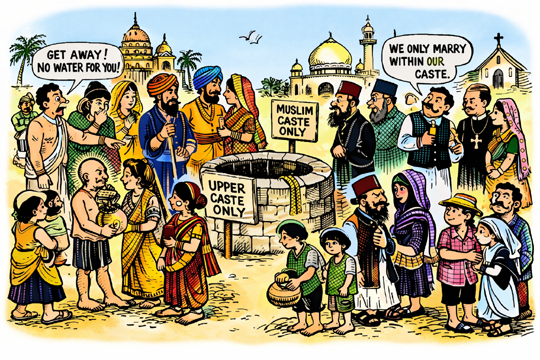
India’s public discourse is often dominated by debates about caste, religion, and identity. Political parties are frequently accused of dividing society along these lines, and election campaigns regularly revolve around caste equations, religious symbolism, and community-based mobilization. Yet a deeper examination suggests that politicians may not be the original creators of these social divisions. Rather, they operate within a cultural environment that already contains powerful identities and inherited loyalties. If politics appears obsessed with caste and religion, it may be because society itself remains deeply invested in them.
From the moment many Indians are born, they are assigned a place within a social and cultural framework that predates modern democracy by centuries. A child does not choose a caste, a religious tradition, or a set of family customs. These are inherited through family and community. Parents, grandparents, relatives, and local social networks become the first teachers of identity. Through everyday conversations, rituals, celebrations, and social expectations, children learn how they are expected to view themselves and others.
This process of socialization is so normal that it often escapes scrutiny. Many families introduce children to caste identities before they are capable of understanding the concept itself. Surnames, marriage discussions, community gatherings, and even casual remarks reinforce social boundaries. In numerous cases, families continue to prefer matrimonial alliances within specific castes, even when they publicly endorse equality. The result is a contradiction between constitutional ideals and social practice. While modern India legally rejects caste discrimination, social life often continues to be organized around caste consciousness.
Religion operates in a similar manner. Religious beliefs are not merely private matters of faith but are frequently embedded in family traditions, social customs, and community expectations. Children learn prayers, rituals, festivals, and religious narratives from an early age. These practices can provide a sense of belonging and continuity. However, when religious identity becomes the primary lens through which individuals understand society, it can also limit critical thinking and reinforce divisions between communities.
The persistence of caste and religious identity therefore raises an important question: if these structures are reproduced primarily through families and communities, how much responsibility should be assigned to politicians? Political leaders undoubtedly exploit existing divisions for electoral gain. They build voting coalitions, craft targeted messages, and appeal to community loyalties. Yet exploitation is not the same as creation. A politician cannot successfully mobilize caste sentiment if caste consciousness is absent from society. Likewise, religious polarization becomes politically useful only when strong religious identities already exist among the population.
This does not absolve political actors of responsibility. Leaders possess immense influence and can either challenge social prejudices or reinforce them. However, blaming politicians alone may obscure the deeper social mechanisms that sustain identity-based thinking. Elections occur every few years, but families shape individuals every day. Political campaigns are temporary; cultural conditioning is continuous. If society wishes to reduce the influence of caste and religious divisions, it may need to look beyond electoral politics and examine the institutions that transmit these values from one generation to the next.
The cultural transmission of caste and ritual
One reason caste remains resilient is that it is often presented not as an ideological system but as a natural part of social life. Many people inherit caste identities without ever being encouraged to question their origins or implications. What begins as a family tradition gradually becomes a social norm. Individuals learn whom they should marry, which communities they should associate with, and how they should interpret social status. Even in urban environments where economic modernization has transformed lifestyles, caste networks continue to influence opportunities, relationships, and political behavior.
The endurance of caste demonstrates that legal reform alone cannot eliminate deeply rooted cultural habits. India’s Constitution established equality before the law and prohibited discrimination. Over the decades, numerous legal measures have sought to reduce caste-based exclusion and improve opportunities for historically disadvantaged communities. Yet legal principles and social attitudes do not always move at the same pace. A society may formally reject discrimination while informally preserving the assumptions that sustain it.
Ritual practices also play a significant role in shaping social attitudes. Rituals are not inherently problematic. Every civilization develops ceremonies and traditions that provide meaning, continuity, and collective identity. Problems emerge when rituals are treated as substitutes for personal responsibility, critical inquiry, or practical action. In some contexts, individuals may come to believe that symbolic acts alone can solve complex personal, professional, or social challenges.
The belief that ritual observance guarantees success can encourage passivity. Economic advancement, educational achievement, scientific innovation, and professional accomplishment typically require sustained effort, discipline, and adaptation. Yet popular culture sometimes promotes the idea that spiritual observance alone is sufficient to secure favorable outcomes. Such thinking may provide emotional comfort, but it can also obscure the practical realities of achievement.
This tension between ritual and effort is not unique to India. Many societies throughout history have wrestled with similar questions. Human beings naturally seek certainty in uncertain situations. Rituals can provide psychological reassurance when outcomes are beyond individual control. The challenge arises when symbolic practices are elevated above practical action. A society that values ritual while also emphasizing education, innovation, and personal responsibility may achieve a productive balance. A society that treats ritual as a replacement for effort risks encouraging fatalism.
The educational system has an important role to play in addressing these issues. Schools and universities can encourage critical thinking, scientific reasoning, and historical awareness. They can teach students to distinguish between cultural heritage and empirical reality. Respect for tradition need not require the abandonment of rational inquiry. Indeed, many of the world’s most successful societies have demonstrated that cultural continuity and intellectual skepticism can coexist.
The family remains the most influential institution in this process. Children learn not only what their parents believe but also how their parents think. If families encourage questioning, evidence-based reasoning, and open discussion, future generations may become less susceptible to inherited prejudices. If families instead emphasize unquestioning obedience to tradition, social change becomes far more difficult.
Politics as a reflection of society
Political systems often mirror the societies in which they operate. Democracies, in particular, tend to reflect existing social realities because politicians depend on voters for support. When caste and religious identities remain powerful in society, political parties naturally seek to organize electoral strategies around them. This does not mean that politicians are innocent participants. Many actively reinforce divisions because doing so can yield political advantages. Nevertheless, their success depends on the continued relevance of those identities among the electorate.
The relationship between society and politics is therefore reciprocal. Social divisions influence political behavior, and political behavior can strengthen social divisions. Breaking this cycle requires intervention at both levels. Political leaders must be willing to promote broader civic identities that transcend caste and religion. At the same time, citizens must be prepared to evaluate leaders based on governance, competence, and policy rather than inherited group affiliations.
One obstacle to such transformation is the persistence of collective thinking. Individuals often derive security from belonging to a larger group. Caste associations, religious organizations, and community networks provide social support, economic connections, and cultural continuity. Consequently, efforts to weaken identity politics can be perceived as threats to established forms of social organization.
Modernization has altered some aspects of this landscape. Urbanization, migration, higher education, and digital communication have exposed millions of Indians to diverse perspectives. Inter-caste friendships and marriages have become more common in many urban settings. Professional environments increasingly reward skill and competence rather than inherited status. These developments suggest that social identities are not immutable.
However, modernization has not eliminated traditional loyalties. In some cases, technological advances have amplified them. Social media allows communities to organize, mobilize, and reinforce collective narratives on an unprecedented scale. Information circulates rapidly, but so do stereotypes, prejudices, and misinformation. Digital platforms can simultaneously promote social progress and entrench social divisions.
The challenge for contemporary India is therefore not simply political reform but cultural transformation. Laws can prohibit discrimination, but they cannot instantly change attitudes. Electoral incentives can be altered, but they cannot erase inherited beliefs. Genuine change requires a shift in how people understand identity, citizenship, and social responsibility.
Such a transformation would involve moving beyond inherited categories toward a more individual-centered understanding of human worth. People would be evaluated according to their character, abilities, and actions rather than their caste background or religious affiliation. Success would be associated with effort, learning, and innovation rather than symbolic status. Cultural traditions could be preserved as expressions of heritage rather than instruments of social hierarchy.
Toward a more rational and inclusive society
The future of India depends in part on its ability to reconcile tradition with modernity. This does not require the rejection of religion, culture, or community. Rather, it requires a willingness to distinguish between those aspects of tradition that enrich human life and those that restrict human potential. Every civilization evolves by reassessing inherited practices in light of changing circumstances. India is no exception.
A more rational society would encourage individuals to question assumptions rather than accept them automatically. It would promote education not merely as a path to employment but as a means of developing intellectual independence. Citizens would be encouraged to evaluate claims on the basis of evidence rather than authority. Public debate would focus more on economic development, institutional performance, scientific progress, and social welfare than on inherited identities.
At the same time, inclusivity requires recognition of the dignity of all individuals regardless of caste, religion, language, or background. Constitutional principles become meaningful only when they are reflected in everyday behavior. Equality before the law is essential, but equality in social life is equally important. A society cannot fully realize its democratic ideals if large segments of the population continue to be judged according to inherited categories.
Families have a central role in this transformation. Parents who teach their children to respect people from different backgrounds contribute to a more inclusive future. Parents who encourage curiosity rather than conformity help create independent thinkers. The values transmitted within households ultimately shape the character of society.
Political leaders also bear responsibility. Rather than exploiting social divisions, they can work to cultivate a broader sense of national citizenship. They can emphasize shared challenges and common aspirations. They can demonstrate that governance is about solving practical problems rather than mobilizing inherited loyalties.
The debate over caste and religion in India is therefore not merely a political issue. It is a cultural question, an educational question, and a social question. Politicians may benefit from existing divisions, but those divisions originate in a broader social environment that extends far beyond electoral competition. Understanding this reality is essential for anyone seeking meaningful reform.
India’s greatest achievements have emerged when individuals transcended narrow identities and focused on larger goals. Scientific discoveries, entrepreneurial successes, artistic innovations, and democratic accomplishments have all depended on talent, effort, and imagination rather than inherited status. The future will likely belong to those who embrace these values. The challenge is not to abandon culture but to ensure that culture serves human progress rather than obstructing it. Only then can the country move toward a society where citizenship matters more than caste, where character matters more than inherited labels, and where effort and reason are valued above ritual and social hierarchy.