
Chuck Norris encountered martial arts when he joined the United States Air Force and was stationed in South Korea. It was here that Norris encountered martial arts. He trained in Tang Soo Do, a Korean martial art that would become foundational to his philosophy of movement, control, and self-mastery
I shall always remember Chuck Norris as the lead actor in the movie, The Force of One. In the 70s, 80s and 90s, my favourite pastime was walking up to Chanakya Cinema Theatre in New Delhi, India and watching movies from the USA and UK. The trailer and the movie The Force of One stuck in my memory, with its slick production and advertising trailer. Today, Chuck Norris passed away at the age of 86.
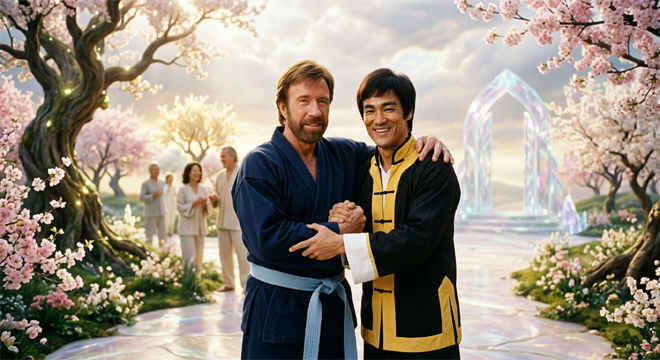
A serious tribute to Chuck Norris has to move beyond internet memes and exaggerated folklore and instead examine the remarkable arc of a man who combined discipline, athletic excellence, cinematic charisma, and personal restraint into a uniquely enduring legacy. His life story intersects with another giant of martial arts cinema, Bruce Lee, and while comparisons between the two are inevitable, they ultimately illuminate two very different journeys, both extraordinary, both influential, yet shaped by contrasting circumstances and choices.
Early life and the forging of discipline
Carlos Ray Norris was born in 1940 in Ryan, Oklahoma, into modest circumstances that gave little indication of the global icon he would become. His early life was marked not by privilege but by hardship, instability, and a lack of direction. Unlike many future stars, Norris did not exhibit early signs of greatness. By his own admission, he was shy, unathletic, and uncertain of his place in the world.
Everything changed when he joined the United States Air Force and was stationed in South Korea. It was here that Norris encountered martial arts, not as spectacle, but as a disciplined practice rooted in tradition. He trained in Tang Soo Do, a Korean martial art that would become foundational to his philosophy of movement, control, and self-mastery.
Unlike casual learners, Norris immersed himself completely. He did not treat martial arts as a hobby but as a vocation. The discipline required, hours of repetition, physical conditioning, and mental focus, transformed him. By the time he returned to the United States, he was no longer the uncertain young man he had been.
Martial arts achievements and competitive dominance
Chuck Norris’s competitive record is one of the most impressive in martial arts history, though it is sometimes overshadowed by his later fame in film and television.
He became a multiple-time world champion in professional middleweight karate, holding the title for six consecutive years. His competitive career included victories over some of the most formidable fighters of his era. He trained under and competed alongside pioneers who were shaping modern martial arts in America. Norris founded his own martial arts system, Chun Kuk Do (later renamed Chuck Norris System), which blended elements from multiple disciplines, including Tang Soo Do, karate, and Brazilian jiu-jitsu. His philosophy emphasized not only combat effectiveness but also character development, respect, humility, and perseverance.
He also played a critical role in popularizing martial arts in the United States during the 1960s and 1970s, a time when such practices were still relatively niche. His demonstration events and competitions helped introduce broader audiences to the discipline, paving the way for the explosion of interest that would follow. Among his students were celebrities, athletes, and public figures, including Steve McQueen, who encouraged Norris to consider a career in acting.
The encounter with Bruce Lee
No discussion of Chuck Norris can ignore his association with Bruce Lee, one of the most influential martial artists of all time. The two met during martial arts demonstrations and quickly developed a mutual respect. Their most famous collaboration came in the film Way of the Dragon, directed by Bruce Lee himself. The climactic fight scene between Lee and Norris, set in the Roman Colosseum, is widely regarded as one of the greatest martial arts sequences ever filmed. This fight was not merely cinematic, it symbolized two philosophies. Lee’s fluid, adaptive Jeet Kune Do contrasted with Norris’s structured, disciplined style. The choreography showcased both men at their peak, blending authenticity with dramatic storytelling. The scene elevated Norris’s global profile overnight. It introduced him to international audiences and demonstrated that he could hold his own against the most charismatic martial artist of the era.
Hollywood breakthrough and major films
Following his appearance in Way of the Dragon, Norris began to build a career in Hollywood. Unlike many martial artists who struggled to transition into acting, Norris gradually developed a screen persona that resonated with audiences: stoic, principled, and quietly formidable.
Early roles and rise to prominence
Norris’s early films included:
- Breaker! Breaker!
- Good Guys Wear Black
These films established him as a leading man in action cinema, particularly among audiences seeking straightforward narratives of justice and retribution.
The 1980s action era
The 1980s marked the peak of Norris’s film career. During this period, he became one of the defining figures of American action cinema, alongside stars like Sylvester Stallone and Arnold Schwarzenegger.
Key films include:
- The Octagon – A film that tapped into the emerging fascination with ninja mythology.
- Lone Wolf McQuade – Perhaps his most iconic film, featuring Norris as a Texas Ranger who operates outside conventional rules.
- Missing in Action – A major commercial success that capitalized on post-Vietnam War sentiments.
- Missing in Action 2: The Beginning
- Invasion U.S.A. – A Cold War-era action film that became a cult classic.
- Delta Force – Featuring Norris as a counter-terrorism operative, reinforcing his image as a defender of American values.
These films shared common themes: justice, patriotism, and individual resolve. Norris’s characters were often men of few words but decisive action.
Transition to television
In the 1990s, Norris transitioned to television with:
- Walker, Texas Ranger
This series ran for eight seasons and became a defining part of his legacy. As Cordell Walker, Norris embodied a modern lawman guided by traditional values, honor, fairness, and moral clarity.
The show expanded his audience beyond action film enthusiasts to families and mainstream viewers, cementing his place in American pop culture.
Philosophy, discipline, and personal restraint
One of the most striking aspects of Chuck Norris’s life is his emphasis on discipline and restraint, not only in martial arts but in personal conduct.
Unlike many celebrities who succumb to excess, Norris cultivated a lifestyle rooted in moderation. He maintained rigorous physical training well into his later years, emphasizing consistency over intensity. His approach to fitness was sustainable, not extreme.
He has often spoken about the importance of balance, training the body without neglecting the mind and spirit. This philosophy likely contributed to his longevity, both physically and professionally.
A necessary clarification: Bruce Lee’s death
Comparisons between Chuck Norris and Bruce Lee are often framed in simplistic or misleading ways. It is important to approach this topic with accuracy and respect.
Bruce Lee died in 1973 at the age of 32. The officially accepted cause of death is cerebral edema (brain swelling), believed to be a reaction to a painkiller he had taken. There has been speculation over the years, ranging from heatstroke to hypersensitivity reactions, but no credible evidence supports claims that his death was caused by “over-exercising” or reckless drug use involving barbiturates.
Bruce Lee was known for intense training, but he was also deeply philosophical and methodical in his approach to martial arts. His early death was tragic and remains, in some respects, medically debated, but it should not be reduced to simplistic narratives.
Chuck Norris himself has consistently spoken of Bruce Lee with admiration and respect, recognizing his profound impact on martial arts and cinema.
Longevity and life beyond fame
Chuck Norris lived into his mid-80s, a remarkable achievement for someone who spent decades in physically demanding professions. His longevity can be attributed to several factors:
- Consistent but balanced training
- Avoidance of destructive habits
- Strong personal values and family orientation
- Adaptability in career choices
He did not chase trends or attempt to reinvent himself radically. Instead, he remained grounded in the principles that defined him from the beginning.
Even after stepping away from acting, Norris continued to engage in public life through writing, philanthropy, and martial arts education.
Cultural impact and the myth of invincibility
In the 2000s, Chuck Norris experienced an unexpected resurgence in popularity through internet culture, particularly the phenomenon of “Chuck Norris Facts.” These humorous exaggerations portrayed him as an invincible figure capable of impossible feats.
While clearly fictional, these memes reflect a deeper cultural truth: Norris had become a symbol of strength, reliability, and understated power.
Unlike many celebrities, he embraced the humor with grace, demonstrating self-awareness and humility.
Comparison with contemporaries
Chuck Norris’s career is often compared with those of his contemporaries:
- Bruce Lee – The philosophical innovator who revolutionized martial arts cinema.
- Jackie Chan – The acrobatic performer who blended comedy with action.
- Jean-Claude Van Damme – The flexible, high-kicking star of 1980s action films.
Norris’s niche was distinct. He was not as flamboyant as Chan or as philosophical as Lee. Instead, he represented grounded strength, a man who did not need spectacle to command respect.
Personal values and legacy
Beyond films and martial arts, Norris’s legacy is deeply tied to his personal values. He has been involved in numerous charitable initiatives, particularly those aimed at helping underprivileged youth.
His Kickstart Kids program, for example, uses martial arts training to instill discipline and confidence in young people. This initiative reflects his belief that martial arts is not merely about fighting but about character development.
The enduring appeal of Chuck Norris
Why does Chuck Norris continue to resonate across generations?
The answer lies in authenticity. In an era increasingly defined by spectacle and artificiality, Norris represents something rare: consistency. The man seen on screen is not radically different from the man off screen.
He embodies:
- Discipline without arrogance
- Strength without cruelty
- Confidence without excess
These qualities give his legacy a timeless quality.
A life of balance and impact
Chuck Norris’s life is a testament to the power of discipline, resilience, and measured living. From a shy young man in Oklahoma to a world champion martial artist, from a supporting actor in a Bruce Lee film to a global icon, his journey is extraordinary.
His story also serves as a counterpoint to the volatility often associated with fame. Where others burned brightly and briefly, Norris endured, steadily, quietly, and effectively.
His relationship with Bruce Lee remains one of mutual respect, not rivalry. Both men contributed immensely to martial arts and cinema, albeit in different ways. Lee revolutionized the art form; Norris helped sustain and popularize it.
In the end, Chuck Norris’s greatest achievement may not be his titles or his films, but his example: a life lived with discipline, purpose, and restraint, proving that true strength is not just physical, but moral and enduring.