
Classical Hindu texts have historically imbued eclipses with moral and spiritual resonance. Ancient scriptures like the Puranas describe the myth of Rahu and Ketu, shadow planets believed to swallow the Sun or Moon during eclipses. While contemporary astrology interprets Rahu and Ketu symbolically as lunar nodes rather than physical bodies, their influence is thought to intensify karmic patterns and hidden emotions during eclipse periods
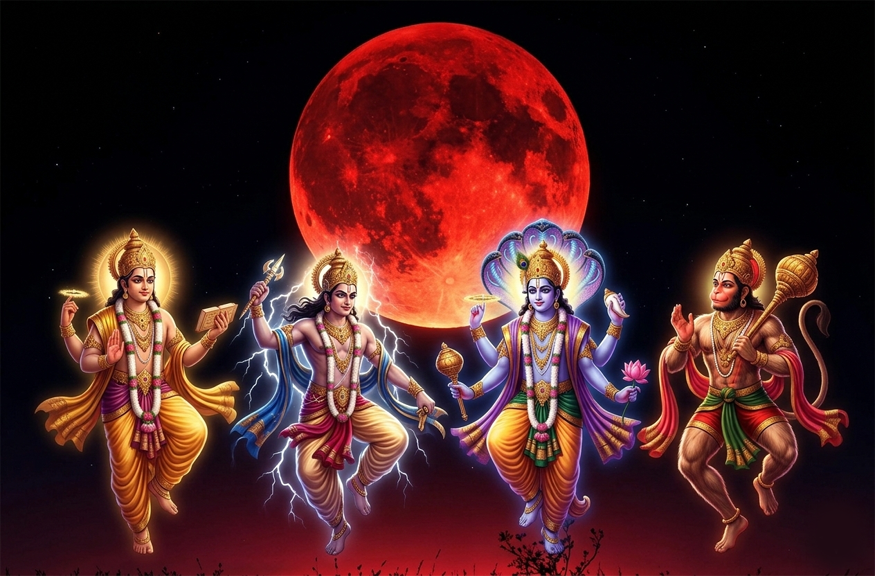
On the evening of March 3, 2026, the skies over India will host one of the most arresting astronomical spectacles: a total lunar eclipse, traditionally known as Chandra Grahan. As the Earth’s shadow slowly engulfs the Moon and the familiar silver disc turns a deep coppery red, observers across the subcontinent will witness what is popularly called a “Blood Moon.” The eclipse is expected to conclude at approximately 21:23 IST, with the most intense visual and symbolic phase unfolding during the early evening hours. Beyond its scientific explanation, this celestial alignment carries immense cultural, spiritual, and astrological significance in India, where eclipses have long been interpreted as moments of karmic reckoning and emotional revelation.
In astronomical terms, a total lunar eclipse occurs when the Earth comes directly between the Sun and the Moon, casting a shadow that darkens the lunar surface. The reddish hue arises because sunlight passing through Earth’s atmosphere scatters shorter blue wavelengths and bends longer red wavelengths toward the Moon. Yet while science explains the mechanics, astrology and tradition interpret the meaning. The March 2026 Blood Moon is being described in many astrological circles as emotionally charged, particularly affecting fixed zodiac signs, Leo, Aquarius, Scorpio, and Taurus, and individuals whose natal charts feature a weakened Moon. In these interpretations, eclipses override the regular rhythms of the lunar cycle, creating a 48-hour window of instability, heightened emotion, and profound introspection.
Scientific understanding and traditional interpretation
Modern astronomy has demystified eclipses, but in India, scientific insight coexists with a vibrant symbolic tradition. Institutions such as the Indian Space Research Organisation and observatories across the country routinely publish precise eclipse timings and visibility maps. These agencies emphasize the safety and wonder of viewing a lunar eclipse, which unlike a solar eclipse requires no protective eyewear. Educational outreach programs encourage families and students to observe the phenomenon as a lesson in celestial mechanics.
At the same time, classical Hindu texts have historically imbued eclipses with moral and spiritual resonance. Ancient scriptures like the Puranas describe the myth of Rahu and Ketu, shadow planets believed to swallow the Sun or Moon during eclipses. While contemporary astrology interprets Rahu and Ketu symbolically as lunar nodes rather than physical bodies, their influence is thought to intensify karmic patterns and hidden emotions during eclipse periods.
The March 3, 2026, Chandra Grahan thus stands at the intersection of science and symbolism. It is both a predictable astronomical event and a catalyst for reflection, prompting many to engage in prayer, fasting, or meditation during the eclipse window. The conclusion of the eclipse at 21:23 IST marks not merely the end of a shadow but, in traditional belief, the closure of a temporary energetic disturbance.
The emotional landscape of the March 2026 Blood Moon
Astrologers suggest that this particular Blood Moon carries themes of emotional truth rising to the surface. Lunar eclipses are often compared to full moons magnified several times over. While a regular full moon brings heightened sensitivity and culmination, an eclipse is believed to expose deeper, often suppressed realities. In March 2026, these revelations are forecast to center primarily on relationships and career structures.
Relationships, romantic, familial, or professional, may undergo sudden clarity. Hidden resentments could surface; unresolved conversations may demand attention. Emotional reactions during the 48 hours surrounding the peak are predicted to be intense and occasionally disproportionate. Because eclipses are said to override normal lunar rhythms, decisions made in the heat of the moment may not reflect long-term truth. Astrological guidance for this period advises restraint, observation, and contemplation rather than impulsive action.
In career matters, the eclipse may illuminate structural imbalances. Individuals feeling trapped in stagnant roles could experience a surge of awareness about their dissatisfaction. Alternatively, sudden recognition or opportunity might arise, compelling reassessment of professional priorities. The underlying message attributed to this Blood Moon is transformation, not necessarily through external upheaval, but through internal realization.
Impact on fixed zodiac signs
A notable emphasis in forecasts for this eclipse is its pronounced impact on fixed zodiac signs: Leo, Aquarius, Scorpio, and Taurus. In astrological theory, fixed signs represent stability, determination, and resistance to change. They anchor the seasons and provide continuity. However, during an eclipse, this steadfast energy can become tension-filled if change is overdue.
For Leos, the eclipse may highlight questions of identity and leadership. Issues related to recognition, ego, or creative expression might surface. Aquarians may find their ideals challenged, prompting introspection about community roles and long-term visions. Scorpios, already associated with transformation, could experience deep emotional purging, confronting hidden fears or attachments. Taureans might feel shifts in financial security or personal values, urging flexibility where rigidity once prevailed.
While these influences are symbolic rather than deterministic, they illustrate a broader theme: the eclipse tests stability where growth has been resisted. In many interpretations, the karmic dimension is strongest when individuals cling to outdated patterns.
The Moon’s strength in personal horoscopes
Astrological discourse around the March 2026 Chandra Grahan also emphasizes the condition of the Moon in individual birth charts. The Moon represents emotions, memory, nurturing instincts, and subconscious patterns. A “weak Moon” in astrological terminology may indicate emotional volatility, difficulty with self-soothing, or heightened sensitivity.
During a lunar eclipse, individuals with such placements are thought to experience amplified emotional waves. This does not imply inevitable distress but rather a greater need for grounding practices. Meditation, journaling, prayer, or simply limiting exposure to conflict may help stabilize the internal landscape.
Conversely, those with strong lunar placements might experience the eclipse as a moment of clarity rather than turmoil. The difference lies not in the external event but in personal receptivity. The March 3, 2026, eclipse thus becomes a mirror, reflecting the inner condition of each observer.
The 48-hour window of instability
A recurring theme in eclipse forecasts is the 48-hour period surrounding the peak. In the case of March 3, 2026, the hours leading up to and immediately following the climax in early evening are considered particularly sensitive. Emotional reactions may intensify; misunderstandings can escalate rapidly.
Astrologers caution against making irreversible decisions, such as resigning from a job, ending a long-term relationship, or initiating major financial commitments, during this window. The reasoning is symbolic: eclipses temporarily obscure clarity, much as Earth’s shadow obscures the Moon. Once the shadow passes, perspectives may shift.
However, this period is not solely about avoidance. It is also regarded as potent for spiritual practice. Many traditions recommend chanting, silent contemplation, or recitation of mantras during the eclipse. The perceived thinning of ordinary boundaries between conscious and subconscious realms is seen as an opportunity for insight.
Cultural practices during Chandra Grahan in India
In India, Chandra Grahan has long been accompanied by ritual observances. Some households avoid cooking during the eclipse, believing food prepared under the shadow may carry negative vibrations. Others place tulsi leaves in stored food as a symbolic purifier. After the eclipse concludes, a ritual bath is commonly performed, marking renewal.
Temples may alter schedules, and many devotees recite sacred texts or offer prayers. Pilgrimage sites such as Triveni Sangam often see increased spiritual activity during eclipses, as confluences of rivers are believed to amplify purifying energies. These customs vary by region and community but share a common theme of reverence and caution.
Importantly, modern perspectives increasingly encourage balancing tradition with rational understanding. Observing the eclipse safely and appreciating its scientific beauty can coexist with personal spiritual reflection.
Psychological symbolism of the Blood Moon
The red hue of a Blood Moon evokes powerful imagery. In psychological symbolism, red is associated with vitality, passion, anger, and transformation. When the Moon, symbol of emotion, turns red, it can metaphorically represent the surfacing of primal feelings.
The March 2026 eclipse, described as “emotionally charged,” fits this symbolism. Individuals may find themselves confronting feelings long buried beneath daily routines. This does not guarantee dramatic external events; often, the most profound transformations occur internally. A realization about one’s needs, boundaries, or ambitions can be more life-altering than any visible upheaval.
Because eclipses are cyclical yet irregular, they symbolize turning points rather than steady progressions. They disrupt patterns to reveal truth. Whether one interprets this literally or metaphorically, the concept encourages mindful self-examination.
Career structures and transformative change
Astrological forecasts for this Blood Moon highlight career structures as a focal point. Structures imply systems, hierarchies, contracts, long-term plans. When an eclipse interacts with such themes, it suggests reassessment of foundation and purpose.
For some, this may manifest as recognition that a job no longer aligns with personal values. For others, it may bring validation and reinforcement of chosen paths. The key element is awareness. Fixed signs, known for persistence, might resist change even when growth requires it. The eclipse acts symbolically as a cosmic nudge.
From a pragmatic standpoint, career decisions should be approached with deliberation. The emotional intensity of the eclipse period may color perceptions. Waiting until the energy stabilizes before acting ensures that choices reflect clarity rather than temporary reaction.
Karmic themes and introspection
The language of karma often accompanies eclipse interpretations. In this context, karma refers not to fatalistic punishment but to patterns formed by past actions and habits. Eclipses are seen as checkpoints, moments when unresolved issues resurface for integration.
The March 3, 2026, Chandra Grahan may thus bring encounters with unfinished emotional business. Old acquaintances might reappear; forgotten ambitions could reignite. Rather than fearing these returns, astrologers recommend observing them as opportunities for closure or renewal.
Introspection becomes essential. Journaling feelings, reflecting on recurring themes, and seeking wise counsel can transform potential turbulence into growth. The eclipse does not create problems; it illuminates them.
Collective mood and social atmosphere
Beyond individual horoscopes, eclipses are sometimes interpreted as influencing collective mood. In a diverse and populous country like India, such interpretations often intertwine with social discourse. While empirical evidence linking eclipses to societal events remains inconclusive, the shared experience of observing a Blood Moon can foster communal reflection.
Public interest in astronomy tends to spike during eclipses. Schools, amateur astronomy clubs, and science communicators host observation events. This communal curiosity underscores the unifying aspect of celestial events: regardless of belief system, millions look up at the same sky.
At the same time, social media conversations may amplify emotional narratives around the eclipse. Being mindful of heightened rhetoric during the 48-hour window can prevent unnecessary conflict. Emotional awareness at both personal and collective levels aligns with the broader theme of introspection.
Practical guidance for the eclipse evening
As the eclipse unfolds on March 3, 2026, practical steps can help balance observation with emotional steadiness. First, check official timing updates from reliable astronomical sources to plan viewing. The peak intensity in early evening provides an accessible window for observation before the eclipse concludes at 21:23 IST.
Second, create a calm environment. Whether one engages in prayer, meditation, or simple quiet observation, intentional stillness can counteract emotional volatility. Limiting impulsive communication, especially heated discussions, reduces the risk of misunderstandings.
Third, postpone major decisions. If a realization arises, note it down and revisit it after several days. The clarity that remains once emotions settle is more likely to reflect enduring truth.
After the shadow passes
When the Earth’s shadow recedes and the Moon regains its luminous glow, the symbolic message is one of renewal. Eclipses remind observers that darkness is temporary and part of a larger cycle. Emotional turbulence, too, subsides.
The days following March 3, 2026, may feel calmer yet subtly transformed. Insights gained during the eclipse can guide measured action. Relationships clarified under the red light may move toward healthier balance. Career reflections might inspire gradual restructuring rather than abrupt departure.
Ultimately, the Chandra Grahan is both spectacle and metaphor. It invites awe at cosmic precision and contemplation of inner landscapes. Whether viewed through the lens of astronomy or astrology, its power lies in its capacity to pause routine and provoke reflection.
Embracing caution and clarity
The Blood Moon of March 3, 2026, visible across India, is poised to be a moment of heightened awareness. Ending at 21:23 IST, with its most intense phase in the early evening, it symbolizes emotional truth emerging from shadow. Fixed signs and those with sensitive lunar placements may feel its resonance most strongly, particularly in matters of relationship and career.
Yet the eclipse need not be feared. Its message, repeated across traditions, is caution paired with introspection. The 48-hour window of instability encourages restraint, not paralysis. By acknowledging heightened emotion without surrendering to it, individuals can harness the transformative potential of the event.
As the red Moon fades back to silver, what remains is insight. The shadow reveals, then withdraws. In that rhythm lies the enduring lesson of Chandra Grahan: illumination often begins in darkness, and clarity follows when we allow reflection to replace reaction.