
Ali Khamenei’s tenure from 1989 to 2026 coincided with cycles of repression at home and confrontation abroad. For supporters of regime change, his removal represents the first tangible step in what they describe as a rollback of torture, executions, and coercive enforcement of authoritarian interpretations of Sharia law. People who mourn this person’s death may be identified as future problems to dealt with later
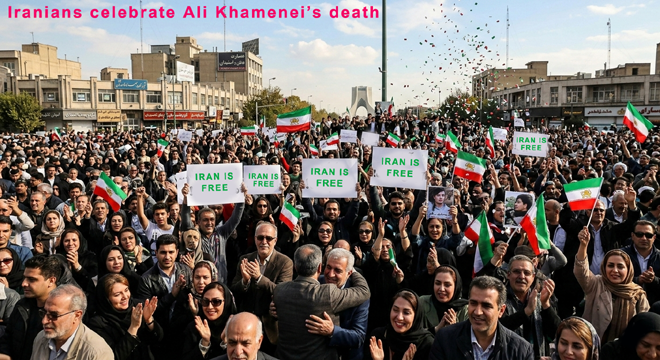
The reported death of Ali Khamenei in a joint strike attributed to Israel and the United States would, if confirmed, mark one of the most consequential geopolitical ruptures in the modern Middle East. For nearly four decades, Khamenei stood at the apex of the Islamic Republic’s power structure, shaping Iran’s internal security policies, regional interventions, and ideological posture. His tenure from 1989 to 2026 coincided with cycles of repression at home and confrontation abroad. For supporters of regime change, his removal represents the first tangible step in what they describe as a rollback of torture, executions, and coercive enforcement of authoritarian interpretations of Sharia law—both within Iran and across allied movements, including in Gaza under Hamas rule.
This article examines the historical record of executions, protest crackdowns, and allegations of torture in Iran during Khamenei’s leadership; the parallel dynamics in Gaza under Hamas since 2007; and the catalytic impact of the October 7, 2023 attacks on Israel. It situates the present moment within a broader debate about sovereignty, human rights, deterrence, and the risks of externally driven regime decapitation.
The architecture of power under the Islamic Republic
When Khamenei succeeded Ruhollah Khomeini in 1989, he inherited a political system designed to fuse clerical oversight with republican institutions. As Supreme Leader, he exercised authority over the armed forces, the judiciary, state broadcasting, and key appointments. Over time, the Islamic Revolutionary Guard Corps (IRGC) consolidated economic and security influence, becoming both a military pillar and a domestic enforcer.
Iran’s penal code retained capital punishment for a range of offenses, including murder and certain drug crimes, as well as vaguely defined national security offenses. Human-rights monitors repeatedly criticized due process deficiencies, forced confessions, and the use of televised admissions. The state rejected many of these claims, arguing that its courts followed Islamic jurisprudence and national law.
Executions from 1989 to 2026: scale and controversy
Across Khamenei’s tenure, activist groups estimate that tens of thousands of executions were carried out. Some place the total between 20,000 and 30,000, though comprehensive, independently verified datasets do not exist. The opacity of Iran’s judicial reporting—combined with fluctuating transparency across different administrations—makes precise accounting difficult.
Women were among those executed. Based on monitoring by organizations such as Iran Human Rights, between 700 and 1,000 women may have been executed between 1989 and 2026. In 2024 alone, at least 31 women were reportedly executed, according to the United Nations human rights office. These cases ranged from murder convictions to political or security-related charges.
Juvenile offenders—defined as individuals under 18 at the time of the alleged crime—also faced capital punishment. Estimates suggest that 150 to 250 juvenile offenders were executed during this period. Iran maintained that its procedures complied with its interpretation of Islamic law, including assessments of maturity, while critics argued this contravened international conventions prohibiting the execution of minors.
Protest waves and lethal crackdowns
Iran’s political history under Khamenei was punctuated by mass protests. The 2009 Green Movement, sparked by disputed presidential election results, saw widespread arrests and reported abuses. The 2022–23 protests—ignited by the death of Mahsa Amini in morality-police custody—expanded into a nationwide challenge to clerical authority.
A UN-mandated human-rights mission reported approximately 551 protesters killed during the 2022–23 unrest, including around 49 women and 68 children. Activist-verified casualties from January 2026 protests included at least 176 women and 100 children identified by rights-monitoring groups as victims of security-force violence. Separate tallies cited at least 118 children killed during the 2025–26 protest period.
Iranian authorities consistently disputed higher-end casualty figures and framed the unrest as foreign-instigated sedition. Nevertheless, the cumulative toll underscored a pattern: public dissent was often met with force, mass detention, and prosecutions carrying severe penalties.
Deaths in custody and allegations of torture
Deaths attributed to torture or mistreatment in custody are among the hardest to quantify. Activist sources document hundreds of women allegedly killed under torture over the decades, though these numbers remain unverified by the UN. Organizations including Human Rights Watch documented cases of children subjected to beatings, sexual assault, or enforced disappearance during protest crackdowns.
Iranian officials have periodically announced investigations into individual deaths in custody, sometimes attributing them to illness or suicide. Critics counter that systemic opacity prevents accountability. The lack of independent forensic access has fueled mistrust and international censure.
Gender-based violence beyond state action
Not all violence against women in Iran is directly attributable to state policy. Human-rights organizations reported at least 182 women murdered in 2024 from causes including domestic violence. In 2025, femicide reports documented at least 207 female deaths linked to gender-based violence. These figures reflect broader societal challenges—patriarchal norms, legal barriers to divorce or protection orders, and uneven enforcement—that intersect with, but are distinct from, political repression.
Gaza under Hamas: executions and internal control
In the Gaza Strip, the Islamist movement Hamas has governed since 2007 following a violent split with Fatah. Human-rights groups including Amnesty International and the Palestinian Centre for Human Rights have tracked judicial executions carried out under Hamas authority.
From 2007 to early 2026, there were no documented cases of Hamas formally executing a woman or a child via judicial death penalty. Official executions—estimated at roughly 46 to 50 since 1994 in the Palestinian territories, the majority in Gaza—have involved adult men, typically convicted of collaboration with Israel or premeditated murder.
However, extrajudicial killings have occurred, particularly during internal conflicts and wartime crackdowns. In 2014, during what Hamas termed “Operation Strangling Necks,” suspected collaborators were summarily executed in public squares. Victims were reported to be men, though children were sometimes forced to witness these killings as a deterrent. In August 2014, an explosion targeting a senior official killed his wife and infant son—an example of women and children dying during targeted operations, though not via formal execution.
Human-rights monitors argue that Gaza’s legal processes often lack due process and rely on confessions allegedly obtained through coercion. Hamas maintains that its actions are lawful within its security framework.
The October 7 attacks and their aftermath
On October 7, 2023, Hamas and allied militant groups launched a cross-border assault into southern Israel. By March 2026, investigations and forensic recoveries placed the death toll at approximately 1,200 people. Over 800 civilians were killed, including at least 36 children. The massacre at the Nova music festival accounted for 364 deaths. Roughly 370 soldiers, police officers, and first responders were killed in the initial fighting. More than 7,200 people were treated for injuries.
A total of 251 hostages—civilians and soldiers—were abducted into Gaza. As of January 26, 2026, the body of the last remaining hostage, Ran Gvili, was returned to Israel, ending an 842-day crisis. Approximately 85 hostages died or were murdered in captivity, including members of the Bibas family—Shiri, Ariel, and infant Kfir—whose deaths were confirmed in early 2025. Some 105 hostages were released in November 2023; others were freed or recovered in phases through 2024 and 2025.
Investigations by the United Nations and Israeli police concluded that sexual violence was widespread and systematic during the attack. A March 2024 UN report found clear and convincing evidence of rape, sexualized torture, and genital mutilation at multiple sites, including the Nova festival and Kibbutz Be’eri. Survivors, such as Amit Soussana, provided testimony of assault while in captivity. Because many victims were killed and bodies burned or mutilated, the precise number of rape cases may never be known.
Linking Tehran and Gaza: ideology and support
Iran has long provided financial, military, and political support to Hamas, viewing it as part of a broader “axis of resistance” against Israel and Western influence. Israeli and American officials have accused Tehran of enabling militant capabilities that culminated in October 7. Iran has denied direct operational control over Hamas decisions while acknowledging political alignment.
For critics of Khamenei, this nexus means that internal repression and external militancy are intertwined. They argue that a leadership change in Tehran could reduce support for armed groups and ease the cycle of violence. Skeptics caution that institutional interests—particularly within the IRGC—may persist beyond any single leader.
The legality and risks of targeted killing
The reported strike that killed Khamenei raises profound legal and strategic questions. Targeted killing of a sitting head of state is extraordinary. Proponents argue that in an ongoing armed conflict involving proxy warfare, senior leadership directing hostilities can constitute lawful military targets. Opponents contend that such actions violate sovereignty and risk escalating into interstate war.
Historically, decapitation strategies have produced mixed outcomes. Removing a central figure can disrupt command structures and embolden opposition movements. It can also create power vacuums, factional infighting, or hardline consolidation. The immediate aftermath in Iran would likely hinge on the cohesion of clerical institutions, the IRGC’s stance, and public mobilization.
Prospects for rollback of torture and executions
If a post-Khamenei transition were to prioritize reform, several areas would be under scrutiny: narrowing the scope of capital offenses; commuting death sentences for nonviolent crimes; banning execution of juvenile offenders; granting independent access to detention facilities; and revising laws governing protest and assembly. International incentives—sanctions relief, reintegration into global markets—could be tied to measurable human-rights benchmarks.
In Gaza, any rollback of coercive practices would depend on governance changes and broader Israeli-Palestinian arrangements. The end of hostage-taking, dismantling of extrajudicial execution practices, and judicial reforms would require both internal political shifts and external security guarantees.
The human dimension behind the numbers
Statistics—700 to 1,000 women executed, 150 to 250 juveniles put to death, hundreds killed in protests—risk abstraction. Each figure represents a family altered irreversibly. Likewise, the 1,200 killed on October 7 and the 85 who died in captivity reflect personal tragedies that reverberate across societies. Public reckonings with violence are often uneven, shaped by narratives of victimhood and resistance.
A sustainable rollback of torture and executions would require more than leadership change. It would entail transparent investigations, reparations, and institutional redesign. Truth commissions, independent judiciaries, and civil-society protections are slow to build but crucial to prevent recurrence.
Regional reverberations and global stakes
The Middle East has repeatedly demonstrated how local shocks cascade regionally. A destabilized Iran could affect energy markets, maritime security in the Gulf, and proxy theaters from Lebanon to Yemen. Conversely, a reform-oriented Iran could recalibrate regional alignments, reducing support for armed nonstate actors and opening diplomatic channels.
For Israel and the United States, the calculus blends deterrence with risk management. For European and Asian partners, it intersects with nonproliferation and trade. For ordinary Iranians and Palestinians, it centers on daily security, economic opportunity, and dignity.
Between rupture and reform
The end of an era defined by Ali Khamenei—if indeed it has occurred—does not automatically end practices of execution, torture, or political repression. But it alters the equation. Whether this moment becomes the first step in a genuine rollback of authoritarian enforcement in Iran and Gaza will depend on institutions, incentives, and the courage of local actors as much as on external pressure.
History cautions against simple narratives of liberation through decapitation. Yet history also shows that entrenched systems can change when internal demand converges with external constraints. The coming years will test whether the immense human toll catalogued over decades becomes a ledger of grievance—or a catalyst for reform.