
If Bharat Taxi can be launched in a cooperative – corporate garb and successfully, seamlessly compete with Ola, Uber, Rapido and inDrive in terms of operations, logistics and adoption by cabbies then can it also metamorphose into a food delivery app arm of its own?
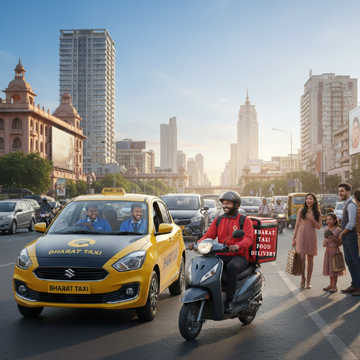
Why can’t the pilot version of Bharat Taxi in Delhi NCR also get into food delivery by adopting restaurants seamlessly just as it adopts cab drivers. This Bharat Taxi initiative, is led by the Indian Union Ministry of Cooperation, and is being positioned as a fairer alternative to privately owned cab hailing platforms such as Ola, Uber and Rapido. Cooperation Minister Amit Shah had confirmed the existence of the app in the Indian Parliament earlier and highlighted that the platform is meant to free drivers from dependency on private companies. The widely downloaded and adopted by cabbies, Bharat Taxi app is run by the Sahakar Taxi Cooperative Limited, which is jointly promoted by eight leading cooperative and financial institutions, including NCDC, IFFCO, AMUL, KRIBHCO, NAFED, NABARD, NDDB and NCEL. Meanwhile, the Government of India, via the Ministry of Cooperation, acts as the chief promoter.
India’s platform economy has, over the last decade, been dominated by privately owned digital intermediaries that aggregate labour, assets and consumers at scale. Ride-hailing platforms such as Ola, Uber, Rapido and inDrive reshaped urban mobility by organising millions of drivers and riders through technology. Yet this transformation also created new asymmetries: drivers became dependent on opaque algorithms, high commissions and unilateral policy changes. It is within this context that the Bharat Taxi initiative has emerged, positioned not merely as another app but as a structural counter-model rooted in India’s cooperative tradition.
Bharat Taxi is being piloted in the Delhi NCR region under the leadership of the Union Ministry of Cooperation. Cooperation Minister Amit Shah has publicly confirmed its development in Parliament, framing it as a platform meant to free drivers from exploitative dependence on private corporations. The app is operated by the Sahakar Taxi Cooperative Limited, a cooperative entity jointly promoted by eight of India’s most powerful cooperative and financial institutions—NCDC, IFFCO, AMUL, KRIBHCO, NAFED, NABARD, NDDB and NCEL—with the Government of India acting as the chief promoter. This institutional backing gives Bharat Taxi a unique character: it is neither a state-run utility nor a venture capital-driven startup, but a cooperative-corporate hybrid anchored in public purpose.
The central question, however, is whether Bharat Taxi can evolve beyond ride-hailing. If it can successfully compete with private incumbents in operations, logistics and driver adoption, can it also metamorphose into a food delivery platform? And if so, why shouldn’t the pilot itself explore this possibility by onboarding restaurants as seamlessly as it onboards drivers?
Cooperative logic versus platform capitalism
To understand the transformative potential of Bharat Taxi, it is necessary to contrast cooperative logic with platform capitalism. Private platforms are built to maximise shareholder value, often through aggressive scaling, price undercutting and labour arbitrage. Drivers and delivery partners are classified as “independent contractors,” insulating companies from labour obligations while retaining algorithmic control over work allocation and income.
A cooperative platform, by contrast, is structurally designed to serve its members. In the case of Bharat Taxi, drivers are not merely service providers; they are stakeholders. The institutions backing Sahakar Taxi Cooperative Limited have decades of experience in organising farmers, producers and rural communities at scale. AMUL’s dairy cooperative model, for instance, transformed millions of small farmers into collective owners of a global brand. Applying this logic to urban services is a natural progression, especially as India’s cities absorb vast numbers of informal workers.
If Bharat Taxi succeeds, it will demonstrate that digital platforms need not be extractive. Instead, they can be participatory, transparent and redistributive. This philosophical foundation is also what makes the idea of expanding into food delivery compelling rather than speculative.
The overlap between mobility and food delivery
From an operational standpoint, ride-hailing and food delivery are not fundamentally different businesses. Both rely on real-time matching of supply and demand, route optimisation, digital payments, customer support and large networks of gig workers. In fact, many drivers already straddle both sectors, driving passengers during peak hours and delivering food during off-peak periods.
Private players recognised this overlap early. Uber experimented with Uber Eats globally, while Ola explored food delivery and cloud kitchens through initiatives like Foodpanda (briefly) and Ola Foods. Although these ventures had mixed success, they demonstrated that mobility platforms can be leveraged to build logistics ecosystems.
For Bharat Taxi, the logic is even stronger. A cooperative platform that already aggregates drivers could extend their earning opportunities by enabling food delivery without forcing them into another app controlled by a different corporate entity. This would deepen driver loyalty, stabilise incomes and increase platform utilisation throughout the day.
Onboarding restaurants: A cooperative opportunity
The question of restaurant adoption is central. Food delivery platforms today impose high commissions—often ranging from 20 to 35 percent—on restaurants, squeezing margins in an already competitive industry. Smaller, independent eateries suffer the most, becoming dependent on platforms that control visibility, discounts and customer data.
A Bharat Taxi food delivery arm could position itself as a cooperative-friendly alternative for restaurants as well. Just as drivers are liberated from private monopolies, restaurants could be freed from punitive commissions. Cooperative institutions like NAFED, NDDB and NABARD already work closely with food producers, agri-processors and rural enterprises. Integrating urban restaurants into this ecosystem would not be an alien extension but a logical continuum from farm to fork.
In Delhi NCR, where the pilot is underway, there exists a dense network of small restaurants, dhabas, cloud kitchens and home-based food entrepreneurs. A pilot food delivery service could start by targeting these segments, offering transparent pricing, lower commissions and shared governance. The adoption challenge, often cited as a barrier, could actually become a strength if restaurants are treated as partners rather than clients.
Technology, trust and seamless integration
One of the reasons private platforms scale rapidly is their obsession with user experience. Seamless onboarding, intuitive interfaces and reliable logistics are non-negotiable. For Bharat Taxi to compete, whether in mobility or food delivery, it must meet these benchmarks. Cooperative ownership alone cannot compensate for poor execution.
However, the institutions behind Sahakar Taxi Cooperative Limited are not novices to scale. IFFCO, AMUL and KRIBHCO manage complex supply chains involving millions of participants. NABARD and NCDC bring financial and developmental expertise, while NCEL focuses on digital commerce for cooperatives. If these capabilities are harnessed effectively, Bharat Taxi could build a robust tech stack that supports multi-service expansion.
Trust is another critical asset. Government-backed initiatives, when well-executed, often enjoy higher baseline trust among users and workers. In food delivery, trust extends to hygiene, pricing and grievance redressal. A cooperative platform that is accountable to its members and regulated by public institutions could differentiate itself sharply from opaque private players.
Regulatory tailwinds and policy alignment
India’s policy environment is increasingly supportive of cooperative and digital public infrastructure models. The creation of the Ministry of Cooperation itself signals a strategic intent to revitalise cooperatives as engines of inclusive growth. Simultaneously, India Stack, UPI and ONDC have demonstrated how open, interoperable digital systems can challenge entrenched monopolies.
A Bharat Taxi food delivery arm could potentially align with ONDC, leveraging its open network to avoid walled-garden dynamics. This would allow restaurants to be discoverable across platforms while retaining autonomy. Drivers, similarly, could benefit from interoperable work opportunities rather than being locked into a single app.
Such alignment would also reduce the capital intensity of expansion. Unlike venture-funded startups that burn cash to acquire users, a cooperative platform supported by public institutions can grow more sustainably, focusing on long-term value rather than short-term market share.
Challenges and realistic constraints
It would be naïve to assume that expansion into food delivery is without challenges. Private incumbents have deep pockets, sophisticated algorithms and entrenched consumer habits. Logistics for food delivery are often more complex than passenger transport, involving temperature control, packaging and service-level expectations.
There is also the risk of mission drift. Bharat Taxi’s primary objective is to empower drivers and provide fair mobility services. Diversification must not dilute this focus or overextend managerial capacity. Cooperative governance, while inclusive, can sometimes slow decision-making in fast-moving digital markets.
Moreover, government-backed initiatives are often scrutinised more harshly for inefficiency or failure. A poorly executed expansion could undermine the credibility of the entire platform.
Why the pilot phase matters
The Delhi NCR pilot offers a controlled environment to experiment without committing to nationwide rollout. Pilots are meant precisely for testing hypotheses, identifying bottlenecks and refining models. Introducing a limited food delivery feature—perhaps during non-peak mobility hours—could provide invaluable data.
Such a pilot could begin with a small cohort of restaurants and drivers, focusing on specific zones. The goal would not be to immediately rival Zomato or Swiggy, but to test cooperative viability in a new vertical. Success metrics could include driver earnings stability, restaurant satisfaction and customer retention rather than sheer order volume.
If successful, the model could be replicated in other cities, adapting to local conditions. If not, the learnings would still strengthen Bharat Taxi’s core operations.
A cooperative super-app?
At a more conceptual level, Bharat Taxi raises the possibility of a cooperative super-app—a platform where mobility, delivery and other urban services are integrated under a member-owned structure. Such a vision aligns with India’s civilisational ethos of collective enterprise and mutual benefit.
The institutions behind Sahakar Taxi Cooperative Limited have already demonstrated that cooperatives can operate at national and even global scale. Translating that success into the digital services economy could redefine how value is created and distributed in India’s cities.
Food delivery, in this sense, is not just another revenue stream but a strategic step towards building a cooperative digital common.
From roads to kitchens, a cooperative path forward
The launch of Bharat Taxi is more than a policy experiment; it is a statement about the kind of digital economy India wants to build. If it can successfully compete with Ola, Uber, Rapido and inDrive in mobility, it will have already achieved something remarkable. The question of expanding into food delivery is not a distraction but a natural extension of its cooperative logic.
By onboarding restaurants as seamlessly as drivers, Bharat Taxi could challenge another extractive segment of the platform economy. The institutional backing, policy alignment and operational overlap make this not only plausible but strategically sound. The pilot phase in Delhi NCR is the ideal moment to explore this possibility, cautiously yet creatively. Ultimately, Bharat Taxi’s success or failure will depend on execution. But if it succeeds, it could demonstrate that in the age of apps and algorithms, cooperation is not an anachronism—it is a competitive advantage.