
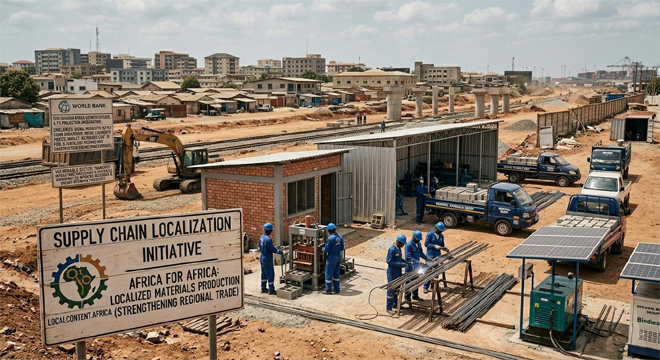
While the 4.1% growth target is a moderation, it also highlights an urgent need for localized supply chains. Investing in regional cement production or green energy for construction could eventually buffer the continent against these global shocks. It’s a tough “growing pain,” but one that might force more sustainable, intra-African trade solutions
Africa’s infrastructure and business landscape is entering a complex but transformative phase, where short-term macroeconomic pressures coexist with powerful long-term growth drivers. Over the past 10 days, a series of developments across banking, infrastructure financing, energy, and transport sectors reveal both stress and resilience. Institutions like the World Bank, African Export-Import Bank, and United Nations Economic Commission for Africa are playing central roles in shaping this evolving landscape. While rising global tensions, inflationary pressures, and debt burdens are constraining governments, new financing models, domestic capital mobilization, and technological shifts are opening fresh avenues for growth.
The immediate macroeconomic context is challenging. A recent outlook by the World Bank projects Sub-Saharan Africa’s growth to moderate to approximately 4.1 percent, reflecting the cumulative impact of global geopolitical instability, supply chain disruptions, and rising commodity prices. Fuel and fertilizer costs have surged, feeding directly into construction and engineering expenses. Infrastructure projects—especially in transport, roads, and railways—are particularly vulnerable to such cost escalations, as they depend heavily on imported materials and energy-intensive processes.
Compounding this challenge is the debt burden faced by many African governments. With roughly 18 percent of government revenues being allocated to debt servicing, fiscal space for new infrastructure investments is shrinking. This means fewer new projects, delays in ongoing ones, and tighter financing conditions overall. The implication is clear: while infrastructure remains a priority, its rollout is slowing in the short term due to constrained public finances.
Macroeconomic stress and its impact on infrastructure rollout
The effects of macroeconomic stress are not evenly distributed across sectors, but infrastructure development is among the hardest hit. Roads, railways, ports, and energy projects require long-term capital commitments, often denominated in foreign currency. When global interest rates rise and currencies weaken, project costs increase significantly. This has led to a cautious approach among governments, many of which are re-evaluating project pipelines.
Construction companies and engineering firms are facing rising input costs, forcing renegotiations of contracts or scaling down of project scopes. Transport infrastructure, particularly large-scale highway and railway systems, is experiencing delays due to financing gaps. Even where funding is secured, execution timelines are being extended as governments prioritize fiscal stability over aggressive expansion.
However, this slowdown is not indicative of declining demand. On the contrary, Africa’s infrastructure deficit remains enormous, and the need for investment is growing due to rapid urbanization, population growth, and industrial ambitions. The current slowdown is therefore cyclical rather than structural, suggesting that once macroeconomic conditions stabilize, investment could rebound strongly.
Afreximbank’s $10 billion intervention reshapes liquidity landscape
In response to these pressures, the African Export-Import Bank has launched a $10 billion crisis-response financing facility aimed at stabilizing the financial ecosystem. This initiative is designed to provide liquidity support to banking systems, enable trade finance, and sustain infrastructure-linked businesses during a period of global uncertainty.
The significance of this move cannot be overstated. By injecting liquidity into the financial system, Afreximbank is helping to prevent a credit crunch that could otherwise cripple infrastructure development. Banks are better positioned to extend loans, contractors can access working capital, and cross-border trade projects can continue without major disruptions.
For infrastructure contractors, this facility acts as a lifeline. Many projects depend on continuous cash flow to maintain momentum, and disruptions in financing can lead to costly delays. By ensuring that financial institutions remain liquid, Afreximbank is indirectly supporting the continuity of infrastructure projects across the continent.
Moreover, the facility strengthens regional trade integration by supporting trade finance. Infrastructure projects, especially those involving transport corridors, are closely linked to trade flows. Ensuring that trade continues smoothly helps sustain demand for infrastructure and reinforces the economic rationale for ongoing investments.
Digital and AI infrastructure emerges as a strategic priority
Alongside financial interventions, there is a growing recognition of the importance of digital infrastructure. The United Nations Economic Commission for Africa has called on African countries to increase borrowing, mobilize domestic capital, and invest in digital and artificial intelligence-driven infrastructure.
This marks a significant shift in development priorities. Traditionally, infrastructure investment in Africa has focused on physical assets such as roads, railways, and power plants. While these remain critical, digital infrastructure is now being viewed as equally important for economic transformation.
Key focus areas include data centers, high-speed connectivity, and smart infrastructure systems. These technologies enable more efficient management of urban systems, improve service delivery, and support the growth of digital economies. For engineering firms, this represents a new frontier, requiring different skill sets and investment strategies.
AI-driven infrastructure can optimize traffic flows, manage energy consumption, and enhance logistics networks. For example, smart transport systems can reduce congestion in rapidly growing cities, while AI-enabled energy grids can improve reliability and efficiency. These innovations are particularly valuable in contexts where resources are limited and efficiency gains are essential.
Electrification and energy investments unlock broader growth
Energy infrastructure remains a cornerstone of Africa’s development strategy. Recent announcements of over $1.15 billion in funding from institutions such as the European Investment Bank and global foundations highlight the scale of investment being directed toward electrification.
The goal is ambitious: expanding electricity access to hundreds of millions of people. This includes grid expansion, development of mini-grids, and deployment of solar-powered systems. These investments are not just about improving living standards; they are fundamental to enabling industrial growth, urbanization, and modern transport systems.
The example of Kenya illustrates the transformative impact of electrification. Increased access to electricity has boosted rural economies, supported small businesses, and improved productivity. As more regions gain reliable power, the potential for economic diversification increases significantly.
From an engineering perspective, energy infrastructure projects are complex and capital-intensive, involving multiple stakeholders and advanced technologies. However, their long-term benefits far outweigh the costs, making them a priority even in times of fiscal constraint.
Urban rail expansion and Nairobi–Thika corridor development
Urban transport is another area witnessing significant activity. In Kenya, the Nairobi–Thika corridor is undergoing a major upgrade as part of a $1.7 billion commuter rail project. This initiative aims to modernize urban transport, reduce congestion, and improve connectivity within the metropolitan region.
The shift toward commuter rail systems reflects a broader trend across African cities, where rapid urbanization is putting immense pressure on existing transport infrastructure. Road networks alone are insufficient to handle growing demand, leading to increased interest in rail-based solutions.
Commuter rail systems offer several advantages, including higher capacity, lower emissions, and greater efficiency. They also support urban planning objectives by encouraging transit-oriented development. The Nairobi–Thika project is therefore not just a transport initiative but a catalyst for broader urban transformation.
Innovative railway financing models reduce dependency
A notable development in the railway sector is the shift toward innovative financing models. Kenya is exploring new approaches to fund railway expansion, including reduced reliance on Chinese debt and the use of revenue-backed financing mechanisms such as railway levy securitization.
This represents a significant departure from previous models, where large infrastructure projects were often financed through external loans. While such financing enabled rapid development, it also contributed to rising debt levels. The new approach seeks to balance growth with fiscal sustainability.
Revenue-backed financing aligns project funding with actual usage, ensuring that investments are supported by income streams. This reduces the risk for governments and investors alike, making infrastructure projects more financially viable.
Regional road corridors drive integration and trade
In West Africa, major cross-border projects like the Abidjan–Lagos Corridor are gaining momentum. This multi-country highway system is one of the largest infrastructure initiatives on the continent, designed to enhance regional connectivity and support trade integration.
Such corridors are critical for economic development, as they reduce transportation costs, improve logistics efficiency, and facilitate the movement of goods and people. By linking major economic hubs, they create opportunities for industrial growth and regional cooperation.
The importance of these projects extends beyond transport. They are instrumental in building integrated markets, attracting investment, and fostering economic resilience. As global trade dynamics evolve, strong regional networks will be essential for Africa’s competitiveness.
Long-term infrastructure outlook remains strongly positive
Despite short-term challenges, the long-term outlook for infrastructure investment in Africa is highly positive. Industry projections indicate that the Middle East and Africa infrastructure market could exceed $280 billion in expansion by 2030.
This growth is driven by several factors, including urbanization, population growth, and increasing demand for energy and transport services. Sovereign wealth funds and institutional investors are also playing a larger role, providing the capital needed to sustain long-term projects.
For engineering firms and construction companies, this represents a significant opportunity. The pipeline of projects is expanding, and demand for expertise in areas such as digital infrastructure, renewable energy, and urban transport is increasing.
Mobilizing domestic capital reshapes funding landscape
One of the most promising trends is the focus on mobilizing domestic capital for infrastructure investment. Discussions around unlocking $4.4 trillion in African capital highlight the potential of pension funds, sovereign wealth funds, and other local sources.
This shift toward self-funded infrastructure is crucial for reducing dependence on external debt and enhancing financial resilience. Domestic investors are more likely to have a long-term perspective, aligning well with the nature of infrastructure projects.
By tapping into local capital markets, African countries can finance development in a more sustainable manner. This also strengthens financial systems and promotes economic stability.
A dual narrative of constraint and opportunity defines the present
The current state of Africa’s infrastructure and business environment can best be described as a dual narrative. On one hand, there are significant short-term headwinds, including rising costs, debt constraints, and geopolitical uncertainties. These factors are slowing project execution and tightening financing conditions.
On the other hand, there is strong long-term momentum driven by innovative financing models, large-scale funding programs, and strategic investments in energy, transport, and digital infrastructure. The emergence of AI-driven systems and the mobilization of domestic capital are particularly noteworthy developments.
This dual dynamic suggests that while the pace of growth may fluctuate in the near term, the underlying trajectory remains upward. Africa’s infrastructure sector is evolving, becoming more resilient, diversified, and aligned with global trends.
Conclusion: navigating transition toward sustainable growth
As Africa navigates this period of transition, the ability to balance immediate challenges with long-term goals will be critical. Institutions like the World Bank, African Export-Import Bank, and United Nations Economic Commission for Africa will continue to play pivotal roles in shaping policies and providing support.
The shift toward sustainable financing, digital innovation, and regional integration is setting the stage for a new phase of development. While the road ahead may be complex, the foundations for growth are being strengthened, ensuring that Africa’s infrastructure sector remains a key driver of economic transformation in the years to come.

