
CEIC’s monthly data for India’s exports to China (spanning decades) does not show a clear, similar steady upward trend for a long stretch corresponding to a seven-month continuous rise
For seven consecutive months in FY26 India’s shipments to China have risen — an unmistakable run of momentum after years in which trade with Beijing looked lopsided and volatile. That run matters because China is not only the world’s largest manufactured goods market; it is also central to global value chains that India is trying to wedge itself into. The rise in exports is neither accidental nor monocausal. It is the product of policy nudges (from both sides), shifting demand patterns inside China, structural changes in India’s industry, and global trade realignments that accelerated after the pandemic and recent tariff shocks. The short version: India is exporting more because Chinese demand has shifted toward specific Indian goods, India has improved capacity in key sectors, and geopolitics-plus-policy has opened windows that exporters are quickly exploiting.
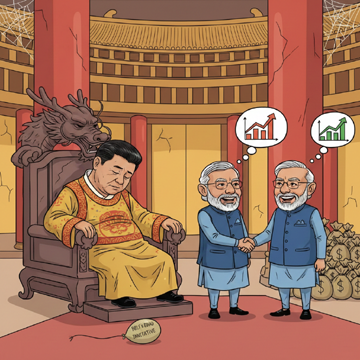
CEIC’s monthly data for India’s exports to China (spanning decades) does not show a clear, similar steady upward trend for a long stretch corresponding to a seven-month continuous rise. Bilateral trade analyses (such as by PHDCCI) point out certain months of very strong year-on-year growth (e.g., April–October 2017), but they don’t show a clean, unbroken 7-month run of export levels being higher than the same month in the prior year. For example, in April–October 2017, y-o-y growth of exports to China ranged quite a bit (April ~ +40%, October ~ +72%), but that doesn’t necessarily mean every month’s export value was up relative to the same month in the previous year in a clean, identical pattern.
What the numbers say
Official and media reports point to a clear jump in merchandise flows: goods exports to China rose strongly in the opening months of FY26 (April–July), with some reports showing year-on-year gains of around 20% in the early part of the year and seven straight monthly increases overall. Electronics — including parts of telephone sets — and specific agricultural and mineral products have featured prominently among the gainers. At the economy level, India’s overall export performance in FY26 has also improved, reinforcing these bilateral trends.
Why China is importing more from India — the demand side
- Industrial upgrading in China has created demand for a wider basket of inputs. As China pivots from labour-intensive assembly to higher-value manufacturing and domestic consumption, some intermediate goods it needs (raw aluminium products, certain chemicals, agricultural inputs, and even specific electronics components) have become import targets. When China cannot source these at scale domestically or wants to diversify suppliers, India becomes an alternative.
- Chinese consumer demand shifting to foreign food and specialty agri-products. A rising middle class and changing dietary patterns mean China imports more seafood, spices, and specialty agricultural goods. Indian shipments of shrimp, spices and selected horticulture have found buyers. Reports note items like shrimps and some agri-commodities among the exported items drawing higher Chinese volumes.
- Price and quality arbitrage. For some categories — garments, certain chemicals, metals and semi-finished products — Indian suppliers offer competitive prices or demonstrated quality advantages that make them attractive to Chinese buyers looking for alternatives to traditional suppliers. Currency movements, freight dynamics, and local Chinese margins also play a role.
- Temporary policy and trade-realignment effects. After the U.S. slapped tariffs on some Indian exports earlier in 2025, exporters looked to diversify destinations. China — with large demand pockets and existing trade infrastructure — absorbed some of that redirected export flow. In addition, China’s own industrial policy and procurement choices occasionally favour sourcing from a broader supplier base.
Why India is able to sell more — the supply side
- Capacity expansion under PLI and industry push. India’s Production-Linked Incentive (PLI) schemes and related initiatives have materially increased domestic production capacity in electronics, certain chemicals and pharma intermediates, and specialty manufacturing. That has converted latent capability into exportable volumes and components that Chinese firms can buy. Reports show electronics exports — mobile phones and components — surging in FY26, with China among the destination markets.
- Diversifying exporter strategy. Indian firms and trade houses actively sought to reduce destination concentration after tariff shocks and demand softness in traditional markets. This commercial re-orientation — combining aggressive market development with participation in trade fairs and digital B2B platforms — helped open Chinese buyers’ attention to Indian suppliers.
- Niche strength in certain goods. India has comparative advantages in items such as generic pharmaceuticals and APIs, certain chemicals, gems & jewellery, marine products (like shrimp), and increasingly in electronic assemblies. When Chinese buyers need such items in specific grades or volumes, Indian exporters are now better positioned to respond.
- Logistics and trade facilitation improvements. Faster customs clearances, better freight linkages (sea and regional air cargo) and improved compliance with standards mean Indian consignments can reach Chinese buyers more reliably than in the past. Government promotional activity — embassy-level trade pushes and industry delegations — also matter in opening doors.
Which sectors are showing the biggest gains
Several categories stand out in the FY26 uptick:
- Electronics and mobile parts: Components, parts of telephone sets and even finished mobile phones (as India scales up assembly) are important contributors. Electronics exports to multiple destinations, including China, recorded strong growth in early FY26.
- Agri and marine products: Shrimp and selected horticulture/processed foods have seen stronger off-take into China.
- Metals and semi-finished products: Aluminium products, some steel semi-finished items and related goods have featured in the surge.
- Chemicals and pharmaceuticals (APIs/intermediates): India’s deep generic pharma ecosystem and chemical producers supply inputs that Chinese manufacturers can use.
- Gems and jewellery, textiles and certain engineered goods: These have shown sporadic but important pickup as buyers diversify sourcing.
Drivers — policy and geopolitics
Two policy threads matter. First, India’s industrial policy (PLI, export promotion, trade facilitation) has intentionally boosted production and export readiness in targeted sectors. Second, geopolitical churn — US tariffs, global supply-chain reconfiguration, and India’s cautious post-2020 recalibration of ties with China — create a mixed environment where both sides selectively engage on trade while maintaining strategic caution. India has also signalled that in some segments it may relax certain import restrictions or anti-dumping measures to secure crucial inputs, recognising that exports depend on imported raw materials for some sectors. Reuters reporting indicates New Delhi is weighing easing some curbs to reduce supply-chain bottlenecks.
What this trend means for India over the next 10 years
The sustained increase in exports to China, if consolidated, can reshape several aspects of India’s economic trajectory — but it is not a risk-free bonanza.
- Stronger integration into regional value chains. Regular trade with China for intermediate goods or finished products can embed Indian firms deeper into Asia-Pacific value chains. Over a decade this could mean higher manufacturing complexity, more technology absorption, and improved supplier capabilities.
- Export diversification and resilience. Selling to China as well as to established markets (US, EU, Middle East) lowers concentration risk. If Indian firms use this opportunity to build scale and quality, they will be more resilient to shocks in any single destination.
- Employment and industrial upgrading. Increased exports in electronics, chemicals and processed foods can create manufacturing jobs and boost ancillary industries (packaging, logistics, testing labs). The quality of jobs and wages will depend on how value-added the activities are — assembly jobs differ from component design and R&D roles.
- Potential technology spillovers — and limits. Trade opens channels for learning; Chinese demand for certain standards can push Indian suppliers to upgrade processes. However, deep technology transfer generally requires investment, joint ventures or foreign R&D partnerships — trade alone is an imperfect substitute.
- Strategic trade dependencies and policy tradeoffs. A rising export relationship should not blind India to a simultaneous large trade deficit in goods with China. Many Indian export sectors still depend on Chinese inputs; easing import curbs to facilitate exports can increase dependence on Chinese raw materials. Over a decade, India will need to manage this balance — use China as a market and partner where sensible, while building domestic sourcing where national security or strategic autonomy is at stake. Reuters reporting shows New Delhi is already wrestling with such trade policy tradeoffs.
- Bargaining power and geopolitics. Stronger economic links provide India with levers of influence but also create vulnerabilities: economic interdependence can both stabilise relations and complicate strategic choices. Over the next ten years, a pragmatic dual approach — deepen commerce where it supports growth, tighten rules where national security concerns arise — is most likely.
What India should do to convert the momentum into durable gains
- Move up the value chain. Policies should nudge firms from assembly to component manufacturing and design: higher value capture yields better jobs and resilience.
- Secure critical input supply. Where exports depend on Chinese raw materials, India should either develop domestic alternatives or diversify import sources to avoid chokepoints.
- Ensure quality and standards. Meeting Chinese technical, sanitary and regulatory standards consistently will be crucial to retain buyers. Invest in labs, quality certification and export testing infrastructure.
- Use trade diplomacy smartly. Embassy networks, trade missions and industrial partnerships can institutionalise new buyer-seller relationships.
- Invest in logistics and digital trade platforms. Faster, cheaper, traceable shipments and digital market access will lower friction for exporters.
Risks to watch
The upswing is encouraging but sits alongside risks: tariff changes overseas, renewed geopolitical tensions, a sudden slowdown in Chinese demand, and India’s own capacity constraints (input shortages, logistics bottlenecks). Policymakers must avoid complacency: rising exports to a single destination are valuable, but diversification — across goods, markets and buyers — remains the safer long-term objective. Is this a war we are winning?
Seven straight months of export growth to China is a meaningful signal that Indian industry is both responding to new market opportunities and benefiting from policy nudges. It reflects supply-side gains in electronics and manufacturing, demand-side shifts inside China, and strategic reorientation by exporters. If India pursues a pragmatic industrial strategy — raise value addition, shore up critical inputs, and deepen trade relationships without creating unhealthy dependencies — the FY26 upswing could be the start of a decade in which India captures a steadily larger share of Asian value chains and builds more resilient export muscles. The key will be converting short-term momentum into structural capability so that ten years from now India is not just a source of more exports, but a producer of higher-value goods that sustain jobs, technology and growth.