
By global standards, the Labour Codes 2025 reforms move India closer to practices adopted in Europe and parts of East Asia. Fragmented and colonial-era laws were incompatible with global supply chain participation; simplification was vital
Economic dynamism, prosperity, and global competitiveness rise not only from tightening labour laws but from cultivating education, innovation, creativity, and a questioning culture. The Government of India’s announcement that the four Labour Codes—the Code on Wages (2019), Industrial Relations Code (2020), Code on Social Security (2020), and the Occupational Safety, Health and Working Conditions Code (2020)—will come into effect from 21 November 2025 marks a historic overhaul of a legal framework long considered outdated. It rationalises 29 Central labour laws into four unified codes, promising clarity, reduced compliance burden, better wages, greater social security, and a safer working environment.
There is no denying the importance of this moment. A regulatory architecture designed in the pre- and early post-Independence era (1930s–1950s) was no longer suited to a $4-trillion, globally integrated economy. The world of work has changed dramatically—gig employment, platform work, mobile labour markets, and skills-based industries require rules that are simple, transparent, and future-ready.
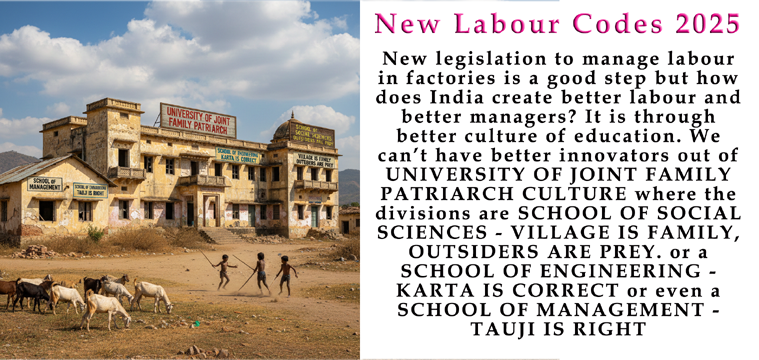
Labour Codes are laws. Laws can ensure social welfare but economic and industrial growth happens with innovation and filing of new patents. New labour codes announced by the Government of India may ensure better hiring and firing but will not be able to match innovation. Innovation comes from better university ecosystems, which already exists in the USA and Europe for the last 200 years and has been cultivated in China in the last 20 years. Indian IITs still make very hard working mechanics labelled engineers. Indian IIMs make excellent middle level managers who execute what bosses abroad tell them to do. Don’t count a 100 exceptions to the norm and point out Pichais and Nadellas. India desperately needs better schools and better universities. For this we desperately need better teachers at all levels. To create better teachers we need a better culture of exploration and inquisitiveness. To achieve a better culture of exploration and questioning, seeking answers, we need to douse the Indian joint family system where the word of the patriarch karta is law. This culture seeps in at all levels of Indian society and prevents everything wise and good.
Yet, as transformative as these codes appear, labour reforms—by their nature—are laws. And laws, while capable of ensuring protection, fairness, and ease of doing business, cannot by themselves manufacture innovation, inventiveness, or intellectual breakthroughs. Economic and industrial growth does not spring from legislation alone—it comes from minds that question, experiment, create and challenge norms.
India’s challenge, therefore, is dual: fix the labour ecosystem, but equally, fix the innovation deficit. And that deficit is rooted not in legal codes but in education, teaching quality, cultural structures, and the country’s suppressed tradition of intellectual exploration.
2025 Labour Codes: Modernising a crumbling framework
Before turning to innovation and education, it is important to understand what the four Labour Codes attempt to achieve and why they are important for India’s ambitions.
1. Code on Wages, 2019
The Wage Code brings together laws on minimum wages, payment of wages, bonus payments, and equal remuneration. It aims to ensure:
- A national floor wage
- More transparent wage structures
- Timely payment of salaries
- Reduction in disputes between employees and employers
For industries, this offers predictability. For workers, it promises dignity.
2. Industrial Relations Code, 2020
Perhaps the most debated of the four, the IR Code introduces:
- Flexible hiring and firing norms
- Faster resolution of industrial disputes
- Clearer strike regulations
- Simplified role of trade unions
The government believes this will boost manufacturing and reduce barriers that discourage companies from scaling.
3. Code on Social Security, 2020
This code attempts to usher India into a new era of worker welfare by:
- Extending social security to gig and platform workers
- Expanding ESIC and EPFO coverage
- Digitising worker registration
- Increasing employer accountability
In a country with a large informal workforce, this is a step toward universal social protection.
4. Occupational Safety, Health and Working Conditions Code, 2020
This code replaces 13 older laws governing workplace safety and working conditions. Its goals include:
- Better safety standards in factories, mines, plantations
- Transparency in working hours
- Mandatory welfare provisions
- Health and sanitation facilities
The purpose is not only to reduce accidents but to create a more humane industrial environment.
Together, these four codes aim to build a protected, productive, future-ready workforce and resilient industries—an essential ingredient of the government’s Aatmanirbhar Bharat vision.
By global standards too, the reforms move India closer to practices adopted in Europe and parts of East Asia. Fragmented and colonial-era laws were incompatible with global supply chain participation; simplification was vital.
And yet, the leap from better laws to becoming an innovation-driven economy is neither automatic nor guaranteed.
The limitations of law: Why innovation cannot Be legislated
Labour Codes are necessary, but not sufficient. They can ensure fairness, transparency, and efficiency; they cannot create inventors, risk-takers, or Nobel laureates. Legislation can smooth the functioning of industries, but innovation requires a different ecosystem entirely—one rooted in good schools, great universities, inquisitive teachers, fearless questioning, and cultural encouragement of experimentation.
Countries that dominate global innovation—the USA, UK, Germany, France, and more recently China—did not reach this position because of labour codes. They did so because they built:
- world-class universities,
- research-backed academic cultures,
- thriving ecosystems for start-ups,
- strong scientific traditions,
- and societies that reward curiosity.
The US and Europe: 200 years of academic ecosystem
For over two centuries, western universities have been epi-centres of scientific revolutions:
- The Industrial Revolution grew out of British and European research institutions.
- Silicon Valley emerged from the academic and military research culture embedded in Stanford, MIT, and UC Berkeley.
- Germany’s Fraunhofer Institutes and Max Planck Society remain engines of applied research.
These places do not merely teach—they produce ideas, patents, prototypes, and new fields of knowledge.
Where do Google, Facebook, Cisco, Hewlett-Packard, Coca-Cola, PepsiCo, McDonald, Wal-Mart, Amazon, Apple, Berkshire Hathaway, Exxon-Mobil, JP Morgan Chase, Costco, Microsoft, Bank of America, Goldman Sachs, AT&T, Dell Technologies, The Walt Disney Company, Fedex, in short the world’s largest companies and largest brands with the highest market cap exist – they exist in a nation with the best universities. Similarly, for Europe, we have SAP, L’Oreal, Siemens, Airbus, Allianz SE, Deutsche Telekom, Accenture, Santander, Schneider Electric. These are globally accepted brands with highest values. They could be created because of the culture of education at all levels in the USA.
China: A 20-year transformation
In just two decades, China has:
- built the world’s largest STEM ecosystem
- become a global leader in patents
- created academic towns with massive R&D funding
- lured back top researchers
- produced global giants in AI, semiconductors, and green energy
This was not the work of labour laws; it was the work of education policy, university culture, and disciplined long-term innovation planning.
India’s education paradox: hardworking, not innovative
India’s IITs and IIMs are celebrated globally, but their output reflects systemic limitations.
IITs: Hardworking Mechanics, Not Inventors
Indian Institute of Technology graduates are often exceptionally hardworking, diligent, and technically disciplined. But the criticism in the provided text captures a troubling truth: they frequently emerge as highly skilled mechanics rather than world-changing innovators.
Why?
- The curriculum remains rigid and exam-centric.
- Research output per faculty remains low.
- Laboratories often lag behind international counterparts.
- Bureaucracy throttles free inquiry.
- Students prioritise placements, not research.
The result? Large numbers of IITians excel in executing tasks for global multinationals, but relatively few start deep-tech ventures or contribute to original research.
IIMs: Brilliant Middle Managers, Not Visionary Strategists
Similarly, IIM graduates are capable, articulate, efficient, and extremely well versed in business frameworks. But most end up as mid-level managers executing orders for headquarters in the US, UK or Singapore.
They are valuable cogs in a global corporate machine—but they rarely become the machine designers.
The suggestion not to count the “100 exceptions”—the Sundar Pichais and Satya Nadellas—is fair. Exceptional individuals prove individual excellence, not systemic strength.
If India wants thousands of innovators, not dozens, the solution is not labour codes. It is cultural and educational transformation.
The real crisis: A broken school–university pipeline
Before universities can produce innovators, schools must produce curious students.
India Needs Better Schools
The foundational problem lies in:
- rote learning
- exam obsession
- fear of questioning teachers
- inadequate exposure to labs, creativity, arts
- undertrained or underpaid teachers
Better schools require:
- better-trained teachers
- activity-based learning
- encouragement of discussion
- freedom to challenge norms
- integration of arts and sciences
India needs far better teachers
Teachers shape the intellectual spirit of a country. Yet teaching in India:
- is not aspirational
- is often underpaid
- involves little incentives for innovation
- is burdened by outdated pedagogy
Countries like Finland, South Korea, and Japan focus heavily on teacher quality because they recognise that innovation springs from classrooms, not corporate boardrooms.
To create better teachers, India must first build a culture where:
- inquiry is normal
- experimentation is encouraged
- mistakes are acceptable
- questioning authority is not punished
And this leads to the deepest cultural barrier of all.
The major cultural obstacle: The Indian joint family system
This may appear unrelated to labour codes, but it is fundamental. The provided text points to a critical sociological truth: India’s joint family system often suppresses independent thinking.
In many families:
- the patriarch (karta) is unquestionable
- elders are always right
- obedience is valued above exploration
- disagreement is seen as disrespect
- conformity is rewarded
This conditioning travels with individuals into:
- classrooms (where teachers are not questioned)
- universities (where students seldom challenge established thinking)
- workplaces (where managers avoid risk)
- society (where innovation is seen as impractical or rebellious)
To create innovators, a nation needs:
- rebels
- risk-takers
- nonconformists
- problem-solvers
- independent thinkers
But how can these qualities flourish when emotional, cultural, and social structures reward the opposite?
Thus, reforming labour codes without reforming family and learning culture is like increasing a car’s speed limit while the engine remains weak.
Labour Codes, a foundation—Not the final step
The government is right to argue that the four Labour Codes create:
- better wages
- better compliance
- stronger social security
- safer workplaces
- reduced litigation
- harmonised rules aligned with global standards
These are crucial for:
- attracting investment
- formalising employment
- improving ease of doing business
- promoting manufacturing
- enhancing worker protections
The codes also bring India in line with global regulatory frameworks, a necessary step if the country wants to integrate into global supply chains.
The comparison between the “before” and “after” labour ecosystem is striking:
- From fragmented to unified
- From outdated to modernised
- From ambiguous to predictable
But even after fixing the regulatory regime, India still faces a steep climb toward becoming a knowledge-driven economy.
The path forward: Towards a culture of innovation
India’s future will be shaped by whether it can transform its innovation ecosystem, not just its labour ecosystem. The following steps are essential:
1. Transform Schools
- Move from rote to inquiry-based learning
- Invest heavily in teacher training
- Introduce lab-based and project-based learning early
2. Reinvent Universities
- Increase research funding
- Encourage interdisciplinary studies
- Attract global faculty
- Reduce bureaucracy
3. Inspire Teachers
- Raise salaries, status, and training standards
- Encourage them to innovate
4. Reform Cultural Norms
- Promote critical thinking
- Encourage debate within families
- Reduce hierarchical rigidity
5. Build a Society That Celebrates Questions
Innovation begins with a simple question: Why?
Or an even more powerful one: Why not?
For India to evolve from a service-driven to an innovation-driven economy, it must create millions of minds that ask such questions seamlessly, fearlessly and as a matter of course.
Laws can protect but ideas shape the future
India’s new Labour Codes represent a historic leap in legal and administrative reform. They simplify a labyrinth of 29 laws into four coherent codes, modernise worker protections, align with global standards, and promise safer workplaces and greater social security. They are necessary reforms—long overdue and essential for an Aatmnirbhar Bharat.
But laws cannot substitute innovation. They cannot replace bold ideas, creative thinking, or a thriving ecosystem of discovery.
Innovation does not come from better hiring and firing norms—it comes from better minds.
Better minds come from better teachers, who arise from better cultural values, nurtured by a society that encourages questioning rather than obedience.
If India wants to become a global innovation leader—not merely a service provider—it must go beyond legal reform and embark on a cultural, educational, and intellectual renaissance. Labour Codes may build a future-ready workforce.
But only innovation will build a future-ready nation.