
Looking at a “carbohydrate eating country index,” where the daily caloric intake is from carbohydrates.
Carbohydrates provide energy for short bursts of activity but they do not provide building blocks of life or in other words a carb rich diet does not result in strong bones and strong muscles besides starving a population from hunting, sporting and innovation related activities
Food shapes societies. What people eat determines not only their physical strength but also their cognitive development, productivity, and even the broader social and economic patterns that guide national progress. In recent years, dietary analysis has gained renewed attention, especially as global organizations—from the Global Nutrition Report to UNICEF, FAO, and various consulting and academic institutions—have highlighted how macronutrient composition influences health outcomes and economic potential.
Among the most discussed nutritional contrasts is the gap between carbohydrate-dominant diets and diets with higher protein composition. When we examine global dietary patterns, a clear divide emerges between countries that derive the majority of their calories from carbohydrate staples, and those where diets include more animal-based and plant-based protein sources. Understanding this divide sheds light on not only health outcomes but also patterns of productivity, physical activity, and innovation.
Mapping the Carbohydrate-Intensive Diet While there is no officially recognized “Carbohydrate Eating Country Index,” numerous datasets—particularly those summarized by World Atlas, FAO Food Balance Sheets, and Global Nutrition Report—provide insight into which countries derive the highest proportion of their calories from carbohydrates.
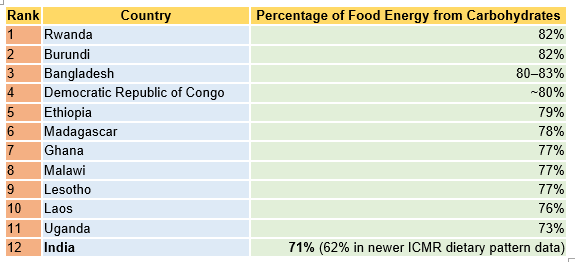
By contrast, several European and high-income countries derive a much lower share of calories from carbohydrates:
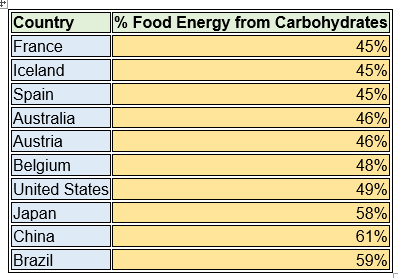
These figures reveal a pattern deeply connected to historical agriculture, cultural food habits, and economic access.
Why Do Some Countries Consume Mostly Carbohydrates?
Nutrition researchers point to three key factors:
- Economic Constraints and Availability
Many high-carbohydrate-consuming countries are low- or lower-middle-income economies. In these regions, daily meals are built around locally grown staples such as rice, maize, cassava, sorghum, and plantain because they are affordable and accessible. The Global Nutrition Report (2023) notes that animal protein and dairy are among the most expensive nutrition sources relative to income in Sub-Saharan Africa and South Asia. - Cultural and Culinary Systems
Food is not just nutrition—it is identity. From injera in Ethiopia to rice-polished meals in Bangladesh and India, carbohydrate staples are deeply embedded in cultural practice, festivals, and everyday eating. Changing dietary culture requires more than increasing availability; it requires reshaping habits. - Food Security Pressures
The World Food Programme and FAO report that populations experiencing chronic food insecurity often rely on carbohydrates because they provide reliable calorie density and store well. In regions affected by drought, conflict, or unstable food supply chains, carbohydrate staples act as survival foods.

The Limitations in Interpreting Carbohydrate Data
Any analysis of diet composition must recognize:
- Relative vs. Absolute Intake
A population with 80% carbohydrate intake may actually consume fewer total calories than a population with lower carbohydrate percentage. In many Sub-Saharan nations, the problem is not just carbohydrate dominance, but overall calorie insufficiency. - Quality of Carbohydrates
Whole grains, legumes, and root vegetables provide fiber and micronutrients. But many rapidly growing economies have seen a shift toward refined carbs—polished rice, refined flour, processed sugars—which decrease nutritional value. - Dietary Diversity as the Core Issue
The Global Nutrition Report (2024) emphasizes that the most reliable predictor of positive health outcomes is dietary diversity, not any single macronutrient share.
Still, the ratio of protein to carbohydrates remains essential for building strong bones, healthy muscle mass, metabolic stability, and cognitive growth.
Protein: The Building Blocks of Strength, Endurance, and Cognitive Potential
Carbohydrates provide quick energy, but proteins build and repair the body. Proteins supply amino acids required for:
- Muscle synthesis and strength
- Bone density (in combination with calcium and vitamin D)
- Immune system function
- Hormone and enzyme production
- Brain development and cognitive performance
This is why protein shortages in childhood are strongly correlated with stunting, lower learning performance, and reduced adult productivity, according to UNICEF Nutrition Framework (2023).
Societal Patterns and the Nutrition-Productivity Link
Some analysts argue that societies historically reliant on carbohydrate staples have tended toward low-energy physical work patterns, limited upward social mobility, and low structural innovation. These claims should be interpreted carefully—economic systems, governance, education, and cultural values all play a major role.
However, research shows a clear connection between protein sufficiency and workforce productivity:
- The International Food Policy Research Institute (IFPRI) finds that low protein intake among children leads to a measurable lifetime reduction in cognitive capacity and income potential.
- A McKinsey Global Institute (2023) report links nutritional quality to GDP growth, estimating that improving protein intake in South Asia alone could raise long-term GDP growth by 1–1.5 percentage points.
In other words, nutrition shapes human capital, and human capital drives innovation and economic advancement.
Case Study: India’s Nutritional Paradox
India illustrates how high carbohydrate consumption does not necessarily ensure nourishment.
Despite large food production, India ranked:
- 102nd out of 123 countries in the Global Hunger Index (2025)
- GHI Score: 25.8 – “Serious” category
Key health outcomes reveal deep structural nutritional gaps:

The Indian Council of Medical Research (ICMR, 2025) found that the average Indian diet now contains:
- ~62% carbohydrates
- 10–12% protein, much of which is low-quality grain-based protein
This results in populations that may not necessarily be calorie-deficient, but are frequently nutrient-deficient, affecting physical strength and cognitive outcomes.
Countries with High Protein Intake: A Different Pattern of Activity and Innovation
The contrast is sharp when examining countries with the highest protein consumption per capita:
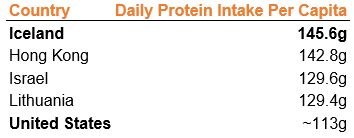
These countries consistently score high on:
- Physical fitness indicators
- Sports participation
- Workforce productivity
- Innovation indices
- Corporate risk-taking and entrepreneurial activity
These links are correlative, not solely nutritional—but protein is an underlying factor enabling higher muscle mass, metabolic stability, sustained activity, and cognitive endurance.
Protein-sufficient societies encourage movement, competition, and innovation because people have the physical and neurological foundations to sustain them.
The Path Forward: Redefining Nutrition for Development
If developing economies aim to transition toward high-productivity, high-innovation systems, improving protein access and dietary diversity must be central to policy strategy.
Key interventions supported by research include:
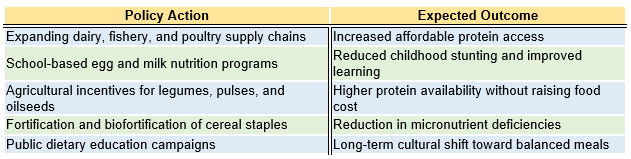
Examples of successful models:
- Brazil’s “Fome Zero” program transformed school nutrition and reduced childhood malnutrition.
- Rwanda’s Girinka Initiative (one cow per family) increased rural protein access and lowered stunting rates.
Conclusion: Food Is Not Just Survival—It Is Capability
At the core, nutritional composition shapes:
- What bodies can do
- What minds can imagine
- What societies can become
Countries dominated by high-carbohydrate diets often face constraints rooted in affordability, agricultural tradition, and food security. But the global evidence is clear: protein is essential for physical strength, cognitive function, and economic growth.
Societies seeking not just survival, but progress—whether in education, industry, sports, technology, or innovation—must invest in the shift from calorie sufficiency to nutrient sufficiency.
Food is not just fuel.
It is the foundation of human potential.