
Denude forests, narrow the legal definition of hills and forests, then every farmhouse and road becomes legal overnight. That’s the intent and that is the procedure being followed to rob the exchequer of natural resources and natural assets
By Debasish Roy
CEO, Royalle Corporation (www.royalle.in)
The Hills That Built the City
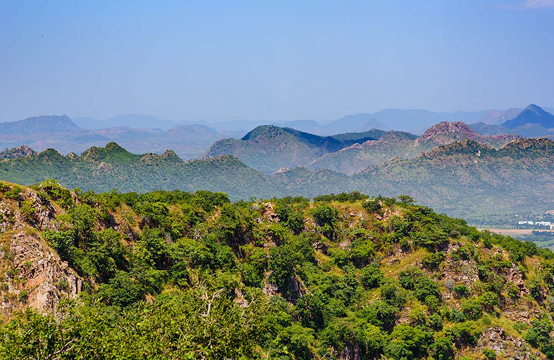
The Aravalli Range has guarded Delhi and its adjoining plains for over 1.5 billion years. These weathered hills, running from Gujarat through Rajasthan to Haryana and Delhi, are India’s oldest geological formation — a living wall that keeps the Thar desert from marching eastward, recharges groundwater, and filters the toxic air of the National Capital Region. As the Aravalli erodes with human mal-intervention, Delhi-NCR gets more and more polluted with dust and devoid of ground water.
Yet today, they are being systematically eaten away — not by time or erosion, but by real estate greed, political complicity, and bureaucratic redefinition.
In Haryana and Rajasthan, a slow-motion land grab is underway. It hides behind the language of “development,” “urban renewal,” and “ecotourism.” Its weapons are technical redefinitions, doctored land records, and selective enforcement of environmental laws.
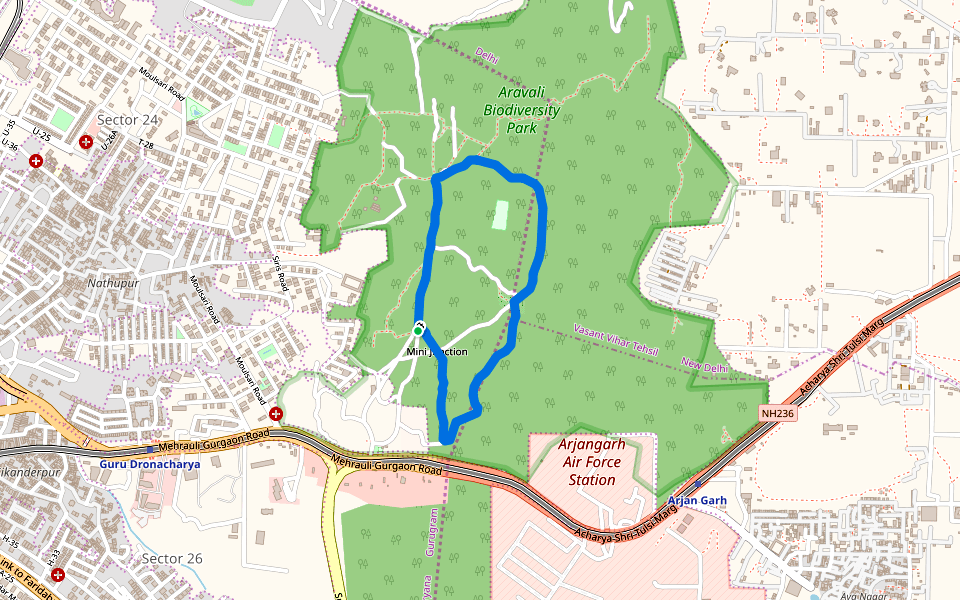
The story of the Aravalli Biodiversity Park in Gurgaon — India’s first OECM (Other Effective Area-Based Conservation Measure) site — shows how even a celebrated conservation zone can become the first domino in a long game of ecological dispossession.
And in distant Ladakh, a different silence — the refusal to notify the region as a tribal or eco-sensitive zone — is creating another frontier of land transfer, this time maybe and reportedly for projected Indo-Chinese infrastructure and industrial projects that erase both ecology and indigenous rights.
The New Definition Scam
In October 2025, the Haryana government quietly issued a new definition of what qualifies as “Aravalli Hills.” Only hills that rise at least 100 metres above surrounding terrain and are composed of rocks a billion years old will be treated as Aravalli formations.
On paper, it sounds scientific. In practice, it deletes hundreds of square kilometres of scrub forest, stony ridges, and shallow hillocks from protection. Large tracts of land around Gurgaon, Faridabad, and Nuh — long considered part of the Aravallis — are suddenly “non-Aravalli” and thus available for construction and industrial use.
Environmentalists call it a “developer’s charter.” “This is not a geological redefinition, it’s a political reclassification,” says ecologist Vijay Dhasmana, who helped restore the Aravalli Biodiversity Park. “The government is drawing lines with bulldozers, not with scientific reasoning.”
A senior forest officer, requesting anonymity, admits what many insiders whisper: “Once you narrow the definition, every farmhouse and road becomes legal overnight. That’s the intent.”
Courts That Cried Into the Void
The Supreme Court has been warning about this plunder for over a decade. In 2009, it imposed a total ban on mining in the Aravalli hills of Haryana and Rajasthan, calling the devastation “environmental anarchy.”
By 2018, the Court noted with shock that 31 hillocks had vanished entirely from the Aravalli range in Rajasthan. Justice Madan B. Lokur told state officials in open court: “You are putting the lives of Delhi’s residents at risk for royalty money. Fifteen to twenty percent of the hills are gone.”
Despite repeated bans, illegal mining and encroachment continue. In 2024, the Court had to remind four states — Haryana, Rajasthan, Delhi, and Gujarat — not to issue any new mining permissions until a uniform definition of “Aravalli Hills” is framed by the Centre.
The National Green Tribunal (NGT) has also issued over a dozen orders since 2016 directing Haryana to remove illegal farmhouses, stop construction roads through forests, and restore quarried land in Nuh and Faridabad. Yet the enforcement is selective — token demolitions of a few farmhouses while politically-connected builders go untouched.
In March 2025, the Punjab and Haryana High Court pulled up the state for “turning a blind eye” to illegal mining in Dadam hills, demanding maps of “no-mining zones.” It was déjà vu: similar orders had been issued in 2021, 2022, and 2023.

How Builders Legalised Their Crimes
To understand the Aravalli grab, one must look at how legality is manufactured.
The weapon of choice is the Punjab Land Preservation Act (PLPA) 1900, originally meant to prevent soil erosion and protect forest cover. The Act empowers the state to declare certain lands as “protected,” barring cutting, mining, or building. But it also allows the government to withdraw protection through notification.
Over the past decade, successive Haryana governments have selectively withdrawn PLPA protection from patches of land adjoining highways and real estate corridors — sometimes days before they were auctioned to private builders.
In 2019, the Supreme Court stopped a proposed amendment that would have legalized thousands of illegal constructions in PLPA areas, observing that “a blanket withdrawal of protection defeats the purpose of conservation.”
But the bureaucratic playbook has evolved. Now, instead of openly amending PLPA, governments redefine what the Aravallis are. The result is the same — protected lands become developable, often sold at auction or leased to “educational institutions,” “research parks,” or “ecotourism hubs.”
In 2025, the Anti-Corruption Bureau filed FIRs against officials and developers of the Ansal Housing Group for manipulating land records to convert Aravalli hill plots — recorded as gair-mumkin pahad (non-cultivable hills) — into farmhouses. The FIRs mention “systematic tampering” of revenue records with the connivance of local officers.
An activist with the “Let Aravalli Breathe” campaign points out, “Once land use is changed on paper, no bulldozer can save the hill. The fraud happens inside the revenue office, not on the ridge.”
The Nicobar Swap Lie
One of the more surreal chapters in this saga involves the so-called “Great Nicobar Swap.”
When the central government approved massive deforestation on Great Nicobar Island for a ₹72,000-crore trans-shipment and township project, it had to compensate by designating equal land elsewhere for afforestation. Some of that compensatory land was allotted in Haryana’s Aravallis.
But in 2024, the National Green Tribunal discovered that portions of this “afforestation land” were being auctioned for mining and stone-crushing by the Haryana government, allegedly with the approval of the Ministry of Environment, Forest and Climate Change.
The NGT called it a “mockery of compensatory afforestation.” The logic was clear: forest destroyed in the Andamans was supposedly being “replaced” by protecting Aravalli land, which the same government was then leasing out for mining.
“This is a shell game,” says lawyer Ritwick Dutta, who represented petitioners in several Aravalli cases. “They swap forest land on paper, collect the clearance, and then de-notify the compensation land later. It’s bureaucratic laundering of nature.”
When Biodiversity Becomes Real Estate
The Aravalli Biodiversity Park in Gurgaon was born in 2010 from a citizens’ movement called IamGurgaon, which rehabilitated a barren mining pit into 392 acres of thriving scrub forest. It now hosts 300 species of native plants, 185 bird species, and mammals like the golden jackal, civet, and nilgai.
In 2022, it was declared India’s first OECM site by the International Union for Conservation of Nature — a global tag for areas that, while not official wildlife sanctuaries, support rich biodiversity and community stewardship.
Yet even here, the vultures circle. Trucks regularly dump construction waste near its fringes. New roads are being quietly laid to “connect” nearby sectors, slicing through the ridge buffer zone. Encroachments by builders and religious structures creep closer every year.
In 2021, the Municipal Corporation of Gurugram signed a 10-year MoU with Hero MotoCorp for maintenance of the park — an arrangement many activists now fear could open the door to “corporate beautification” projects that dilute ecological control.
“It begins with sponsorship boards and ends with cafeterias, parking lots, and event lawns,” warns a park volunteer. “That’s how every ‘eco-park’ dies — slowly commercialized under CSR.”
The Politician–Developer Nexus
Every illegal Aravalli road, farmhouse, or crusher unit has one thing in common: official complicity. Local sarpanches provide no-objection certificates; district officers look away; state ministers cut fines or alter boundaries.
In 2024, Haryana’s environment department slashed a ₹20-crore fine on a private university that had illegally built on Aravalli land to just ₹6.6 crore — citing “public interest.” The decision drew outrage from the Supreme Court-appointed Central Empowered Committee (CEC), which noted the pattern: big violators get discounts, small ones face demolition.
The same political–business ecosystem fuels “eco-tourism” projects that are little more than luxury resorts. The proposed Aravalli Safari Park, spread over 10,000 acres near Gurugram, is being justified as a conservation-tourism initiative. But environmentalists say it will require clearing forest patches and building massive roads and enclosures — turning a fragile recharge zone into a theme park.
“This is not a safari, it’s a real estate frontier,” says Sunil Harsana, an Aravalli protector who has faced threats for opposing illegal mining. “They’ll fence the forest, drive animals out, and then call it conservation.”
Ladakh: Silence on the Roof of the World
Far to the north, a quieter version of the same story is unfolding in Ladakh.
Since 2019, after its separation from Jammu & Kashmir and conversion into a Union Territory, Ladakh has been governed directly by the Centre. The people of the region — largely tribal, Buddhist, and pastoralist — have been demanding that it be notified as a Sixth Schedule tribal area or given equivalent protection.
That demand has been repeatedly ignored. Without tribal-zone status, land can be leased or transferred far more easily for industrial and infrastructure projects. Activists and former officials warn that this legal vacuum is facilitating a new form of land acquisition for large “Indo-Chinese border projects” and “solar industrial parks.”
Sonam Wangchuk, the renowned climate activist, has repeatedly urged the Centre to provide constitutional safeguards, warning that “Ladakh will become the next Aravalli — a paradise turned into a project site.”
The pattern is familiar: environmental concerns are repackaged as “national interest,” local consultation is bypassed, and what should be protected land becomes available for outside investors. The refusal to notify tribal or eco-sensitive status thus becomes an administrative form of land grab.
The Laws We Ignore
India is not short of environmental laws. What we lack is political will and bureaucratic honesty.
• The Environment (Protection) Act 1986 empowers the Centre to restrict or close polluting industries in fragile zones — but its powers are rarely invoked against politically-connected builders.
• The Forest (Conservation) Act 1980 prohibits non-forest use of forest land without prior approval — but “forest” itself is endlessly re-interpreted.
• The National Green Tribunal Act 2010 provides speedy remedies, yet its orders depend on state enforcement.
• Article 48A of the Constitution directs the state to protect and improve the environment, while Article 51A(g) makes it a fundamental duty of citizens. But as the Aravalli story shows, both state and citizen are failing in this duty.
Citizen Movements That Fought Back
Despite the bleakness, citizens and civil society groups have fought fiercely.
The IamGurgaon collective restored the Biodiversity Park when it was a mined wasteland. Let Aravalli Breathe campaigns relentlessly against illegal construction and waste dumping, often using drone footage and RTI filings to expose encroachments.
In 2025, activist Vaishali Rana’s petition led the NGT to issue notices over illegal car parks and roads in protected Aravalli land near Sector 54, Gurgaon. A spate of FIRs followed, but prosecutions remain minimal.
Grassroots eco-warriors like Sunil Harsana patrol forest trails, document illegal crushers, and risk assault from mining mafias. “We are just protecting what is already protected on paper,” he says, “but the paper is worth less than the dust of these hills.”
In Rajasthan, villagers near Sariska and Neemrana have formed local committees to monitor mining trucks, often blocking roads to enforce the Supreme Court’s ban themselves. Across NCR, students and residents are using eBird data and biodiversity counts to prove the ecological importance of even “low” ridges that the new Haryana definition seeks to delist.
These are India’s real conservationists — unpaid, unsung, and often unsafe.
How the Land Grab Hurts Ordinary People
For most urban residents, the Aravalli hills are weekend hiking spots or distant skylines. But their destruction strikes directly at public health and livelihood.
Without the Aravallis, Delhi’s pollution worsens. Dust storms increase, groundwater falls, and rainfall patterns change. Villagers lose grazing land and forest produce, while water scarcity forces migration.
When hillocks are quarried away, the resulting pits become mosquito-infested dumps. When forest is replaced by concrete, temperature rises. And when land meant for public afforestation is sold to private builders, every citizen loses a piece of common heritage.
Yet, the state’s apathy continues. Enforcement agencies conduct “symbolic demolitions” — 101 illegal farmhouses since 2020 — while thousands remain untouched. Selective enforcement allows officials to claim action while protecting the politically connected.
The Global Mirror
The Aravalli story is not unique. Around the world, hills and green belts near major cities are under siege. Los Angeles’ Santa Monica Mountains, Johannesburg’s gold-mine ridges, and Rio de Janeiro’s granite hills have all seen battles between conservation and construction.
But there’s a crucial difference. In most of these places, citizen vigilance and independent institutions eventually won: strong zoning laws, mandatory public hearings, and public lawsuits make it difficult to erase hills overnight.
India’s challenge lies in weak accountability. Environmental clearance committees are often staffed with bureaucrats, not ecologists. Public hearings are treated as formality. And RTI activists face harassment when they expose land-record manipulations.
As one senior environmental lawyer quips, “Our hills die not in the quarry but in the file.”
A Blueprint for Resistance
If India is to stop this ecological haemorrhage, three steps are non-negotiable.
First, the Supreme Court-mandated uniform definition of the Aravalli Range must be adopted and published as a statutory map, not an advisory note. Every hill, ridge, or scrubland that forms part of the ecological continuum should be protected regardless of height.
Second, land-use change in these zones must require independent environmental clearance and public consultation — not departmental self-approval.
Third, every compensatory-afforestation and CSR-based “eco-project” must be transparent: who maintains it, who profits, and who guarantees it remains non-commercial.
The model is not difficult. The Aravalli Biodiversity Park itself proves that citizens, when empowered and organised, can restore what governments have destroyed.
The Cost of Silence
Both Aravalli and Ladakh reveal the same disease: the slow privatization of public land through administrative trickery. In one, protection is withdrawn by redefining what counts as a hill. In the other, protection is denied by refusing tribal notification.
Either way, the outcome is the same — land moves from the commons to the connected.
For decades, India’s environment has been treated as collateral for growth. Now, as Delhi gasps for air and Himalayan glaciers retreat, it is clear that ecological collapse is not a future threat — it is a present one.
The hills we are losing are not just rocks. They are living fortresses against climate change, water scarcity, and heat. Every bulldozer in the Aravallis digs a little deeper into our own lungs.
A Final Word
The story of the Aravalli Biodiversity Park should have been a triumph — a rare alliance of citizens, municipal bodies, and private partners turning a mining scar into a living forest. Instead, it has become a warning.
When definitions are twisted, when fines are reduced, when forest land is swapped for profit, and when courts must repeat the same bans every five years, it becomes clear: India’s hills are being sold not with shovels, but with signatures.
And yet, hope persists — in the volunteers who plant trees, in activists who file RTIs, in citizens who refuse to forget that these hills belong to everyone.
Because the final defense of the Aravallis — and Ladakh, and every other threatened landscape — will not come from laws or politicians.
It will come from people who remember that what is called “wasteland” today is the soil of tomorrow’s survival.